
Land-based light tackle fishing
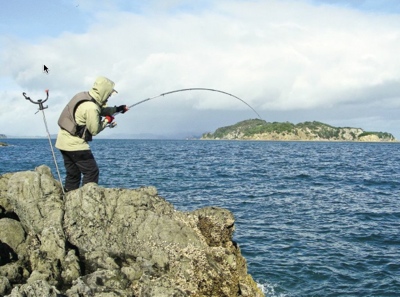 One of my favourites is light tackle fishing, Andy Macleod exclaims. By ‘light gear’ I mean tackle rated 6kg or less, and we are lucky to have a superb variety of common inshore species, that are great fun to fight on such gear, in New Zealand.
Lowering your tackle weight creates a new dimension to your fishing, as fish easily tamed on your ordinary surfcasting or rock-fishing gear can now strip line and truly challenge your ability as an angler. No longer do you have the power to stop a fish in its tracks, so you must learn when to let the fish run, apply pressure, and above all, have patience.
I’ve always fished for kahawai around river mouths with light tackle – typically a light spinning rod of around 2.1m rated for 2-6kg line and paired with a pocket-sized eggbeater. This involves casting small lures and retrieving at varying speeds. Big kahawai leap around enthusiastically and instinctively use the currents of the surf and river to pull line. Sea-run trout and salmon can be caught at the same locations using this method.
My light tackle fishing expanded when I became interested in LBG fishing around the rocks of the North Island. The same light spinning set goes with me on all these excursions, but initially I carried it for different reasons: it allowed me to present small, subtle baits and catch live-bait species such as kahawai (especially on days when they were hard to hook) and smaller species like jack mackerel and piper, which I target with sabiki rigs or small trout hooks. Such strategy worked well, but that was not the surprising part. During those same excursions I hooked, quite by accident, bigger fish – trevally and kingfish mostly – and on the first few occasions I was blown away. However, over time I learnt not to panic and began to land the odd one – and not just over clean ground, but in rugged foul areas on the open coast. This was a real buzz and really opened up the world of light tackle fishing for me.
The advantages of light tackle fishing
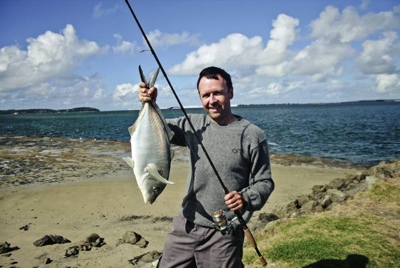
The main advantage of light tackle fishing is that it enables anglers to present smaller, more natural-looking baits than is possible on heavier gear. This is due primarily to the more sensitive rod tips and thinner diameter lines used. In turn, thinner diameter lines drag less in the current (especially important for stray-line or spin fishing) and attract more bites than conventional tackle. For these reasons, light tackle setups account for shy-biting species you otherwise wouldn’t catch, particularly off the rocks. Odd species my mates and I have accounted for on light tackle include butterfish, red moki and tarakihi.
Light gear is easy to carry on long tramps to remote spots and can be cast for long periods without much effort; there is a vast difference between casting whole pilchards on a 15kg stray-line set and flicking out small cut-baits on a light spin set. The latter I can do all afternoon without much effort, because a flick of the wrist is all that’s needed to cast light tackle. On my LBG trips, especially when the fishing is slow or my live bait is already deployed, I regularly spend long periods fishing light gear.
Ways to fish with light tackle
All the main fishing techniques can be replicated with light tackle, but the two main ones are spinning and stray-lining. The sensitivity of light rods and thin diameter lines enables you to flick small lures and small baits long distances that are unachievable on heavier gear. That said, casting distances are not huge overall, and therefore the best places for fishing light tackle is usually where deep water is close at hand, such as off the rocks, from wharves and steep beaches, at river mouths, and on the edges of harbour channels.
Being able to cast light lures reasonable distances is a particular benefit when chasing kahawai, a species that eagerly takes lures, but which can also be fussy, sometimes only being fooled by the smallest, most subtle of lures. The same advantage applies to trevally, a species that takes small lures only occasionally.
My favourite technique is to stray-line directly into a berley trail off deep rock platforms when the targeted fish come into view. This is real ‘sight fishing’, and the light tackle and subtle techniques being used make this more like fly fishing than any other fishing technique I’ve used. Pan-sized snapper are a common catch in these circumstances, and these dart around enthusiastically, making for the nearest rock or weed patch. Soft-baits also come into their own in this type of fishing, working particularly well on kahawai, snapper and rat kingfish – the red and green Nuclear Chicken is a favourite colour of mine.
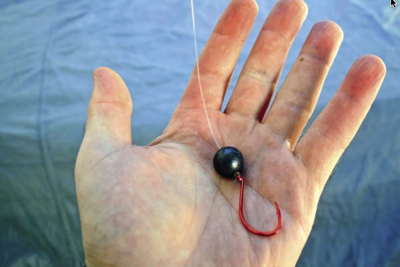
Another technique I use with light tackle is to fish with a crude running rig – simply a 1oz ball sinker sitting directly on a small baited hook. This is effective when fishing over clean bottoms and into a berley trail, especially on bottom-grubbing species such as snapper. Because of the thin diameter lines I use, the light sinker settles the bait nicely on the bottom – though you can bounce it around if you wish, of course.
Gear and how to use it
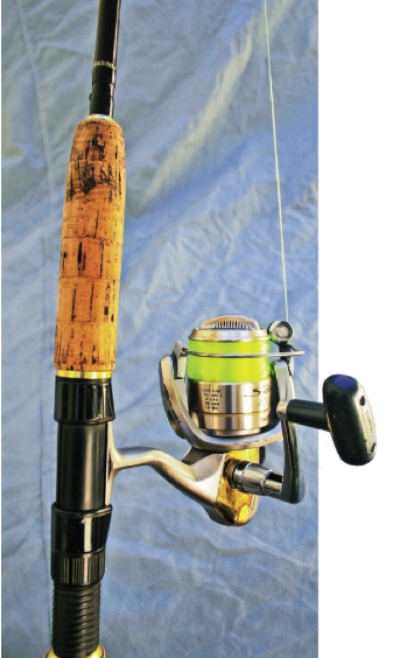
As already mentioned, I class ‘light tackle’ as anything under a 6kg rating; my own 2-6kg spin outfit is teamed with 6kg mono or 20lb braid when fishing off the rocks. When targeting kahawai, I will drop down to 1 or 2kg mono.
A heavier leader is required for the business end of the line and I usually go for standard 18kg (40lb) trace material, though trace down to 9kg can be used depending on the terrain and species targeted. Fluorocarbon is also a good option.
The length of the leader needn’t be long: mine usually don’t exceed two metres. This gives me one or two ‘wraps’ on my spool, while the shorter length improves casting performance and reduces drag in the water – important for presenting attractive, natural-looking baits. Some might express doubts about the lack of abrasion resistance provided by such a short leader, but it is possible to use them and come out on the right side of skirmishes with big trevally and moderate-sized kingfish. However, it is a trade-off, so work out what’s best for you and your fishing.
Light tackle demands well-maintained reels of reasonable quality, because ‘lumpy’ drag systems generally result in broken line or failed knots – the margin for error is much smaller. Rod quality is less important, and I know several serious fishermen who use relatively cheap glass rods for this sort of fishing. In all cases though, a nice sensitive tip helps to cast light baits and cushion the line against erratic fish movements during the fight.
Playing it cool
While light tackle might make it easier to hook fish, it also makes landing them doubly hard. As well as the fish pulling out more line, you can’t exert as much pressure on them, so they take longer to land, and at any moment they could dive down into the rocks and weed for ‘game over’.
Consequently, it is important to accept that you will generally be outgunned, at least at the beginning of the fight, so a longer-term view must be taken. With this in mind, my strategy is to wear the fish down through persistence and patience, and crucially, not shock the fish into drastic action early in the fight. Whilst a bold setting of the hook is required, maintaining a light or moderate drag early in the fight will minimise the risk of the fish heading into rock and reef.
On a few occasions I have had kingfish and trevally rip out 50 to 100m of line. This is a daunting prospect, because when using mono, with line stretch also in the equation, there is a real risk that the fish will get so far away that it is not possible to get the line back. However, by applying steady pressure and not expecting instant results, this risk can usually be avoided. Further, the length of line out can also act in your favour by slowing the fish down and absorbing the fish’s runs (almost like a bungee cord). Often this scenario plays out over half an hour and results in the fish arriving at the net exhausted. Again, the key is not to panic.
Avoiding panic is also important if the fish runs you through rock or weed. Here the inability to apply maximum pressure through your rod tip actually works to your advantage. As a result of this, the line can pass over abrasive surfaces without breaking (though this is more true of mono than braid). The next step is to back off the drag and hope that the fish pulls you free of the snag – and you’d be surprised how often this happens. (Whilst the line comes back in bad shape, it often holds together for the duration of the fight.)
So if you’ve done a lot of conventional rock or surf fishing and you’re on the lookout for something new, try light tackle fishing. It is a technique which requires a base level of skill, so may not be for novice anglers, but it adds a new dimension to fishing for many of our core species, and I wouldn’t be without it.
 |
This article is reproduced with express permission of
written by Andy Mcleod - 2013 Originally published in New Zealand Fishing News ----- Advertisement -----
|
Fishing Reports Visit Reports
Bream Bay Fishing Report - 29/10/26
'Softly softly' approach to workups. Now is the time most inshore snapper fishers dream of... Read More >
Rotorua Fishing Report - 29/10/26
Fantastic fishing set to only get better! The fishing around the Rotorua region has been... Read More >
Eastern Coromandel Fishing Report - 29/10/26
Kingfish, snapper and crayfish on the menu. The anticipation is building as we find ourselves... Read More >
Tauranga Fishing Report - 29/10/26
Fishing and diving heating up. Let’s start on a positive note this week, as water... Read More >


Wednesday 11 November 2026
Major Bites
 - -
Minor Bites
 - -
Thursday 12 November 2026
Major Bites
- - Minor Bites
- -
Comments