
Kayak Fishing - Trolling for Snapper
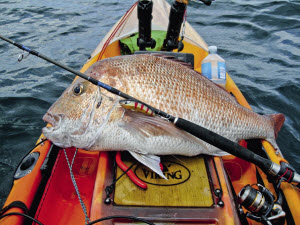 There are now a handful of guys around Australasia actively targeting Pagrus auratus (or Chrysophrys auratus) – it’s the same fish both sides of the Tasman – and the successes are mounting up. I’m also starting to receive plenty of calls and emails from paddlers wanting more hints to give it a go themselves, so here’s a look at the key points I’ve picked up over the last few years when dragging hardware for snapper.
The first point to realize is that snapper are not necessarily as bottom orientated as most anglers believe. As a kayaker I’m no longer surprised at finding them mid water or even closer to the surface. In fact I’ve now had several occasions where I’ve encountered schooling snapper behaving like kahawai or trevally ‘krilling’ on the surface! Whatever they’re chasing though, they’re always incredibly spooky, so any hint of noise (especially nearby boat traffic) sends them plummeting out of sight. But the fact remains that even in deep water snapper can be found within reach of trolled lures.
As a free diver exploring reef structure, headlands and kelp forest with deep water nearby, I regularly encounter snapper within my limited breath-hold capability. In some cases the surface is only a metre or two above us when the fish gives me a startled glance and thumps that big tail into high gear, departing from an equally startled diver! In these environments snapper will readily come to the surface to chase baitfish, again making them prime targets for trolled lures.
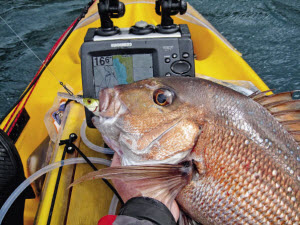 In both situations stealth is essential to trolling success. Unless the fish are in a frenzy (and even then they still tend to be wary), any excessive noise, shadow or movement will have snapper off the bite and diving for cover. This is where kayaks have the ultimate advantage over larger craft. There’s no motor noise, minimal hull slap, and a much smaller shadow on the surface. With careful stowing of tackle and accessories it’s also very easy to limit on-board noises that could resonate into the water, though the typical plastic hull is very good at deadening this.
Small boat anglers could also look at ‘stealthing’ their craft to mimic some of the success we kayakers tend to experience. Paying attention to deadening on-board noises is obviously essential, as is limiting motor noise. Something I’m constantly surprised at is why more anglers don’t look at running electric trolling motors when working structure with soft-plastics. An added benefit would also be the ability to quietly slow-troll lures and use some of the techniques I’m having brilliant snapper success with.
I’ve divided trolling snapper lures into two depth categories – shallow and deep – because I have slightly different techniques for both. The main differences have evolved as a result of how visible and noisy the kayak is in each situation and the need to select appropriate lures.
Shallow water trolling or surface schooling snapper (depths down to around 8-10 metres)
 Obviously if snapper are close to the surface (because the water is shallow or they’re schooling within view), there is a significant chance that even a stealthy kayak is going to startle and put them down. In these situations I select a lure that will run around a metre above the shallowest water I expect to encounter (or which will dive to the depth the fish are holding if near the surface in deeper water). I position the lure at least 40 paddle strokes behind the kayak (I get roughly 1m per paddle stroke and it’s easier to count strokes than look over my shoulder to try and guess how far back the lure is).
My goal with shallow water presentations is to get the lure short-cutting the kayak’s curved track as I navigate a series of broad turns or lazy ‘S’s – in other words, get the lure ‘cutting the corners’. Having plenty of line out allows me to take a wide path around headlands and reef structure, and as the lure short-cuts the turn, it passes through water that hasn’t been disturbed by my paddling. If working an area of shallow water, I weave a path that will keep me away from the most productive looking structure but sees the lure running straight over the top.
With practice it’s easy to become very accurate with the lure’s tracking, avoiding areas that might foul it, while still getting right into undisturbed strike zones. It’s also possible to repeatedly present lures, perhaps changing to different sizes, colours, shapes and actions in areas you’re convinced should be holding fish to find the ‘flavor of the day’.
An important aspect of this style of trolling is ensuring you’re running heavy enough gear. Having the lure well behind the kayak means fish don’t even need to strip line from the reel to make it to structure, so as a general rule I use 10-15kg braid with four metres of 20kg leader (provided this doesn’t stifle the lure’s action). If the hooks on the lure are up to it (I’m using 6x-strong VMCs designed for the tropics), the technique is very much ‘lock and load’ – grab the rod, rudder the kayak around, and don’t give the fish any head-start at all! Snapper in this situation will often hit so hard you’ll be convinced it’s a kingfish to start with.
Deep water trolling (depths beyond 12 metres)
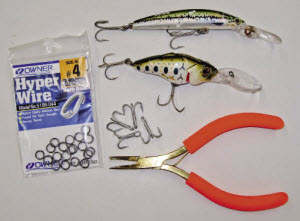
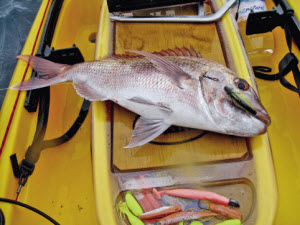 In this instance there isn’t quite the need for finesse in keeping absolutely quiet and presenting the lure (though you won’t get away with being noisy and careless either). The main goal is to get the lure as deep as possible, accompanied by the right kind of action to get the fish interested. This is where I’ve been running ultra-deep-diving bibbed lures designed for fresh water species such as Aussie barra and Murray cod. These broad-bibbed lures will dive to beyond 8-10m and are designed to run at slower speeds than those made for saltwater applications. This makes them much better suited to kayak trolling speeds.
Another feature of many of these lures is their slower vibrating action; over the last couple of years I’ve found the stronger slower pulses generated by this style of lure will attract snapper from further away when trolling from kayaks (boaties often troll faster and may have different experiences). It’s been very educational to mark fish off to one side of the kayak using side-imaging sonar and see how close I have to be to induce a strike.
Another surprise for me has been how far snapper will rise to take a lure passing overhead. Returning from our trip to the Three Kings in July, we stopped and fished inside North Cape. In 20-25m of water I had snapper near the bottom pouncing all over lures that were running between 6-10m. That means the snapper were often rising through more than 10-12m to hit the lures like freight trains!
Tackle-wise, the main difference to fishing shallower water is the reduced need to avoid structure. This allows the benefit of using much lighter and thinner main lines, reducing water resistance so lures will troll deeper. For this reason I tend to reduce the leader weight from 20kg to 15kg. I also attach my lures using a Genie Clip to make swapping between colours and styles much easier, or swap out a lure that’s had its hooks mauled by a big moocher!
Close those barbs
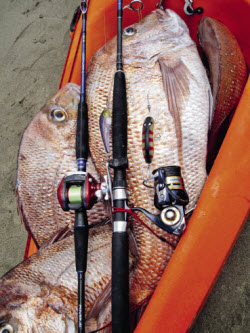 It’s that time of the year again, and the snapper spawn run is about to hit top gear. For many anglers the flurry of action targeting schooling fish has become the highlight of the fishing year, especially coming so soon after the colder months when fish can be more dispersed and difficult to find. Since this is the time of the year our future stocks of New Zealand’s most commonly-sought sport fish are created, it becomes incredibly important to moderate our catch. We also need to use best practice for any and all fish we release.
For me, this is the time of the year when I believe the barbs on all hooks (bait and lure) should be pinched closed or barbless hooks used. This makes it considerably easier to quickly release fish with the minimum of fuss, dramatically increasing their chances of surviving and spawning successfully. Kayakers have the additional advantage of being able to release their fish at the side of the cockpit without even handling or bringing them aboard. Doing this reduces stress and leaves the protective coating of ‘slime’ undisturbed.
Many anglers are concerned that closing the barbs on their hooks might mean a considerable rise in lost fish. In practice I find little difference in my ability to boat fish whether using barbed or barbless hooks, provided I avoid slack-lining my fish. So if fishing in situations or conditions where I may need to drop my rod in a holder to reposition the kayak, I swap to circle-style hooks, or wide-gape worm and treble hooks, which are better at staying in place if the line goes slack.
Interestingly, in some situations where fish are being a bit shy on the bite, I’ve actually found a noticeable improvement in my hook-up rate by closing the barbs on my hooks. Having no barb means it’s significantly easier for the hook’s point to slide into engagement, and often the reaction of the fish is more than enough to set the hook without any rod strike by me.
 |
This article is reproduced with express permission of written by Stephen Tapp - 2012 Originally published in New Zealand Fishing News |
Fishing Reports Visit Reports
Tauranga Fishing Report - 28/05/26
Tarakihi on the bite Trips are few and far between at this time of year,... Read More >
Canterbury Fishing Report - 28/05/26
Fresh and salt turning it on! It is not very often I get to say... Read More >
Bay of Islands Fishing Report - 28/05/26
Lures paying dividends We finally had a break in the SE winds that have been... Read More >
Manukau/West Coast Fishing Report - 28/05/26
Snapper and gurnard in the harbour The weather has finally taken a turn for the... Read More >


Major Bites
Minor Bites
Major Bites
Minor Bites
Comments