
Jigging - Fighting fish on jigs
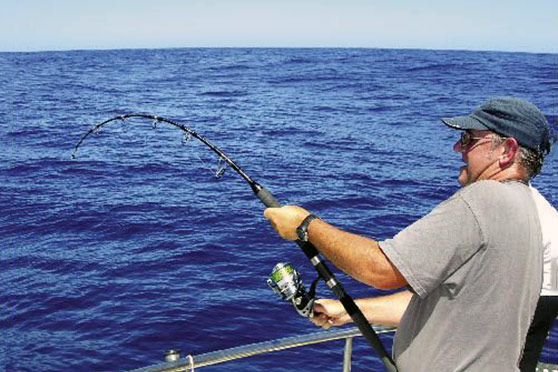
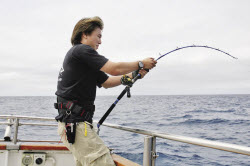 When a fish hits your jig and you feel the weight come on, don’t panic!
However, it’s very important to ensure the hook is well set and that the pressure stays on initially, so fight it with the rod still tucked under your arm for a while, before transferring your outfit to the gimbal belt for the rest of the fight.
When you first hook a fish there will be a brief moment of bewilderment, followed soon after by violent shakes of the head as it tries to get rid of the jig, before the fight starts in earnest. It can take around 5-10 seconds before fish start to dig and run; when the fish is running is the best time to transfer the position of the rod from under your arm to your gimbal belt.
Many, many times I have seen anglers hook up on a fish and then immediately attempt to put their rod into their gimbal belts. In the meantime the fish is going crazy, thrashing around and trying to free the jig from its mouth, so any slack line produced at this point can allow the fish to throw the jig and win its freedom.
However, it’s also very important to keep the pressure on the fish throughout the rest of the fight, too.
Fighting fish effectively
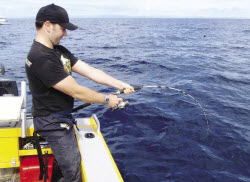 Fighting a fish with modern jigging equipment is quite different to doing so with the other types of rods normally used to target kingfish.
Firstly, you must keep a low rod angle when the rod is loaded, as despite being able to generate a huge amount of power through these little rods, due to the materials used in the their construction, if you lift them up too high (called ‘high sticking’ or ‘point loading’), you can actually break them.
Exactly what sort of rod angle is used when fighting a fish depends on your line’s angle. Obviously, if your line is straight up and down at the time, then you should fight the fish with a 0-45-degree rod angle, but if the fish swims away from you, or the boat is drifting away from your line, then it is safe to lift the rod higher.
Another important thing to try and avoid is dropping your rod tip down so low it’s pointing at the fish. When your rod is out of the equation, the only shock absorber in the entire system is effectively removed, so if you have any imperfections in your mainline or leader, you run the risk of being popped off, especially when hooked to a larger than average fish.
Sometimes it’s impossible to prevent this happening though, as some fish hit the jig like a steam train, and if you’re using a heavy drag with the rod under your arm and one hand holding it, you just don’t have the strength to keep it up at 180 degrees.
When this happens, quickly grab the fore-grip with the winding hand and lift the rod up a bit so it can start absorbing those vicious tail beats and head shakes.
The short-stroke fighting technique
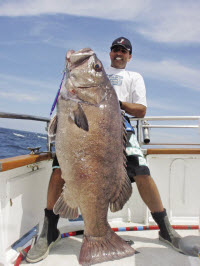 Instead of taking a large lift of the rod and winding like mad on the downstroke, as you might with many other styles of fishing, it is far better to lift the rod just enough to allow one reel-handle turn when lowering it back down again. This action is repeated time and again, and called short-stroking. Short-stroking continually pumps the fish’s head upward towards the boat and doesn’t give it time to recover, as happens when using the old technique of lifting high and winding all the way down. Consequently, it can bring large fish to the boat much more quickly than any other technique, and it’s also a lot easier on you, the angler.
When fighting and catching a number of fish – especially good-sized ones – it is quite easy to burn out the bicep and forearm muscles in your rod arm if using them exclusively to lift the rod. So, to help prevent or delay muscle fatigue, slightly change your lifting muscles by recruiting your shoulder and back muscles instead; try retracting your shoulder blades to help pump the rod up.
You can also take a bit of pressure off by dipping your knees at the same time you lift the rod; when you do this the rod angles up slightly. As you proceed to extend your knees and stand up straight again, take a wind of the reel handle as the rod is lowering.
When the fish is well settled and you can predict when it is going to run for a bit, give your rod arm a break and hold the rod with your other arm – the one you normally wind with – or take the load with both arms instead of just one. Just try to keep things nice and smooth.
Conservation
Jig fishing is a very addictive, exciting and effective way of targeting your favourite predators. However, as it is likely your catch rate will increase somewhat as a result, helping to put additional pressure on fish stocks, please keep conservation in mind. We have a great little fishery here in New Zealand, and by practising and promoting CPR (Catch, Photograph and Release), we can help to ensure it stays that way.
Acknowledgements
A big thank-you to those who helped me over the last few years by sharing information, or fishing with me and learning things together through trial and error. Those people are (in no particular order): Lionel Korach from Memory Maker Charters; Scott Stonex from Action Imports; Chris Wong and Matt Veldhuizen from BCS Enterprises; ‘The Team’ (Norman ‘Tiny’ Coe (R.I.P.), Graeme and Chloe Paterson from Synit Rods); and Graham ‘Boulder’ Mackenzie from Boulder Guiding.
 |
This article is reproduced with permission of |
Fishing Reports Visit Reports
Hauraki Gulf Fishing Report 11/06/26
Workups the best option mid-Gulf for quality snaps and kingfish Fishing across the Hauraki Gulf... Read More >
Bream Bay Fishing Report - 11/06/26
Normal transmission returns! It seems only the hardy have been wetting a line these last... Read More >
Raglan Fishing Report - 11/06/26
Solid snapper hook-ups out deep With the continuation of more settled weather there’s been some... Read More >
Canterbury Fishing Report - 11/06/26
Brave the cold, reap the rewards With a big southerly blow through here yesterday, it’s... Read More >



Major Bites
Minor Bites
Major Bites
Minor Bites
Comments