
Iso Tsuri Techniques - Part 1
 Most targeted fish species in Asia are fewer in number – in comparison to New Zealand – and extremely wary in nature.
Consequently sensitivity and accuracy are required rather than strength and power when it comes to tackle design and the development of fishing methods.
Iso tsuri, the Japanese term for ‘rock fishing’, is one such derivative that has been widely adopted by rock fisherman in greater Asia, and it is still evolving and diversifying.
As a fanatical disciple of this fishing style, I have found the method truly effective and fun when used on the rocks of New Zealand – it has certainly put a few more species on the catch-list.
There are a large number of fishing methods that iso tsuri embraces, from the surface to the bottom, shallow to deep, and ‘fish-your-feet’ to surfcasting – there is a specialised style to suit almost every situation.
For this introductory article I shall begin with the method that I have used in New Zealand over the past few years: float rock fishing.
The ‘floats’
The fundamental theory of float rock fishing is rather simple: use a float to suspend your bait at a specific depth for the fish you want to catch.
To get this working properly and to achieve consistent catches is a different story though, and usually requires a lot of time and patience on the rocks, as well as hard work.
The primary role of the float is to suspend the bait at the set depth and within the berley trail, so the target species can see and take the bait. Unlike freshwater fishing, the strong currents and waves around the rocks constantly affect the position of the float and the terminal tackle trailing below.
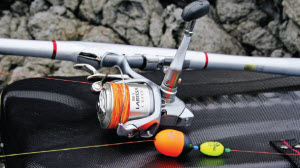 A pencil-shaped float is sensitive, but becomes unstable under the influence of waves and current, whilst a bubble-shaped float provides great stability, but has less sensitivity, failing to indicate the smaller bites made deeper down. Hence, the orange oval-shaped floats we use (as shown in the picture), which provide good stability yet are still sensitive to bites.
The bright-yellow ‘little’ float next to it is an ‘in-water’ float. It may sound a bit confusing, but this is actually a sinker. The reason it’s called an in-water float is because it has negative buoyancy, which not only acts as a sinker to help the bait sink faster, but is shaped to create drag, so it flows with the current more effectively.
Both the float and in-water float (or sinker, if it’s still too confusing) run freely along the mainline, so the line can slide through with minimal restriction when fishing, making sure the mainline under the water stays straight and in contact with the bait as the bait sinks. The small blue and green rubber running beads are spaced between the free-running ‘floats’ so that they don’t collide and damage one another during casting.
Now we have a float on the surface, an in-water float underneath to ensure the rig flows with the current, then a swivel connecting the mainline to the leader and baited hook.
So how does the float indicate the strike if the line runs freely through it? We tie a strand of wool onto the mainline above the float to prevent the line passing through the float, which also makes the sinker dive when the fish bites.
Why wool? The reason is that wool contracts when it gets wet, so holds onto the mainline firmly without damaging it, yet the woolly knot is so small it can pass through the guides on the rod without jamming or damaging them. This woolly stopper is often brightly coloured too, making its progress easier to see on the water whenever the line moves through the float.
Reels and lines
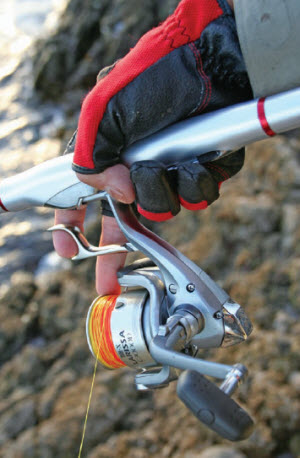
 Most float rock-fishing lines are floating lines, so the line can glide through the water surface more easily and pass through the float while the bait is sinking, as well as allow it to be quickly picked up from the surface when striking.
On our reels is a trigger called a lever-brake, which is specially designed for this type of fishing. When pulled upwards it increases drag pressure, and when pushed downward it disables the manual drag control and locks the reel in its normal front-drag setting. When the lever is in neutral position (neither pushed nor pulled), the anti-reverse is removed, allowing the handle to be cranked both ways.
The main reason for needing manual winding control is because the angler often has to manoeuvre the fish around the rocks with different lengths of line to avoid snags and land the fish; releasing the right amount of line can be crucial while fighting and landing the fish.
The rod used depends on the depth of water, but is typically about 5.3 metres in length. A long rod keeps the mainline clear of rocks and snags while the float and bait drifts in the water. It also provides an advantage when landing the fish, as the line is well clear of rocky edges when the hooked fish gets close to the rocks. Some rods have a ‘zoom function’, enabling the angler to use the rod in two different length options, depending on the fishing situation.
Once the bait is in the water and sinks to its set depth (when the woolly stopper reaches the float and stops the line from passing through the float), the angler should let the float, sinker and bait drift with the current while waiting for a strike. Line should be released off the reel as the bait drifts further away with the current. Hence the bail-arm of the reel is open most of the time.
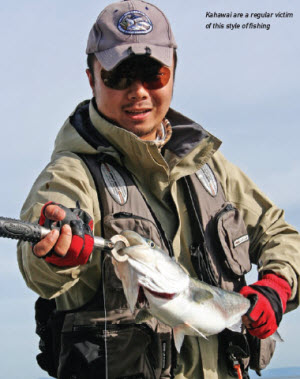
 The silver drummer is one of my favourite target species. The challenge is not only that the silver drummer is a powerful fighter when hooked and shy in nature, but also that other species – such as kahawai, parore and trevally – often take the suspended bait first. Consequently, it often takes time to find the part of the water column where the drummer are hiding and to induce them to take the bait before any other species beats them to it.
The hook-up rate in float fishing is relatively high because – even to snapper – a smallish suspended bait does not require much ‘nibbling’. When the float darts into the water, it is almost certain that the fish had taken the whole bait in a nice, clean gulp.
The reason for requiring such specialised tackle and techniques is because the various iso tsuri disciplines are not just about catching and fighting aggressive fish, it’s also about inducing shy and unusual target species to take carefully-presented baits and then finessing them out of the rocks and weed they normally hide in. Indeed, the qualities of delicacy and subtlety play central roles in iso tsuri basic ideology.
 |
This article is reproduced with permission of |
Fishing Reports Visit Reports
Mercury Bay Fishing Report 01/10/26
Mercury Islands snapper fishing well. Nothing from out wide this past fortnight, but there were... Read More >
Tutukaka Fishing Report 01/10/26
Unpredictable spring weather Spring has arrived in Tutukaka, bringing with it the usual mix of... Read More >
Outer Hauraki Gulf Fishing Report 17/09/26
Spring wind the handbrake. Spring is starting to make its presence felt in the outer... Read More >
Top of the South Fishing Report - 17/09/26
Early snapper in Tasman Bay. Well, spring is finally here, and the days are getting... Read More >



Wednesday 30 September 2026
Major Bites
 - -
- - Minor Bites
 -
-  -
- Thursday 1 October 2026
Major Bites
- - Minor Bites
-
Comments