
How to set lure patterns
 A fish will often come up hot on the splashy lure, have a quick look, then race across and hammer the deep-diving lure opposite.
In my previous two articles I began discussing the pieces of the puzzle that go into creating a consistent lure pattern.
In this article I will discuss the ‘body’ of the lure pattern.
Over many miles of trolling and hundreds of marlin captures, I have come to appreciate just how much we can utilize and control our trolled lures. This is done by the lures we use, how we rig them, how fast we troll them, and where they’re positioned.
The thing we cannot control, though, is how the fish is going to bite them. Without an aggressive bite it is very difficult to hook fish consistently, so we want to give ourselves the best chance of triggering an aggressive attack from a fish. We endeavour to do this in a number of ways, but much of it comes down to lure choice and placement when setting up the main pattern.
Lure choice
 Lure choice has always been a hotly debated topic. I base my choices on what I have seen over the years and what has worked for me. The different styles of lures I run can be put into three groups. The first are deep-diving, straight-running lures. These have cupped and flat-faced heads. The second group consists of surface-running, splashy-type lures. These have angled and scoop-faced heads. Then, finally, there are the lazy bullet and jet-style lures that I covered in last month’s article.
I have noticed that fish go through periods where all they will eat are lures from one particular group. Therefore, when I set up my lure pattern, I take this into account. I split my main lure pattern into pairs. By this I mean my short lures are run as a pair and my long lures are run as a pair. These pairs are all about contrast. On one side I will run a splashy lure that creates a lot of noise on the surface, and opposite that I will run a lure that dives deep and runs very straight, making for an easy target. I do this with both pairs, but make the closer lures larger than my long lures.
With this pair set-up I cover the best of both worlds, and give myself the best chance of eliciting an aggressive bite from the fish. I have noticed that quite often the bite I get on my splashy surface lure is very aggressive. If not, the fish will often come up hot on the splashy lure, have a quick look, then race across and hammer the deep-diving lure opposite.
These are not golden rules, but the splashy surface lure tends to work as a hooked exciter and the deep-diver is the catcher. Then round out your spread with the lazy shotgun lure, and you have all bases covered.
When it comes to setting the lures behind the boat, there are a couple of ways I like to do it, depending on the boat I am fishing on.
Staggered pattern:
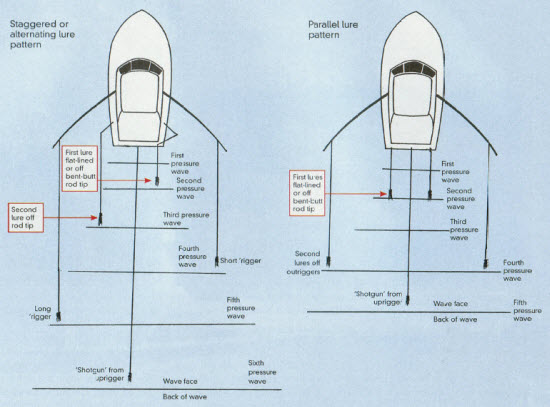
I would highly recommend this lure pattern for trolling on a smaller boat (less than eight metres in length), but it will work for boats of any size. It gives the best spread of lures, so there is only one lure on each wave, which reduces the chance of tangles. Starting at either wave two or wave three for the closest lure to the boat, the lures are evenly staggered, one on each wave for each of the five lures in the spread (i.e. short corner, wave two; long corner, wave three; and so on – see diagram). You can choose which wave you start the lure pattern on according to weather and sea conditions, as well as by the speed you are trolling.
This still works well with the lures in pairs because the lure spread is already very close together. It is also a great way to find out which waves your boat gets the bites on. You can then adjust your lure placement to take advantage of this.
Parallel pattern:
This lure pattern suits boats over eight metres long that are quite wide or able to easily spread the lures. As the diagram shows, the two short lures are run on the same wave – either wave two or wave three. The two longer lures are run on the same wave as well, skipping a wave between the short lures – so either wave four or wave five. The shotgun lure is then run one wave behind these long lures.
This pattern is very simple and extremely effective once you’ve found where your boat gets the most aggressive strikes in the spread, as you can place both lures on that same pressure wave. Once again, you can choose which wave to start the lure pattern on, depending on the weather and sea conditions and the speed you are trolling at. This is my favourite pattern, because running the lures in pairs opposite each other offers the best contrast.
Trolling speed
This is determined mainly by the species you are targeting. For striped marlin a speed of 6.5 to 7.5 knots is ideal. For blue marlin a little quicker is better, around 7.5 to 8.5 knots. These quicker speeds can be hard to maintain due to sea conditions or just not being very fuel efficient, especially in smaller boats, with most being nearly on the plane at these speeds. The most sensible approach involves making sure the boat runs smoothly and is being efficient.
Getting the best from your pattern
There are a number of variables that affect the performance of the lure pattern. These include sea conditions, trolling speed and the distance behind the boat you are trolling the lures. Here are a few tips to help get the best out of your lure pattern.
•Try and pull the leaders as high as possible out of the water without the lure blowing out. The higher the angle you pull the lure from, the more aggressively the lure will move.
•Experiment with your trolling speed. On calmer days you may have to troll faster to get the lures acting more aggressively, and on rougher days you may have to slow down to keep the lures in the water.
•Depending on trolling speed and sea conditions, experiment with the distance you position the lure behind the boat. The closer you pull the lures to the boat, the higher the angle the lure is pulled from. The further back the lower the angle. Just remember to keep the lures close to the boat, so start the lures no further back than the third or fourth wave.
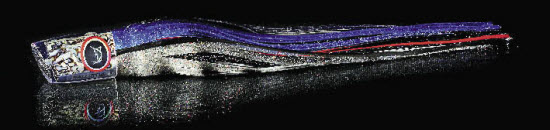
Lures with angled and scoop-faced heads tend to be surface-running, splashy type lures, such as Bonze’s Ballistic and Undertaker models.
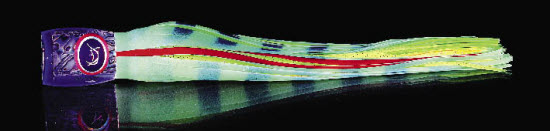
The Hercules and Submission are examples of deep diving lures, which usually have cupped or flat-faced heads.
 |
This article is reproduced with express permission of
written by Bonze Fleet - 2011 Originally published in New Zealand Fishing News |
Fishing Reports Visit Reports
Canterbury Fishing Report - 03/09/26
Whitebait season underway. Spring is here, and along with it, the good old Canterbury nor-Wester!... Read More >
Bream Bay Fishing Report - 03/09/26
Fishing hard, weather conditions trying. Cold winds and lots of rain have made for testing... Read More >
Outer Hauraki Gulf Fishing Report 03/09/26
Workups building as spring approaches. Spring is starting to show its hand in the outer... Read More >
Bay of Islands Fishing Report - 03/09/26
Pacific bluefin tuna return. The day after I submitted the last report, we were out... Read More >


Sunday 13 September 2026
Major Bites
 - -
- - Minor Bites
 - -
- - Monday 14 September 2026
Major Bites
- - Minor Bites
-  -
-
Comments