
How to select squid jigs
Colours
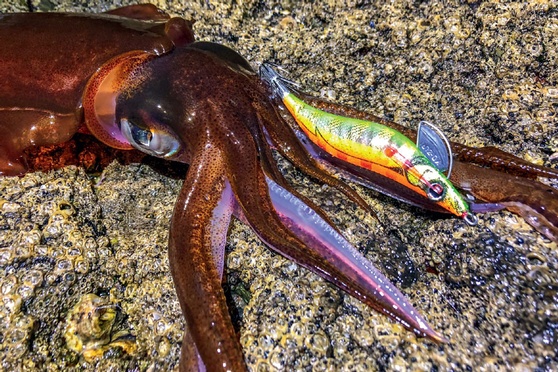
Squid jigs or ‘egi’ are small lures that resemble a baitfish or prawn with a keel-shaped weight at the front, and rows of sharp barbless prongs at the rear. Squid jigs usually have two layers consisting of the underbody and an outside cloth layer, each normally a different colour. The underside of the jig is referred to as the under tape or foil.
There is a consensus that the colour of the under tape is influenced by the time of day and the amount of ambient light in the environment. The colour of the outer cloth layer, on the other hand, is influenced by the water clarity and the activity of the squid. From our experience, the general rule of thumb for choosing the tape colour are as follows
|
Conditions |
Colour |
|
Night time |
Red and lumo |
|
Areas with lots of ambient light (e.g. moonlight or streetlights) |
Gold, silver, rainbow, and clear body |
|
Dawn and dusk |
Gold, pink and rainbow |
|
Day time |
Silver, gold, rainbow, purple, and clear body |
|
Overcast |
Purple, rainbow, red, lumo and keimura* |
*Keimura is a special type of colour that emits a UV glow which is particularly effective in day time
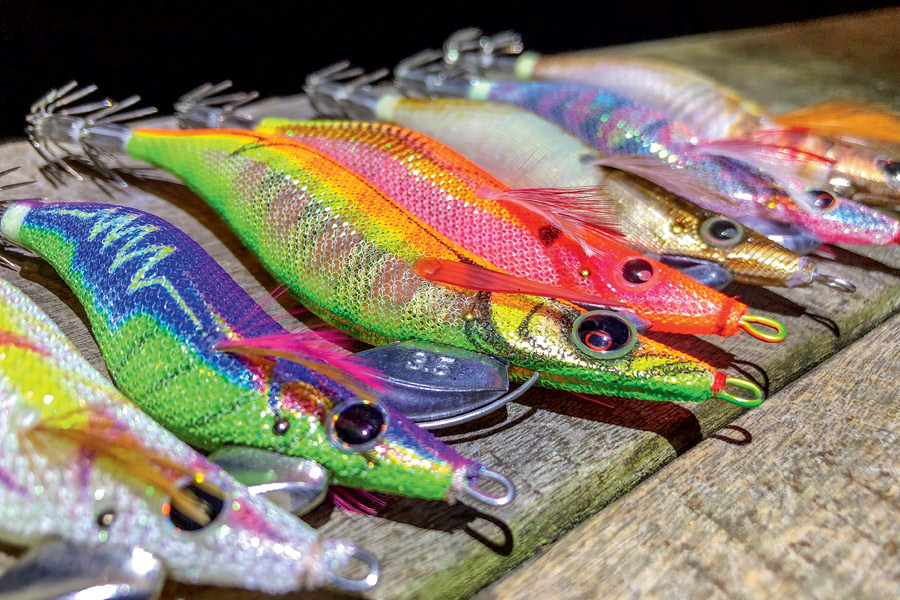
In terms of the outer cloth colour, in clear water darker colours such as brown or dark green and natural colours are the way to go, while bright colours such as orange, bright green are great in dirty waters. Go with as dark a cloth colour as possible to make it as natural as possible.
There is a belief that on nights when the squid are particularly shy, excessive lumo or bright coloured jigs may seem unnatural. In these instances, darker and more natural colours are better.
The foil and cloth combinations can get quite confusing, so basically to put all of the above simply, use bright colours such as pink/orange/green in lumo for low light conditions and darker and natural colours with good reflective foils for lighter conditions.
The above is a general guideline only. Every jig has the potential to catch squid, so don’t get too caught up trying to choose the best colour because there isn’t one. However, it is helpful to use a couple of different colours based on the conditions before changing to something completely different if nothing works. We find pink works in almost every situation, so when in doubt, go pink!
As with any other fishing style, keep an eye on what colour and style of lure is working for others – if they’re catching and you’re not, swap to what they’re using.
Weight
As mentioned earlier, squid jigs come in a range of sizes, all with weighted keels. The keel on a squid jig will usually have a number stamped into it. The number on the jig is not associated with the weight, but rather the size of the jig. Generally, bigger sized jigs sinks faster than smaller ones. However, depending on the brand and type of jig, this can vary.
The sink rates are in seconds per metre, which are written on the packets, so make sure to read them so you can ‘guestimate’ how long you must let your jig sink for it to get down to the strike zone.
In the early season, prior to June, the squid are on the smaller scale, so jigs ranging between 1.8 to 2.5 are recommended. From July onwards, the squid are much bigger, so using size 2.5 and up is good. Bigger jigs offer the advantage of casting further and thereby covering more area.
At night, squid can be picky, so use a variety of jig sizes, dropping down to a smaller jig to entice them. For day time squid fishing, we opt for larger sized jigs between 3.0 and 3.5 as squid are generally holding near the bottom, so you need slightly more weight to get down to them.
One theory is that during the day, they are taking cover from predators, so unless the meal is big enough to be worth the risk of exposing themselves in the open, they will generally ignore it.
In shallow water applications, it is helpful to use smaller jigs as they generally sink slower, giving the squid more time to attack. Nowadays, special ‘shallow’ and ‘deep’ type jigs are available. Shallow-type jigs have the advantage of casting further, enticing bigger squid because of their size, but still providing all the benefits of being slow sinking. Deep types are great for windy and very deep-water conditions where the jig needs to sink deep to the strike zone.
When the squid fishing is hot and then suddenly the bite stops, changing the colour and size can help trigger the bite again. Sometimes squid will follow your jig all the way in without committing to it. Try dropping to a smaller size jig, but if that doesn’t work, change to a more subtle and/or darker colour to entice them.
On certain occasions when you are hooked-up, a group of squid may follow your hooked squid in. Don’t rush to pull the hooked squid from the water. Instead, keep it in the water and get your mates to drop their jig next to your squid. Nine times out ten, they will catch the followers as well.
Quality
The prices of squid jigs can vary greatly, depending on the brand and the quality. Like most things in life, you get what you pay for. Better quality jigs last much longer (if you don’t lose them) and have a more crisp and natural action compared to lower quality jigs.
When the squid are aggressive and hungry, any jigs will work. However, for the most part, squid are quite the fussy creatures and the subtle difference in action can make all the difference to catching or not.
The makers of YO-ZURI and Yamashita squid jigs are renowned for the extensive research behind their designs and their jigs’ squid-catching performance. Warm jacket cloths, rattles, ‘490 glow’ and shift-able internal weights for longer casts and more hang time in the water, are some of the unique features these higher quality jigs offer. Sometimes these features give them an added edge. They are also the more accessible brands in New Zealand.
It also pays to have cheaper jigs in your arsenal for prospecting new areas – we call these ‘suicide jigs’. Suicide jigs are great for scoping out the structure in a new area as there is no pressure if you lose one, especially given that these jigs tend to break apart easily after a short period of use, with the cloth on top usually the first to go.
A quick tip is to apply some Super Glue along the belly and nose sections of the jig as this is where the cloth tends to come off first.
|
----- Advertisement -----
|

Fishing Reports Visit Reports
Canterbury Fishing Report - 01/10/26
Freshwater season underway. Wow, it’s October already, and our freshwater season is underway, and the... Read More >
Top of the South Fishing Report - 01/10/26
Snapper about but not yet firing. It’s certainly nice to see daylight savings upon us... Read More >
Hauraki Gulf Fishing Report 01/10/26
Big reds in the shallows. The weather has made getting out on the water challenging... Read More >
Bay of Islands Fishing Report - 01/10/26
Snapper moving in. A few Pacific bluefin are still gracing the weigh stations with last... Read More >



Friday 2 October 2026
Major Bites
 - -
- - Minor Bites
 - -
- - Saturday 3 October 2026
Major Bites
 - -
- - Minor Bites
- -
Comments