
How to Catch Hapuku
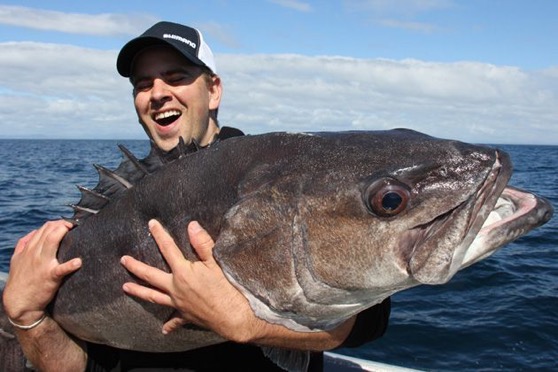
Hapuku are, for me anyway, the ultimate bottom fish. They grow bigger than just about anything else you catch with a hook and sinker and they are as good as any other fish to eat.
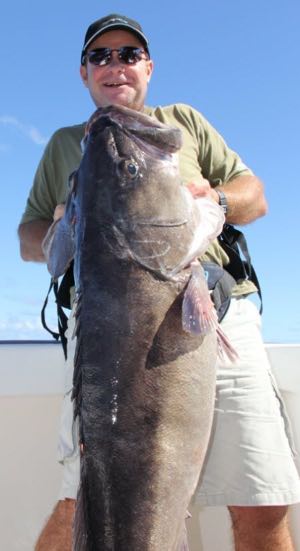 'Puka can be found in all sorts of places but there are certain areas that are better to look if you are serious about catching them. They are widely distributed around the entire coast. Pinnacles, drop-offs and the like in deeper water are a good place to start – foul bottom, the rougher and deeper the better. The days of catching them off the rocks at Lottin Point or White Island are just about gone.
Generally, the tackle used for ‘puka fishing is heavy. There are two main reasons for this. One: usually they are being fished for in deep water so a reasonable line capacity is required; and two: they can be very heavy to lift off the bottom. With a double-header (two fish) to get moving away from the bottom, which may be 300 or 400 metres down, you need a heavy (strong) line. Even when the bottom is only, say, 200 metres down, boat drift and nylon stretch can mean that you still have something like 300 metres of line out.
My preferred rig is a 9\0 reel spooled with 24kg nylon. If I could afford it, I would fish with one of the new superbraids. They have thinner diameter and virtually no stretch. This gives you much a better understanding of what is happening on the bottom. Even after many years, I still get fooled into thinking I have a fish when I am only pulling up my mate's gear, especially in very deep water.
Rods need to match line weight, as is the case with any kind of fishing. Often when a rod is rated 15-24kg it is more suited to the bottom end of the rating. A 24-37kg rated rod will handle the 24kg well. You need to use the rod to work the fish up and a good swell can be useful too. Wind in all the nylon you can as the boat drops down the swell then hold while the swell and boat lift some line for you.
A big reel with the spool full of line makes life a little easier for the ‘puka fisherman. When a 9\0 gets below half-full it takes more revolutions of the handle to put line back on the spool. I firmly believe good-quality reels are the best in any fishing situation. I have come to this conclusion after seeing a lot of gear in use over many years. Always buy the best you can afford.
Terminal tackle
The standard terminal tackle for hapuku, like everything else to do with these fish, is heavy. Right at the bottom you have the ‘puka bomb', a heavy 24 to 32-ounce sinker. They are heavy for three reasons: to pull a couple of large baits or livebaits or whatever down all that way; to get it all down there reasonably quickly so that you get the bait in the right area, and lastly; to keep the baits in the right spot once they are down.
Traces should be around the 100kg mark. This will stand up to the sort of punishment it needs to take, especially from things like gemfish, a by-catch with teeth like a barracouta. Two dropper loops hold the hooks out from the main trace. The dropper loops should be reasonably short so the bait does not tangle around the main line on the way down. They need to be long enough for the puka to suck in the bait and have the hook roll into the comer of his mouth as he swims away – between 150-200 mm (6-8 inches) is spot-on.
Hooks vary but I would be happy to fish any time with tuna circle hooks. Size 15 are good but smaller ones might be worthwhile in shallower water where there is a chance of tarakihi or snapper. I have fished with long-shanked hooks, which worked fine, and a heavy hook from any of the major brands would do the job.
Hooks should be hung ‘inwards’. Thread the end of the dropper loop through the eye of the hook from the front. When you hold the trace from the top the hooks should be turning in toward the trace, not up and away from it. As an added safety precaution, you can double cross the loop onto the hook. Thread the nylon through the eye and over the back of the hook then twist your nylon across itself once and go back again.
I like my traces long, up the three metres. Anything over two metres will do the job with a strong swivel on top. I use box swivels because they are cheap and a little easier to tie on in rough conditions. A ball bearing swivel or extra large barrel swivel is okay. With the trace completed it is just a matter of tying it onto the main line. It is a good idea to have three or four traces made up.
We mostly fish with ‘couta bait for ‘puka and they seem to like it just fine. If you are using tuna circle hooks then put the hook through the bait only once, going into the flesh and coming out the skin side. Just about any bait will work as long as it is big enough. I’m not hot on livebaits as I think they can tangle the trace into weed when they try to hide, but plenty of people who should know swear by them.
A tip if you are lucky enough to be fishing with superbraid line: if you hook into a fish, then wait for another minute or two and see if you can hook a second one.
When you do catch one, try cutting the cheek meat out of the head and do not overlook the belly meat – sweet as!
A Blast From The Past!
|
January1998 - by John Forbes |

Fishing Reports Visit Reports
Hauraki Gulf Fishing Report 11/06/26
Workups the best option mid-Gulf for quality snaps and kingfish Fishing across the Hauraki Gulf... Read More >
Bream Bay Fishing Report - 11/06/26
Normal transmission returns! It seems only the hardy have been wetting a line these last... Read More >
Raglan Fishing Report - 11/06/26
Solid snapper hook-ups out deep With the continuation of more settled weather there’s been some... Read More >
Canterbury Fishing Report - 11/06/26
Brave the cold, reap the rewards With a big southerly blow through here yesterday, it’s... Read More >


Major Bites
Minor Bites
Major Bites
Minor Bites
Comments