
How to catch Blue Moki
- 1 Comment
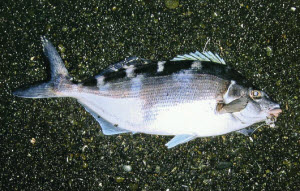
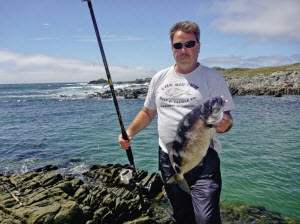 However, another interesting surf-caught species that seldom gets talked about or targeted, yet is readily available, good fun to catch and a top table fish, is the blue moki.
Recent outings on the tail of autumn and early winter have seen me successfully capturing a few moki, and so have my friends, some of whom are first-time moki hunters. The following outlines some of the techniques picked up and the observations I’ve made while targeting blue moki.
A bit about Mr Moki
Ranging from the Eastern Bay of Plenty right down the length of the east coast of both islands (and Wellington), this fish predominantly inhabits pockets of foul and reefy structure, as well as wharf areas, which provide cover and, more importantly, food (in this instance we’re talking about small crabs, crayfish, mussels, limpets and various other small crustaceans and molluscs). Moki can also be found on open stretches of surf and shingle beaches on occasion, but when caught in these areas, it’s likely they are in the midst of migrating along the coast.
Smaller fish seem to be caught through the winter here in Hawkes Bay, ranging in size from 25cm to 50cm – equating to approximately 500g to 2kg (note the legal size is 40cm). Larger fish of 3kg to 6kg are caught in the warmer months, from October to March; in Hawkes Bay these reportedly migrate through the winter to spawn in deep water off the East Cape coastline.
When to catch ’em
 It’s always said that change of light is the best time to go fishing, and this certainly rings true for moki. However, in some of the locations I’ve fished, tides are also important, as are the weather conditions. In certain places we’ve caught moki in the middle of the day in shallow water, but for best results I still prefer targeting them in the first couple of hours into darkness.
The only drawback I’ve found when moki fishing during the hours of daylight is that the baitfish and small reef fish – such as small trevally, yelloweyed mullet, juvenile kahawai, spotties and wrasse – tend to decimate well-presented baits, leaving bare hooks in seconds. After dark these nuisance fish almost disappear, although they may be replaced by other species such as red cod, rock cod, hiwihiwi, conger eels and scorpion fish. The night species tend to be less aggressive though, so the baits generally last a bit longer, allowing moki to sniff out and scoff them down.
Over a shallow reef system, where scattered boulders and small rocks are bordered by a sandy bay (Te Awanga Reef in Hawkes Bay is a good example), I find high tide is a better time to fish. However, tides become irrelevant on steep, shelving shingle beaches – such as Napier’s Town Reef and Whirinaki Reef – because deep water’s just metres from the shoreline.
As for weather and swell conditions, the flatter the better. Periods of offshore winds or a light onshore breeze are preferred, because moki then cruise just behind the shore break. Immediately after periods of rough sea, when the swell has dropped to become flat, can be an excellent time to target moki, because all the food found on the reef has been washed off, smashed up and deposited along the shoreline break. This may consist of mussels, clams, small crayfish and crabs – an easy feed for a moki and a ready-made natural berley for us.
If the swell is up, it becomes almost impossible to keep your short-cast bait in position, and your gear will either end up tangled or thrown up on the beach – which leads me to the technique and baits used…
Baits, rigs and techniques
 There’s no incorrect rig or trace set-up to target blue moki, as most of your terminal tackle set-ups (i.e. pulley, dropper and running rigs) will catch them. Moki are predominantly found feeding just behind the shore break, meaning a short cast of 10 to 20 metres from your beach spike is all that’s required. Consequently, anglers of all ages and abilities can catch moki with ease. In fact, casting further than this often sees your rig snagged in amongst the structure you’re fishing in front of, or next to, making it a costly exercise.
So as specialist distance rigs are often redundant when moki fishing, my preferred rig is a single-hook ledger tied with 40 to 60lb Black Magic Tough Trace, attached to a 3- to 4-oz sinker of any style, and armed with a 4/0 to 5/0 Gamakatsu circle hook. A hook this size suits baiting up with a small chunk of crayfish-tail meat, a whole shelled prawn, a fat juicy mussel, or a few plump tuatua.
I have a friend who swears by 10/0 Suicide hooks, cramming them full with three to four mussels. His theory – and it has merit – is that the large amount of mussel flesh allows time for a moki to find his bait, even when the picker fish are feeding hard out, leaving enough bait to catch the moki.
Blue moki love shellfish and crustacean baits. Some baits can be easily caught or gathered fresh, such as crabs, mussels and tuatuas. Some can also be bought from the local supermarket.
One bait gaining in popularity – and a great alternative to using the harder-to-find crayfish – is prawns. I find Vietnamese prawns the most suitable, but use them raw rather than cooked for best results.
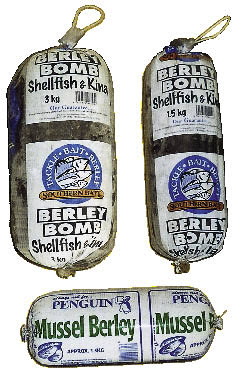
Whilst not essential, a good shellfish berley bomb, deployed in the wash, can liven up the fishing action. Also, broken shells and crab/prawn/cray bodies can be fired into the surf line to fire the moki up.
Other tips
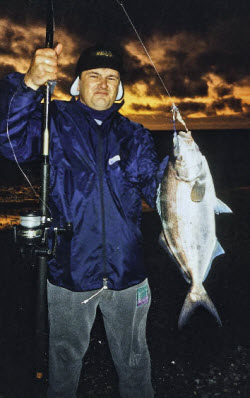 I usually fish a firm drag on moki, as they tend to hit the bait hard and start peeling off line in a bid to run you through the foul. Try to avoid giving them too much line in this situation – sometimes it’s better to increase the strength of your mainline and leaders when fishing amongst the rough ground for moki.
Use a battery-operated tip light, Cyalume light stick, or reflective tape on your rod when night fishing for moki, so you can see exactly what’s going on with your rods and baits. If not watching, you could miss the big ‘moki bender’. Sometimes moki will sit there sucking your bait; a quick, short wind-up with the rod still in the holder often results in a solid hook-up. No movement at all? Could mean a hiwihiwi or a dirty rock cod has swallowed your bait down to its nether regions – wasted time when fishing for a moki!
Take a small bucket of water and/or a towel to cleanse your hands of the mussel mucus and crab guts, which can cement itself all over your fishing gear.
Use Bait-Elastic and/or stocking/gauze bandage to keep the soft-fleshed shellfish baits attached on your hook for longer. While this won’t completely prevent the pickers from flogging your bait, it will slow them down quite a bit, helping your bait to find Mr Moki. Not only that, this also ensures the point of your hook remains proud of the bait and stops it falling off while casting.
Kill and chill straight away. I iki my moki with a sharp knife to the brain, then bleed and gut them on the beach, particularly if not filleting the fish until the next day. Rinse the fish in salt water and then store them on ice in a chilly bin for optimum eating. I love eating the smaller 1.5 to 2kg fish, as their flesh is sweeter and the meat not as dark as that of the larger fish. They are quite an oily-fleshed fish and underrated; I’d eat a small moki over a snapper any day. I can’t believe that in some areas of the country, commercial fishermen net them in set-nets, then slash them with their knives and stuff them into their cray pots as bait!
Hopefully there are a few ideas here to get the moki virgins out targeting a fun, readily available fish that tastes delicious – but, more importantly, pulls a lot of string off your reel, too! Sure makes a nice change from spiny dogs and red cod.
 |
This article is reproduced with express permission of
written by Kane Wrigglesworth - 2012 Originally published in New Zealand Fishing News ----- Advertisement -----
|
Fishing Reports Visit Reports
Tauranga Fishing Report - 28/05/26
Tarakihi on the bite Trips are few and far between at this time of year,... Read More >
Canterbury Fishing Report - 28/05/26
Fresh and salt turning it on! It is not very often I get to say... Read More >
Bay of Islands Fishing Report - 28/05/26
Lures paying dividends We finally had a break in the SE winds that have been... Read More >
Manukau/West Coast Fishing Report - 28/05/26
Snapper and gurnard in the harbour The weather has finally taken a turn for the... Read More >


Major Bites
Minor Bites
Major Bites
Minor Bites
Comments