
Hooks - What you need to know

Following on from last month’s piece on lure construction and split-rings, we come to the point of contact between angler and fish – the hook. Hooks can be critical to success and there are a number of things to consider, as all is not necessarily as it appears to be.
Hooks ain’t hooks
It used to be that you could get a fair idea of a hook’s strength by the thickness of the wire it was made from. Over-strength hooks were indicated by ‘2x’, ‘3x’ and so on. A 2x hook is made from wire as thick as that usually used to make the next size of hook up, and so on.
Another sure sign of a strong hook was a ‘flatted shank’, also called a ‘forged’ hook. By forging the hook on the sides it becomes thicker through the vertical plane and resists being bent open. However, these attributes are no longer necessarily the signs of strong hooks because these characteristics can be ‘forged’ in the other sense of the word, too. (As an aside, if dodgy manufacturers put the same effort into making a good product as they do into making an inferior product that just looks like a good product, it probably wouldn’t cost them much more!)
The plus side is that the latest good-quality ‘name’ hooks can be brilliant. With exceptional strength coupled to relatively thin wire, micro-barbs and sticky-sharp straight out of the box, they are much easier to set into a fish than the old pencil-thick hooks we had to use to cope with the power of large fish. It is no surprise that many of the best hooks come from Japan – that is what a thousand years of making nihonto blades will get you.
Singles or trebles?
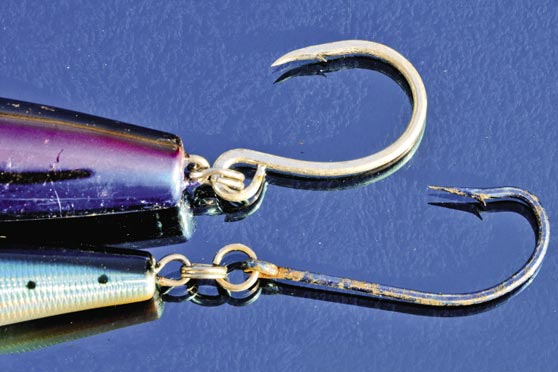
Lures may come fitted with single, double or treble hooks, a mix of types, or even no hooks at all on some top-of-the-line lures, because the manufacturers know that their tackle-nut customers are going to customise the hardware anyway.
Some lures swim better with treble hooks to stabilise them, but it is often worth switching a treble hook for a larger single hook if the lure can handle it. For the same basic dimensions and weight, the single has twice the gape and twice the strength of a treble. A single is also a lot easier and safer to unhook, and doesn’t damage a fish as much as a treble, which is important if the fish is being released.
When looking for strong single hooks to re-arm lures, be sure to buy types where the point is in line with the shank (ie. not kirbed or offset) so the hooks don’t cause the lure to spin and twist the line.
If replacing a treble hook with a conventional single, it may be necessary to use a chain of two split-rings so the single hook rides in the vertical plane and doesn’t unbalance the lure. This also has the effect of reducing the leverage that the fish can apply to the hook. Another option, increasingly popular as mainstream manufacturers catch up with the game, is to use in-line hooks such as those by Gamakatsu, Decoy, VMC, Mustad, Vanfook or Jigstar, where the eye is in the same plane as the hook point. Inline hooks can be fitted with a single split-ring. Some of the new season’s lures now come standard with this type of hook.
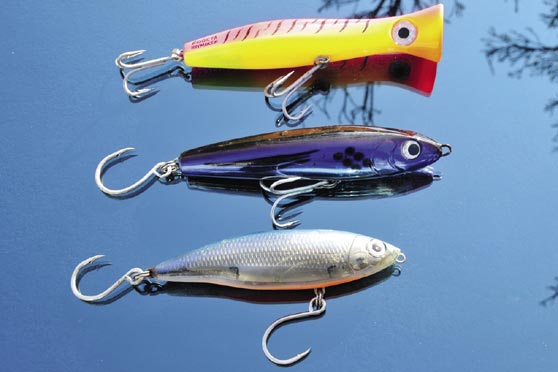
Strength is one thing, holding power is another. It’s kind of like hotting up a car: if you drop in a more powerful engine, you need a more powerful gearbox and drive train or something’s going to give. And where the rubber meets the road, there is no point in the whole process if you have skinny little tires that just spin when asked to translate the extra power to rapid forward motion.
To carry the car analogy to a fishing lure, there is no point in having a beefed-up lure that can take the pressure exerted by a 24kg, 37kg (PE 5 or 8) or even more powerful rig if all that pressure does is pull the hooks out of the fish. This is another good reason for changing out trebles for single hooks; with twice the gape and wire thickness of a treble, a single hook is much less likely to ‘pull’.
But some lures, as mentioned, require treble hooks to balance them and allow them to swim well. So if replacing trebles with stronger trebles, it is a good move to go up one or two sizes so the hook has a wider ‘bite’ and is less likely to pull when heavy tackle and big fish ask the question. I have learned this the hard way. Super-strong treble hooks include those from Gamakatsu, Owner, Decoy and Raptor.
If lures such as poppers, stick-baits or minnows are armed with two sets of trebles and lure balance is not an issue, removing the belly trebles will help ease the problems when unhooking fish. Flattening the barbs can also help make the unhooking process easier.
One configuration that is growing in popularity involves rigging the lure with an in-line single at the tail and a larger-sized treble (sometimes with flattened barbs) at the belly. This rig is strong, holds well, and it is not overly difficult to unhook a fish for release.
A belly treble can also be replaced with back-to-back singles, with a cable tie keeping the shanks in place. And, of course, double hooks – as used on the large, older-style Rapalas – are another option that can reduce treble-hook dramas a bit.
Don’t kill the lure

The trick when upgrading the hardware is not to overpower a lure and kill its action (and attractiveness to fish) by fitting it with hooks that are too large or heavy for the lure’s swimming action to sustain.
This particularly applies to smaller lures used on lighter tackle. Many were originally designed for freshwater use and their hardware is insufficiently tough for strong saltwater pelagic species. If using mono line, the reasonably high stretch factor (up to 30%) may ease the pressure on hooks and split-rings, but it is often necessary to up-spec the hardware for use with braid.
As mentioned, too-large or heavy hooks will sandbag the lure’s action, while oversized split-rings can bind up in the eye of the lure and/or the hook. Over-thick hooks can prove hard to set with light tackle, too. Upgrading hardware must be done carefully, and to this end I always have an eye out for small but strong single hooks, trebles and split-rings when visiting tackle stores. Again, Owner and Gamakatsu, along with Ten Mouth, are good names to start with.

When looking for small, strong single hooks to re-armour lures, the smallest sizes of live-bait hooks offer likely candidates.
The tackle industry is very competitive these days, and the chase for the consumer dollar has attuned companies more closely to the needs of anglers. With them constantly at work sourcing and developing the latest tackle, the choice of off-the-shelf gear is now wide, with specialist tackle stores (Go Fish, Rod and Reel, and YeeHaa Tackle, all in Auckland, are some that spring to mind, but there are many others throughout the country) all keen to stock the latest and greatest. Or, if you can’t find what you need locally, there is always the wonderful world of internet shopping…
Fishing Reports Visit Reports
Rotorua Fishing Report - 01/10/26
Opening is here! The opening of the trout season is upon us and weather conditions... Read More >
Bream Bay Fishing Report - 01/10/26
Signs of spring snapper action. There are some promising signs that Bream Bay is getting... Read More >
Houhora Fishing Report 01/10/26
Softbaiting on fire. September has seen 269 catches submitted to the NZOFC monthly competition through... Read More >
Outer Hauraki Gulf Fishing Report 01/10/26
Fishing kicking into gear. Spring has well and truly arrived in the outer Hauraki Gulf,... Read More >


Thursday 1 October 2026
Major Bites
 - -
- - Minor Bites
 -
- Friday 2 October 2026
Major Bites
- - Minor Bites
 - -
- -
Comments