
Gurnard - surfcasting tips and techniques
The stooging, stubborn depression hasn’t shifted for five days.
This has meant blustery sou’easters, accompanied by heavy, biting showers and big sou’easterly swells rising up from the deep to pummel the coastline. It’s winter – and I’m over it!
This winter has certainly been felt hard on the east coast of Hawkes Bay, with roughly one in seven days being fine. Even then, with the surf up, it’s nigh on impossible to get out and wet a line. All the surfcasting folk I know around here are getting scratchy. We’re waiting, anticipating the season’s change: a shift to more settled weather patterns of west and northwesterly winds to flatten our coastline seas out.
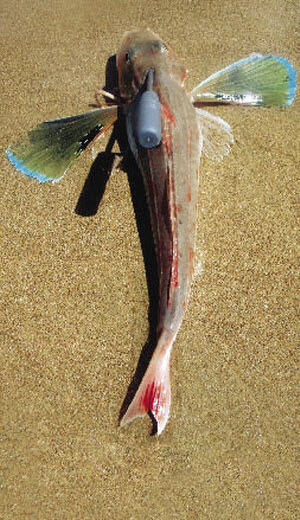
With this change in the weather comes a shift from catching spiny dogs, red cod and barracouta to snapper, kahawai and, one of my favourite fish, gurnard. Whilst not an intense string-puller, gurnard (also known as ‘carrots’) are interesting, inquisitive and delicious-tasting fish. Their butterfly-like wings; the strange feelers situated below their gills used for walking along the seafloor; the barking noise they make when out of the water; and their ability to change colour to blend in with the seafloor – all contribute to make them especially fascinating.
Which is why I look forward to spring, as this tends to be the most productive time to target gurnard – in both size and quantity – and much of this, I believe, is due to those tiresome winter conditions endured earlier.
The big winter storms that turn our coastline upside down – similar to a paddock being ploughed – dislodge and smash up potential food for the gurnard, including paddle crabs, tuatua/pipis, baby sole/flatfish and shrimps. So when the seas begin to settle again, the gurnard come in for the dislodged food washing around in the breakers; it is not uncommon to catch them from steep, shelving shingle beaches – like those found in Hawkes Bay, Opotiki and the Wairarapa – with short casts of just 20m.
Around the same time, baitfish schools, such as whitebait, anchovies and pilchards, start appearing close to shore, where kahawai, barracouta and kingfish smash them up. This feeding frenzy results in a natural berley trail of injured baitfish and assorted body parts, attracting the gurnard in to feed. By casting your baits into an area where this type of action has just happened, your chance of pulling some surf carrots increases dramatically.
I’ve noticed that spingtime produces much larger specimens than at any other time of the year, too – fish over the kilo mark are common, and sometimes are as large as 1.5kg! So as far as fish numbers to fillet weight ratio go, springtime leaves any other time of the year for dead.
Another interesting observation is that gurnard probably spawn year round. It doesn’t seem to make any difference when you catch them, they can be full of roe. I’ve never caught a gurnard with milt in it (a male fish), which is curious. (Perhaps someone can shed some light on this one?)
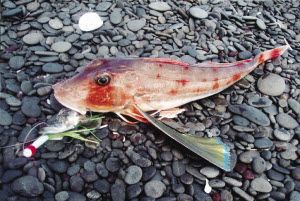 Baits for gurnard
Like most fish in the surf zone, gurnard aren’t really too fussy about what they will eat. However, some baits do work better on certain days than others.
Pilchards are probably the most versatile bait for all species in the surf zone: they’re nice and oily, and fish find them irresistible. Just use the tail or mid section of a pilchard – or if you’re feeling generous, the whole pilchard; after all, gurnard do have BIG mouths!
The only drawback with a whole pilchard bait is that it’s hard to find one small enough to cast whole, although anchovies are a great substitute. Both must be bound on firmly.
How about something tougher? Try any fresh kahawai you catch, or salted skipjack tuna. Fresh kahawai tends to get left alone longer by pickers (i.e. yelloweyed mullet, small kahawai and crabs) and many other non-target species, increasing the chances of your bait being eaten by a gurnard. Fresh kahawai is firm, stays on the hook, and doesn’t require bait-elastic to bind it on. Salted skipjack tuna is another proven favourite and has similar characteristics, but with the added advantage of a higher oil content.
I’ve also caught gurnard on a variety of other baits, including tuatua, crayfish tail, crab and strips of mackerel, barracouta and mullet. However, there’s one bait they’ll turn their noses up at nine times out of ten, and that’s squid. A bit like me and Brussels sprouts, I guess.
Another good trick is to check a gurnard’s stomach contents when cleaning them to see what they’ve been eating. That will give you a great starting point next time you go fishing.
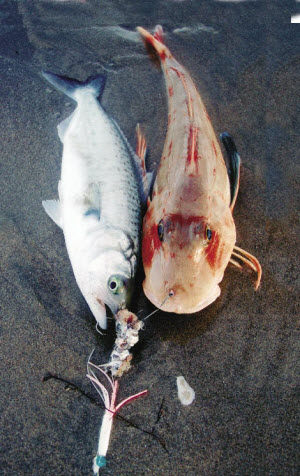
Occasionally they’ll throw up their last meal upon hitting the beach. That’s exactly what you should pick up, rig on your trace and cast back out! It’s uncanny how often that reused last meal produces another carrot for the bin – and it’s economical in these tough times!
Cut your baits to match the size of your hook and type of rig you’re using, because an overloaded hook will drag your distance back dramatically when trying to cast a long way.
Gurnard rigs
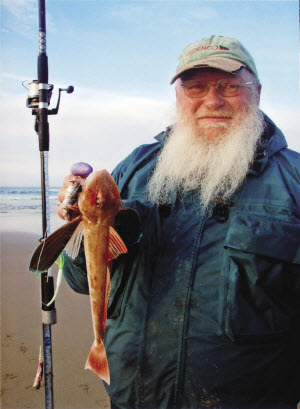 Although there is no absolutely right or wrong way to set your trace up to target gurnard, in certain situations – such as a surf beach (one with sandbars, channels, and rips) or a steep, shelving featureless beach – you may need to change or adapt your regular surfcasting rig. The following rigs work well in these two separate scenarios/locations:
Two-hook ledger rig: This rig is tied with 40lb Black Magic fluorocarbon or Black Magic Tough Trace and allows the angler to present two baits. It is a great way to fish for gurnard when distance is less of an issue (e.g. steep, shelving beaches). I use size 4/0 Gamakatsu Octopus Circle hooks, occasionally dressed up with some flasher material (chartreuse and red Crystal Flash are my favourites to capture the gurnard’s attention with a bit of sparkle and movement. I believe movement is the key when targeting gurnard in the surf. I prefer to use salted skipjack tuna or fresh kahawai; just add small thumbnail-sized pieces of this fish flesh to your rig and wait for the action.
The ‘long-cast Imp pulley rig’ (see May’s NZFN edition) is another effective gurnard-catching rig. Its main advantage over the conventional two-hook ledger rig is the extra 20 metres of distance you’ll cast. This is great when fishing shallower sandy surf beaches and there is a need to cast over a sandbar into deeper water.
The Imp pulley rig involves just one bait held in place, preferably by a 4/0 main hook and a 2/0 keeper. These can be either suicide style or circles – whatever your preference. I like the circle hooks, as there is no need to strike hard at bites – the fish hooks itself!
Once your chosen bait is attached, secure the main 4/0 hook up under the Imp bait-clip and cast. The Imp clip keeps the bait close to the sinker so it travels in one parcel, creating minimal drag through the air and achieving maximum distance. Then, when it hits the water, it disconnects from the Imp clip so that upon reaching the seafloor it’s ready for a gurnard to find it.
Like the ledger rig, I bling it up a bit using some luminescent Needlefish skirts. Colour is irrelevant, as it’s the movement that works wonders on the gurnard.
If night fishing for gurnard (yes, they do feed at night too), make sure you have some lumo beads, tube or fish skirts, as these are a big advantage.
Although you have only one bait on the Imp rig, do not be surprised if you get two fish at once: one on the keeper and one on the main hook. I’ve had two gurnard, a gurnard-kahawai combo, and a gurnard-snapper combo, so it obviously works pretty well.
Lastly, as far as rigs go, don’t let anyone tell you you won’t catch gurnard on baits off the bottom; if they’re hungry they’ll swim up and take baits floated a metre off the seafloor. Consequently, I’ll use a floated bait when the crabs are active, or if I want some fresh kahawai for bait.
Where and when to fish for gurnard
 Gurnard prefer sandy, silty, muddy bottoms where their prey is common, so it makes sense to fish for them there, rather than rocks. (Having said that though, some reefy, rocky areas, where you can cast from a rock onto the sand – such as Snapper Rock at Mahia, Castlepoint Reef in the Wairarapa and the Bluff off Ninety Mile Beach – will produce well at times, as plenty of food gets washed off these rocks onto the sand bordering these areas.)
On steep, shelving beaches, like those in Hawkes Bay and some in the Bay of Plenty, it can be hard to pick the more likely-looking gurnard water, as the gurnard prefer to come in close on these beaches when it is dead-flat and calm. More often than not, a couple of hours either side of high tide fishes better on these beaches.
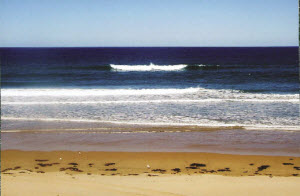
On shallow, sandy surf beaches, look for areas where the water is less turbulent: deeper, darker, flatter water – which tends to be channels and holes, and in front of offshore sandbars, denoted by the broken white water offshore reforming inside the deeper channel then breaking onto the beach. Gurnard will feed inside if the channels are deep enough, or outside the sandbars when taking advantage of any food getting swept out into the channels there. Obviously, these are the areas you should cast your bait. But also look for areas of good shellfish concentrations, as the gurnard will come close in to feed on them – or on the crabs feeding on the shellfish.
Like most fish species, targeting gurnard over the change of light periods, morning and night, is more productive, as are overcast conditions rather than bright, hot, sunny days.
Other tricks and tips
The following ideas and observations have caught me lots of gurnard, saved me from injury, and produced a better eating-quality fish to take home.
Have plenty of traces tied up, baited and ready to fish, as gurnard tend to come through in flurries. I usually fish two rods at one time, and always have spare traces at the ready, baited and ready to cast out again. Often both rods will get hit at the same time, resulting in two fish, but no lines left in the water. By having baited traces ready, I can unclip my trace with fish attached, clip on a fresh bait and recast, losing very little fish-catching time as a result.
Also, just a minute or two later I’ll hook another one or two gurnard. Then I start running around like a silly bugger – quite funny to watch! Sometimes the bite may only last 10 minutes.
Gurnard can often be subtle biters, making your rod come up straight rather than wrenching hard over. It therefore pays to cast an eye over your rod(s) periodically; if it’s up straight and the line’s slack, chances are you’ve had a bite.
To make sure I notice this, I use BOS break-out sinkers and bend the wires right in so they’re firm. I then cast out, put my rod into the rod-stand, wind the line up tight (enabling the sinker wires to grip firmly into the sandy bottom and achieve a nice, even bend in the rod) and set my reel drag. This strategy is also good if its damn windy; it’s hard to tell if you’re getting bites when the rod’s straight and a big bow is in your line.
Don’t strike too hard (that’s why I prefer circle hooks, which hook firmly in the corner of the gurnard’s mouth) and follow your fish through the shallows, avoiding applying too much pressure in the breakers or shallow surf zone, because the gurnard will use its wings to create extra drag, resulting in pulled hooks in those that are lightly hooked.
About those nasty little spines… Care should be taken once you beach your gurnard; use either a wet towel or rag, or adopt the novel approach (if you’re keeping the gurnard) of grabbing the fish by one of its wings and/or its feelers below the gills. Works a treat and saves getting spiked by the spines along its dorsal fin and over its head. If you have an iki-spike, jab it on a 45-degree angle in the soft, fleshy spot behind the gurnard’s bony head between its eyes and in front of the dorsal spine. This is certainly more humane and results in firmer, tastier fish fillets.
All that’s left is to ice down your catch in a good chilly bin to keep deterioration to a minimum.
Catching big springtime carrots can be lots of fun, and although they don’t pull vast amounts of string, they require some strategic measures to ensure consistent results, and taste damn fine too, washed down with a good ale. Best of all, when you start catching them you know the winter weather woes are well behind you!
Potential gurnard-holding water, clearly defined by a sandbar pushing food into the inner channel
Iki spiking your Gurnard will kill the fish quickly, and improve the quality of the flesh
 |
This article is reproduced with permission of |
Fishing Reports Visit Reports
Tauranga Fishing Report - 28/05/26
Tarakihi on the bite Trips are few and far between at this time of year,... Read More >
Canterbury Fishing Report - 28/05/26
Fresh and salt turning it on! It is not very often I get to say... Read More >
Bay of Islands Fishing Report - 28/05/26
Lures paying dividends We finally had a break in the SE winds that have been... Read More >
Manukau/West Coast Fishing Report - 28/05/26
Snapper and gurnard in the harbour The weather has finally taken a turn for the... Read More >


Major Bites
Minor Bites
Major Bites
Minor Bites
Comments