
Gamefishing - sharpening hooks
 To help you catch that fish of a lifetime, having hook points that are sharp, strong and the right shape is critical. Such hooks will not only substantially improve initial hook-up rates, they also help in prolonged fight-time scenarios.
From a chartering perspective (or even recreational for that matter), there are really no excuses for hook failure when you consider all the energies and expense that go into trying to catch that elusive big fish. There are plenty of other things that can go astray without being let down by poor hook selection, sharpening or shaping. For that reason alone, I always make sure every hook that goes in the water has had particular attention paid to it.
Within the New Zealand game fishing scene ‘J’ hooks are the most widely used, due to the popularity of lure fishing amongst our recreational fleet.
The target species, lure type, tackle and line weight utilised obviously all spring to mind when selecting the right ‘J’ hook for the job. As with many fishing aspects, there’s no right or wrong, just strong opinions, and with the selection of hooks on the market today, fisherman are certainly spoilt for choice. In all cases though, seeking to obtain maximum hook penetration is the main theme when looking for the right hook for the job, as well as the hook’s ability to ‘find its mark’ and stay there for the entire fight.
One well-known Australian lure maker actively promotes the use of light-gauge hooks in his lures, especially when targeting our ‘needle-nosed’ striped marlin with 15-24kg tackle. We’re all well aware how difficult it can be to hook striped marlin on lures on occasions, so his views of having fine yet incredibly sharp hooks certainly make sense.
On the whole though, New Zealanders generally use pretty heavy gauge hooks when targeting striped marlin, and have taken quite a bit of convincing in regard to this Australian lure-maker’s views. As a result, medium line-class hook-up rates are generally compromised by the use of heavier/stronger hooks. (I’m sure many New Zealanders would be pleasantly surprised what you’re able to catch with some of the lighter-gauge hooks commonly used by our overseas friends.)
Obviously it’s a little different on the heavier line classes such as 37kg and 60kg, or when targeting the bigger blue and black marlin. In such scenarios, when the heavier drags come into play, the heavier gauge hooks certainly have their advantages – especially over prolonged fights. The lesser penetration of heavier gauged hooks tend to be compensated for somewhat by the heavier drag settings.
 When choosing hook sizes for lures, there’s a rule of thumb bandied around that the gape of the hook should match the size of the lure head. I generally don’t buy into this theory too much myself, but I’m sure there are better lure fishermen around than me that may disagree. I’d rather consider the target species and the line class used when selecting hook sizes; the lure itself really doesn’t come into my reckoning. In my book you’re asking a lot of appropriate 24kg drag settings if trying to sink bigger hooks on a regular basis, no matter how big or how small the lure is, or how well you think you can sharpen hooks.
You’ve obviously got a little bit more leeway with heavier tackle drag settings when attempting to sink the bigger sized hooks, but in saying that I’m really not a fan of using bigger hooks for striped marlin at all. Bigger blue and black marlin yes, certainly, but not stripes. Hooking stripes regularly on bigger hooks (9/0 and up), no matter what tackle you choose, can sometimes be a frustrating and forgettable experience all round. So, with this in mind, some of the popular Australian lure makers’ views on smaller/finer hooks for stripes certainly make lots of sense.
The majority of heavier gauge ‘J’ hooks available at good tackle stores generally require quite a bit of work before use, and in a lot of cases these hooks are in a pretty blunt and unsuitable form. Indeed, some hook manufacturers deliberately leave their hooks this way, so fisherman can sharpen or re-shape them how they best see fit. We fisherman can be a pretty opinionated bunch and there’s certainly more than one way to skin a cat.
I can certainly recall a few fellow fisherman showing me hooks that they considered to be sharp, some of which I wouldn’t dream of having out the back of my boat. This certainly doesn’t make me right or wrong, it’s simply an example of how different people like their hooks sharpened or re-shaped.
 Most of the chemically-sharpened options don’t require any work at all, and in fact you end up doing more harm than good if you alter the point in any way. Some chemically-sharpened options can lose their point over extended periods of trolling due to electrolysis; small zinc stickers work a treat in this situation, minimising electrolysis. However, these little zinc stickers generally aren’t available from New Zealand tackle stores, and are more easily found on some of the more popular internet shopping sites for fishing gear. They certainly work, and at a small price can be the difference between hooking or missing that much-anticipated bite.
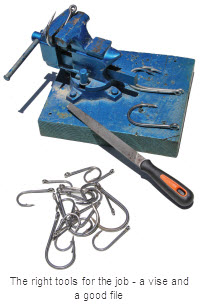
Prior to any game-fishing season I always make sure my tackle is prepared and ready to go, right from the tip of my ‘riggers down to my bait-catching gear. This includes all the hooks I intend to use for the season, whether they are ‘Js’, circles or chemically-sharpened, they’re all ready to be used; the last thing I want is my crew having to sharpen hooks at sea. Other than the fact of getting metal shards and fillings through your boat, you’ll simply never sharpen a game-fishing hook as well as you will in a vice on a work bench.
Most, if not all stainless steel or galvanised steel hooks (straight off the shelf) require a substantial amount of work, and you’ll simply never do them justice unless you have a vice and good quality file (usually around No. 6) to sharpen or re-shape them.
Most ‘J’ hooks are purchased with anything from blunt points to barbs that are too big, or perhaps being too bulky around the ‘shoulder’ area – or maybe the length between the point and barb is simply too long. How you alter these little issues basically comes down to considering the tackle you intend using, the target species and probably quite a bit of personal preference, too – all points already discussed. Trying to sink a hook with a bulky point and big barb on 24kg tackle will do you no favours whatsoever, and vice versa – having too fine a point on 37kg or 60kg tackle can see the point bending over, or the hook even straightening or breaking.
Whatever bench vice you use, it’s always a good idea to use wood between the vice and the hook itself. Light ply works well for this – and a timber ‘Workmate’ bench can be a good option, too. However, Workmate benches don’t quite provide the same purchase as a vice, especially if you need to get stuck into heavier gauged hooks. Squeezing metal on metal in the vice can cause pitting and damage to the hook; whether it’s stainless or galvanised steel, both can be damaged or weakened, with the worst-case scenario possibly leading to a broken hook during a fight.
 When filing the hook itself, always try to use a good-quality file, and run the file in only one direction. Using dull files can cause steel to heat up and alter its temper, leading to weakening once again. Good files will do a much quicker, smoother and accurate job all around. Initially running the file flat against the sides of the hook reduces the manufacturer’s grind marks and excessive ‘shoulder’ area that so many hooks seem to have. Sometimes I find myself tapering this shoulder area right back to the bend in the hook; this is probably when you need to consider the line classes used, as you don’t want to weaken the point too much if using the heavier line classes. Once I’m happy with the tapering on the sides, I’ll smooth/round the manufacturing marks and barb down on the underside of the hook. What I’m looking to do here is basically smooth all the flare in the barb; I’m trying to make hook penetration as easy as possible, yet still retain a small barb for holding.
Following this, I’ll sometimes take the point back a little if not happy with the length between the point and the barb itself. This, again, is in consideration to your intended tackle of choice. Sometimes I find hooks off the shelf have long (weaker) points and can take a lot of sinking, especially on medium-range tackle. In a lot of cases 2-3mm makes a big difference and is plenty enough.
From here I’ll smooth/round the top of the hook; once again, normally right back to the hook’s bend. I’m always looking to take off any excessive shoulder area in an attempt to increase the hook’s penetration without compromising the necessary strength.
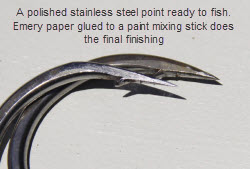
To finish the sharpening process, I use emery paper glued to a paint-mixing stick, which is easily purchased from any hardware store. The emery paper or ‘wet ‘n’ dry’ simply removes all the imperfections caused during filing and gives the point a polished finish. This polished finish not only improves penetration, it also means the tiny imperfections that can become wear points in steel, have been removed. Other anglers use diamond files to finish the job; I’m sure these work fine too, as all you’re really trying to do is finish the hook’s point as finely as possible and remove any blemishes.
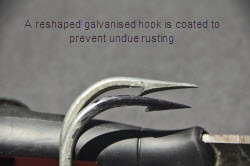
Galvanised hooks need to be painted or coated with a permanent marker on all filed areas or where the galvanising has been removed. Coating the hooks won’t stop the rusting process, but it certainly slows it, and will help maintain that polished finish for longer.
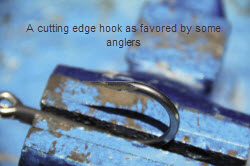
The hook-sharpening process I’ve performed is widely referred to as a conical point; other techniques include shaping the hook with a cutting edge running the point’s length. I’m not really a fan of cutting edges myself, as I find they tend to not only cut their way in, but also cut their way out, particularly during extended fights. I prefer the only cutting edge to be the actual point itself – the only direction the hook can go is in further. In saying that though, I’m also well aware some pretty good lure fishermen prefer hooks with cutting edges.
At times the process of reshaping or sharpening game hooks can take anything up to 30 minutes to get them to that perfect stage – another example of why you really need to be prepared rather than trying to sharpen them on board. I can certainly recall many seasons gone by where I’ve spent close to a week sharpening hooks for an upcoming charter season. It can be a tedious exercise at times, with plenty of puncture wounds and trophy scars to show for your troubles – but all of these things are certainly worthwhile in the whole scheme of things. After all, every hook that goes out the back of your boat might just be the one to be hit by that fish of a lifetime.
 |
This article is reproduced with express permission of |
Fishing Reports Visit Reports
Tauranga Fishing Report - 28/05/26
Tarakihi on the bite Trips are few and far between at this time of year,... Read More >
Canterbury Fishing Report - 28/05/26
Fresh and salt turning it on! It is not very often I get to say... Read More >
Bay of Islands Fishing Report - 28/05/26
Lures paying dividends We finally had a break in the SE winds that have been... Read More >
Manukau/West Coast Fishing Report - 28/05/26
Snapper and gurnard in the harbour The weather has finally taken a turn for the... Read More >


Major Bites
Minor Bites
Major Bites
Minor Bites
Comments