
Game lure hook rigs

Like many fishermen, Tonga-based charter skipper Steve Campbell has tested many hook rigs on his lures – and by testing, he means day-after-day pulling lure rigs to give them valuable water-time, then carefully recording and collating the results. With that sort of effort and over 2200 blue marlin captures, he has come up with a few conclusions around what rig works best, and when…
As a charter operation we have the advantage of seasonal data to work with and that translates to which lure rigs consistently catch more fish. To simplify the topic, I will only address leader, hooks and rigs, categorised as soft, semi-soft and super-stiff.
Rigging lures is, however, a much more complex topic as consistent success depends on many other variables, such as the lure-head design, the hook size, spread positioning and so forth. All the rig examples below have been created using various crimp sizes with readily-available retail components.
The beginning
For me, the starting point is not initially the lure or specific hook rig, but understanding how each billfish strikes a lure. If you have a good understanding of this, on paper certain hook rigs simply don’t match the strike behaviour of the fish and will not produce the desired strike-to-catch ratio.
Various catch ratios are quoted in fishing circles, from 60% to 85%, but the most reliable data you can collect yourself is species-by-species and that will reflect the nuances of each specific billfish’s biting behaviour in the habitat where you fish most of the time.
As an example, sailfish can take a lure from behind or they can sweep and bite. Striped marlin do pretty much the same, but blue marlin and the few blacks that we catch in Tongan waters never bite from behind, but rather sweep and bite.
If we only had one lure rig in our arsenal and encountered all these species, I suspect our catch ratio would be absolutely abysmal. We need to adapt a mix-and-match strategy based on the most likely species we will encounter. That is bound to have a better outcome than relying on Lady Luck.
As fishermen, we encounter differences and environmental/habitat variables day-on-day, so the trick is being observant to understand how these variables may impact on success.
As an example, we use a super-stiff, single-hook rig for blue marlin and average around 80% strike-to-catch ratio, but when blues are in ‘billing’ mode (tapping at the lure but not biting) the stiff rig percentages drop away.
To adapt to this billing action, we modify the stiff rig by rigging a flemish loop at the hook-eye so the hook can swing, slightly. We don’t get a lot of clean mouth hook-ups, but we get a big increase in outside mouth hook-ups where the hook is located in bony cartilage and that translates into fewer dropped fish.
As an aside, why the ‘billing’ action? I reckon these fish have been feeding in deeper water on squid where they sweep and slash through a school and then return to pick up stunned squid.
At the risk of offending some lure manufacturers, from my data, based on over 2,240 caught blue marlin, any lure that doesn’t have a secure crimp-locking mechanism behind the head has a huge hurdle to overcome, regardless of the hook rig used.
The majority of lure manufacturers now have a rubber grommet or stopper glued at the back of the lure head, allowing the hook/s to be locked in one orientation. If you are running lures without this feature, simply glue a stopper or drill-out the back hole to the correct size and insert a suitable length of rubber tubing. Without this locking feature it is difficult to set and hold any hook rig in the position you want.
Game hooks
There are multiple game hooks from manufacturers such as Mustad, VMC, Pakula, Owner and Bart Pa’a, to name a few, most with open- or closed-gape options. I prefer an open-gape hook in the belief that you have a better chance of an initial hook point penetration.
The hook is a critical element, so I would suggest you buy the best you can afford and look after them. They need a fresh water wash after each day, re-sharpening and if not using immediately, a liberal application of Vaseline to minimise rust pitting, even if they are quality stainless.
Light-gauge hooks have a place, but for a predominantly blue-marlin fishery, we prefer a traditional, heavier-gauge hook.
Hooks need to be super-sharp but avoid creating too fine a point as the bony cartilage around the bill and mouth area is hard enough to fold over the tip and prevent the hook from embedding.
Everyone sharpens hooks differently, so this should be a job only one member of the crew undertakes. That way your hooks will last heaps longer.
Single versus double-hook rigs is an argument which anglers will never reach consensus on, so it comes down to individual preference and what works for you. My preference for running single hooks is based on my own data. Our strike-to-catch ratio using single hooks is significantly better than when running double hook rigs. An additional benefit is one of safety for both crew and the billfish. Single hooks reduce billfish mortality upon release as they are easier to get out.
The hook curve should ideally sit just inside the skirt or slightly outside. The exact rig length will depend on the balance that is achieved, so with different head designs and skirt weights the rig length will need to be lure-specific.
We run our hook upright and offset up to 10 degrees with the hook point facing into the middle of the spread. This matches the ‘sweep-and-bite’ or ‘strike and flight’ behaviour of blue and striped marlin.
Most predators are themselves most vulnerable from attack when they are about to strike prey and it is my belief that marlin have a sixth-sense, based on survival instinct. They work out an exit strategy before striking, and this behavioural trait is very predictable.
They strike the inside pattern lures and exit out into clear, clean water outside the wake. By off-setting the hook so it faces into the middle of the spread you have an increased chance of an initial hook-point set and a subsequent successful clean mouth hook-up.
Monofilament leader
My basic rule: go as heavy as you can without dampening the lure’s performance too much. Some leader material is too stiff and can ruin a lure’s natural action, but you need strength, too. There is nothing worse than having the fish of a lifetime pretty much beaten, but at the boat you struggle to hold or control it because the leader is too light.
With specific reference to striped and blue marlin, one could categorise the following whether using single- or twin-hook rigs:
1.Soft rig – floppy
2.Semi-stiff rig – more rigid,
but still moves
3.Super-stiff-rig – totally rigid.
In times gone by, chain rigs were used. These were super-floppy and a vast percentage of hook-ups were outside the mouth region, which resulted in a lot of pulled hook/s. The implication is obvious.
A quick test to check ‘floppiness’: with the lure/rig complete, hold the lure head and shake the rig up and down and sideways. By my definition, any up and down or sideways movement of the rig section and it’s a floppy.
I prefer minimum movement simply based on how billfish bite. The floppier the rig the more outside-the-mouth hook placement. My goal has always been to achieve the vast majority of clean mouth hook-ups in bony mouth cartilage. This translates into fewer dropped fish. Billfish are powerful predators with the ability to tear out hook/s, especially those in soft tissue.
Soft monofilament – single-hook rig
The leader can be crimped super-tight to the hook-eye or some hook movement can be achieved by less loop pressure and/or using a Flemish eye.
To reduce any movement at the hook eye section you can cover it with heat shrink or wrap multiple times with quality insulation tape. This also protects the immediate hook-eye section from billfish mouth grinding and chafing.
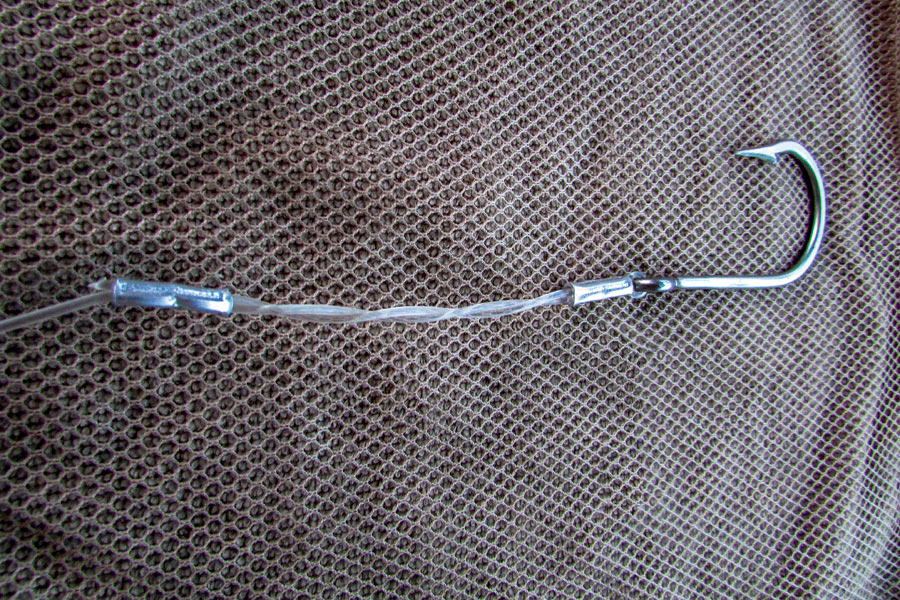
The hook-eye section is taped to reduce movement.
If you want a less floppy rig, you can wrap insulation tape along the whole monofilament rig section. Heat shrink can also do the same job, but you have to be careful not to over-heat the monofilament. The hook rig is then pulled tight into the lure grommet/stopper and is ready to fish.

The whole rig section is taped to reduce floppiness.
Multi-strand wire – single-hook rig
There are different diameters of wire to create floppy to semi-stiff floppy rigs.

Single hook wire rig where the hook eye can swing slightly.
The monofilament leader section is crimped with a loop protector (plastic or stainless) to reduce the incidence of the wire damaging the mono-loop section. The lure grommet can accommodate the crimped wire loop section, and this can reduce some movement to improve semi-stiffness. Heat shrink or insulation tape along the whole rig can achieve a less floppy overall rig.

Single hook wire rig can be modified to create a soft or semi-stiff rig and/or swing hook by removing the heat shrink.
The multi-strand wire rig is reasonably durable and good insurance against toothy critters.
Super-stiff single-hook rig
The only difference to a standard mono soft-rig is the insertion of a stainless rod between the two crimped sleeves. The best rod to use is old throttle cable wire core. It is heat-treated and doesn’t bend easily.
This rig is super-stiff, especially if you put a lot of pull pressure at the hook-eye section when crimping the leader. If you get a strike and no hook-up, always check the rig as it could be slightly bent, and this may affect the true running ability of the lure.
This rig is my favourite. It is the closest rig in matching the vast majority of billfish bites we get in our waters. Not only is the catch rate 80%-plus, but the vast majority are clean mouth hook-ups. This rig is ideal for medium to large lures, including the short corner which historically attracts the heaviest average blues we catch.
Twin-hook rigs
Twin-hook rigs can be made soft, semi-stiff or stiff depending on the choice of terminal material e.g. monofilament for a soft rig and multi-strand wire for reduced floppiness.

Twin hooks that can be modified to create off-set hook angles and/or back hook can swing slightly.
The hook rigs can be created with various off-set angles, from 0-180 degrees, to suit where in the spread they are to be positioned. As with the other rigs, insulation tape and/or heat shrink is used to reduce floppiness and the risk of chafing.
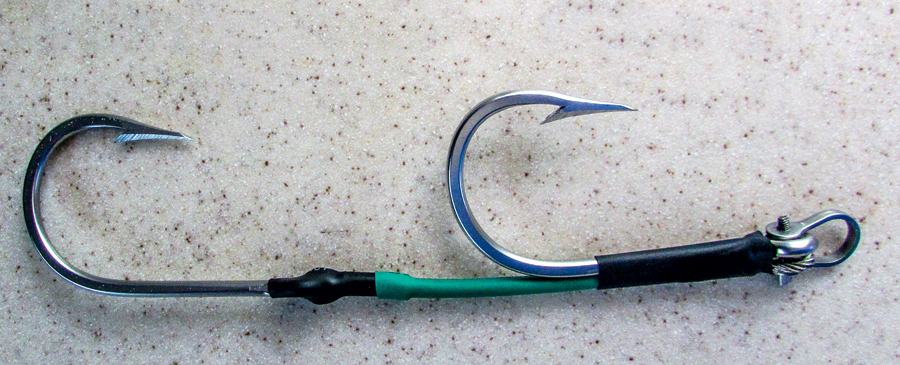
Twin hooks that can be modified to create a stiff or floppy rig and/or offset hook angles.
When pulling very big lures, including XOS size, the multi-strand double-hook wire rig can be a useful addition, but be mindful of safety aspects when dealing with two hooks at boat-side.
In the eyes of the beholder
So what hook rig is best for you?
All the hook rigs mentioned are pretty much standard, and with the right materials on hand (such as mono-leader, multi-strand wire, stainless rod, heat shrink, insulation tape, various sized sleeves and a good crimping tool), you can pre-make any option.
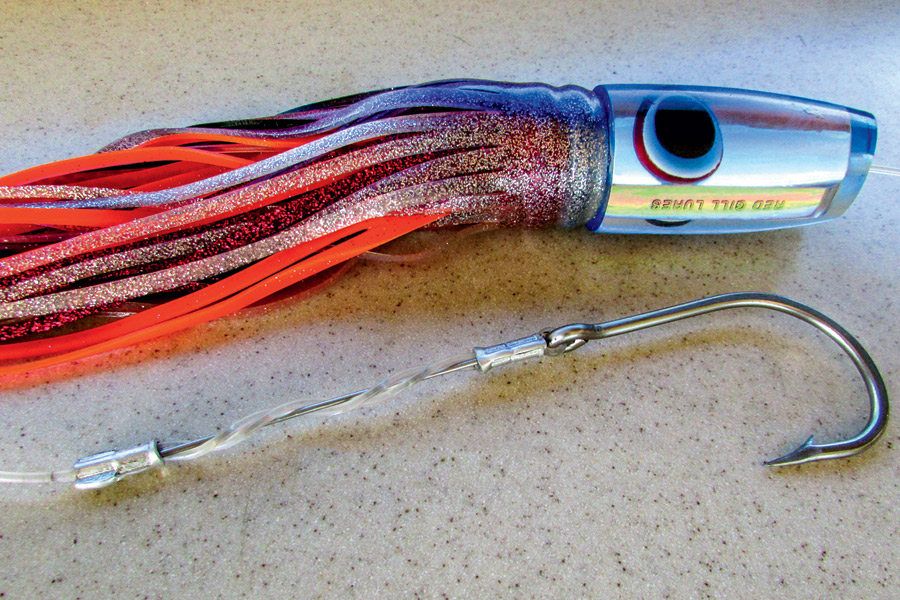
The hook-eye section needs to be taped or heat-shrinked to stiffen the link and protect from chaffing.
If you are just starting out, keep it simple and before long, your basic hunting instinct will take over. Fishermen just can’t help experimenting and fine-tuning.
As your lure-craft develops over time, you will create refinements in the belief you have perfected the ideal hook rig… if only!
|
|

Fishing Reports Visit Reports
Hauraki Gulf Fishing Report 11/06/26
Workups the best option mid-Gulf for quality snaps and kingfish Fishing across the Hauraki Gulf... Read More >
Bream Bay Fishing Report - 11/06/26
Normal transmission returns! It seems only the hardy have been wetting a line these last... Read More >
Raglan Fishing Report - 11/06/26
Solid snapper hook-ups out deep With the continuation of more settled weather there’s been some... Read More >
Canterbury Fishing Report - 11/06/26
Brave the cold, reap the rewards With a big southerly blow through here yesterday, it’s... Read More >


Major Bites
Minor Bites
Major Bites
Minor Bites
Comments