
Fishing for parore.
As a visitor to New Zealand on a fairly regular basis, I’m still amazed at the wealth of ocean fishing your country’s anglers have at their disposal.
 There’s big snapper off the beaches, kingies from the headlands (and from boats within easy sight of land in a lot of cases) and kahawai for anyone that wants to fish for them. Tuna and marlin can be caught from small boats, for Pete's sake!
To my mind it’s mega-fishing without spending mega-bucks. Here in Australia it’s all so different. The fish are smaller and a darned sight fewer; while the anglers are far greater in number. It’s an equation that can never add up to good fishing, I’m afraid.
The easy, accessible fish are long gone and now the likes of quality snapper and kingies are only available from offshore boats, travelling well out to sea to find patches of unexploited reef. GPS units are switched on as soon as the motors warm and those bits of reef that still produce fish are continually being worked over.
Game fishing is far more involved, too, and to be really sure of success, a lot of dollars need to be thrown at the water, so to speak. One direct result of all this ‘few fish-too many anglers’ business is to make us fish-hungry Aussies far less selective than our New Zealand counterparts when it comes to fish for dinner. We have, in fact, turned to some fairly unlikely fish to satisfy our craving for sport and fish fillets.
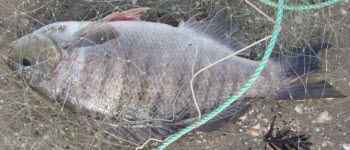
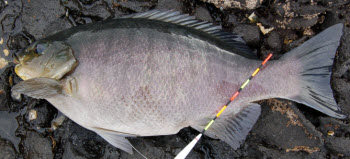
Like, for instance the parore. In Australia we know this fish as a luderick or blackfish, while you folk have a far more descriptive name for it! Starts with ‘S’ and ends with ‘T’! Let me tell you here and now though, that one hell of a lot of eastern Australian anglers are devoted to these critters. And when I say devoted, I mean about as devoted as a baby is to its Mum’s milk.
Part of their popularity stems from their wide distribution. These fish are quite widespread along the east coast of Australia, being found from around southern Queensland right through to Victoria and even into Tasmania. A big one over here is around the one and a half kilo mark (the largest on record was some eighty centimetres long), but most fish taken seem to be around the thirty to fifty centimetres in length. Little fellows, eh?
The fish start to school up to spawn in winter and it's then that the fishing starts in earnest. The number of anglers that congregate to fish for these blokes has to be seen to be believed. Could you imagine anglers fishing shoulder to shoulder along a rock wall in New Zealand fishing for parore? Like I said, we’re not all that choosey in the land of Oz.
Spawning blackfish are usually located not far from the ocean and just love to hang around some sort of cover, so river walls, mud banks, the ocean rocks and also jetty and wharf pylons and similar structures are popular spots, provided there is some clean blue water nearby. The main thing required to make a spot a good blackfish possie is the presence of that cover and some moderately deep water close at hand. Aussie luderick are shy fish and are also quite vegetarian in nature, feeding mainly on the green weed that grows on or near the sorts of structures I’ve just described.
With the knowledge that parore are pretty common in parts of New Zealand’s coastal areas and that more than one angler has been somewhat surprised at both the fighting ability of these fish and the way that they taste if treated correctly, I’ve put a few lines together on the tried and proven Aussie fishing methods just in case some more daring New Zealand folk decide to give them a try. I’m not thumping the tub for these fish, mind – they can never taste as good as snapper or fresh kingie – but maybe, just maybe, you might be pleasantly surprised if you give them a go.
Some of the parore I’ve seen in your country are whoppers, and would obviously give a light rod angler a hell of a run for his or her money. Remember, for best eating these fish need to be bled, gutted and iced down in pretty quick succession, and the stomach lining removed from the fillet or else a typical weedy taste will pervade the flesh – to the extent that your mother-in-law’s cat won't eat them, even if marinated in champagne and cooked in egg and breadcrumbs!
The truth is that we do regard them as fine light tackle sport fish and whatever the angling venue: rock wall, ocean rocks, mud bank, whatever, for us the basic rig is going to be the same. A long, fine rod around three metres in length is favoured and that rod needs to be fairly soft in action, especially at the tip. There’s just no requirement for radical tapers or Brutal Bessie type sticks for these fish and the reason for the longish, soft-tipped rod is explained as follows.
When luderick angling we use a slim, long-stemmed float to indicate that a fish has taken the weed bait drifting not far from the bottom. Sometimes there can be as much as three metres (or more) of line from float to bait because the rig is set up according to the depth of water being fished.
What's more, the rig is allowed to drift away for some distance, too, in order that the bait can cover a bit of territory. The long rod makes handling that sort of a set-up so much easier, especially when it comes to setting the hook when the float has gone down. A short rod can never lift the length of line that a long rod can, it’s as simple as that.
Why the soft tip? Blackfish have a small, soft, mouth. Further, they tend to roll and bulldoze about when hooked and too strong a rod, with too fast an action, will usually tear the hook loose during the spirited fight. Complementing the rod will be a reel set up just for this style of angling. I personally favour a centre-pin style such as the Alvey specialised luderick reel or a Shakespeare centre-pin but many folk manage quite well with their threadlines (fixed spool spinning reels).
Actually, I reckon a closed-face reel would be perfect too. Here’s why. In a complete departure to usual angling styles where a bait is cast and either left to sit or retrieved until a bite is felt, our style of luderick angling requires that the angler manages the bait in a drift-away situation, the idea being to allow the float and bait to drift at current speed along a channel edge or rock wall or, if on the ocean rocks, to move naturally in the wash. In this way the bait looks natural in the way it’s moving. To spoil that rate of drift is to spoil the chance of getting a fish because the bait will swing up and away from the feeding zone. It's as simple as that.
Our luderick are shy so a fine line is required to entice them to take the bait. Which is fair enough, but if the reel is filled up with really fine line the first snag that’s encountered will see the line broken and the whole rig, including the expensive float, lost. So the smart alternative is to spool up with a heavier main line, perhaps five kilo b/s, and work with a fine hook trace around the two or three kilo mark. The trace can be up to a metre in length but I like about half a metre of trace for reasons I’ll explain soon.
As I’ve mentioned, the float is a specialised item: long stem, pretty paint job to make it visible, and a couple of runners through which the line is threaded. Used by itself it floats far too high to register the tentative sucking bite of our quarry so sufficient split shot or small sinkers are clamped onto the trace somewhere above the hook to weigh the float down until only the stem is showing. Personally, I like to corral all of the weight on the last section of the heavier main line and have the hook trace virtually weight-free with just one split shot near the hook. Enough weight to allow only the stem of the float to sit above water is employed and a small swivel will join the two sections of line quite nicely.
Did I mention the hook? A size eight in a medium thickness pattern (for extra strength) is the preferred hook. Chemically sharpened is the way to go, the sharper the hook the better. As I mentioned previously, our Aussie blackfish are vegetarians and a bait of green weed (looking just like green cotton wool and found around ocean rocks where some shelter ensures that the waves don’t pound too hard) about as thick as a match is carefully plaited around the hook so that a little ‘tail’ about three centimetres long hangs below the bend of the hook. Actually, our fish seem to eat quite a few types of oceanic weed but the fine green stuff from the rock pools seems to be most eagerly sought by the fish.
 That fairly well describes the bait and rig; the next question is determining the depth to fish and how to maintain it because this is critical in that the blackfish feed near the bottom but not really on it.
The first part is simple: the bait needs to be kept just off bottom. Working out the depth of water isn’t that hard and maintaining the workable fishing depth (depth to bottom less a little) is just as easy, keeping in mind that the float actually runs up and down the main line with the hook trace tied onto the last section. To stop the terminal rig from running straight down until it snags on the bottom a cunning little stopper knot (a bit of wool, dental floss or rubber band will do) is tied onto the main line above the float so that the float runner contacts the knot and thus stops all downward travel of the rig.
Sometimes the float runner is a little on the large side and rather than persist with a big stopper knot which catches in the rod’s tip guide and then moves to alter the critical fishing depth, a little bead is threaded on the main line above the float. The bead contacts the stopper knot and prevents the float from sliding any further up the main line as the float runner, in turn, contacts the bead. Sound simple? Well, of course it is. To adjust the depth of drifted rig, all we do is move the stopper knot. Up the line makes it deeper; down makes it shallower.
When fishing a rock wall, channel or mud bank in an estuary, Aussie blackfish bite best when there is a fair bit of tide run evident and as the tide rises the stopper knot is moved further up the line to keep the bait down near the fish. As it drops, the stopper is moved down towards the bait. All it takes to keep in touch with the fish is to make the necessary adjustment.
Two basic fishing situations seem to exist: the river or estuary scene is one and it’s deservedly popular, but I always reckon that it’s around the ocean rocks that it really all happens. Where there is not much run or wash, these fish are finicky, bait-sucking little mongrels, but once there's some wash and a bit of wave action they start to actively compete for tucker and the balance tips the angler’s way.
Either angling situation is greatly enhanced by the use of berley in the form of chopped up weed mixed with sand. Berley is usually fed into the area where the float is drifting, the idea being to keep it supplied to attract the fish and whip them into a feeding frenzy. Some mornings, from my little boat, I’ve seen a whole plastic rubbish bin full of berley go over the side and some forty or more fish return over the transom. The best dozen are kept for the table.
There’s a bit of an art in hooking fish too. As explained, the rig is allowed to drift with the baited hook just off bottom. Once that float goes down (indicating a bite) the clue is to allow about a two-second delay and then lift the rod quickly. The fish should feel like a snag, except that it’s kicking.
There’s no hurry or rush to get the fish in or the hook will tear loose and the closing stage of the fight virtually requires a landing net, particularly when boat fishing. On the rocks the fish is washed up with a wave. To lift a flapping fish about the place is to virtually guarantee it will fall off the hook.
As can be seen, there is a fair bit of setting up and getting things just right in the Aussie way of fishing for our blackfish and yet, from what I've seen of the parore, in that they also hang around ocean rocks and river walls looking for a bit of weed, I’d bet London to a brick that the fish would respond to similar fishing techniques. Kiwi fish are identical except in overall size.
I’ve yet to taste an Enzed parore but look forward to the opportunity, even if they are regarded as shit fish. When cooking up a feed of these blokes I lightly flour a skinned fillet and then fry it quickly in a hot pan that has a little butter sizzling in it. As the fillet browns on the second side I garnish it with some parsley flakes and hit it with a squeeze of lemon juice just as it’s finishing.
A Blast from the Past! This article originally appeared in NZ Fisherman magazine - June 1997
A Blast From The Past!
|
June 1997 - by Wayne Kampe |

Fishing Reports Visit Reports
Manukau/West Coast Fishing Report - 15/10/26
Big spring snapper in 60 metres. The El Niño weather pattern isn’t going to be... Read More >
Rotorua Fishing Report - 15/10/26
Solid start to the season! The Rotorua lakes have all started the season well, and... Read More >
Tutukaka Fishing Report - 15/10/26
Big snapper in shallow. Things remain relatively quiet on the fishing front out of Tutukaka,... Read More >
Tauranga Fishing Report - 15/10/26
Bait and temperature on the rise. It’s been great to get out and see some... Read More >


Friday 23 October 2026
Major Bites
 - -
- - Minor Bites
 - -
- - Saturday 24 October 2026
Major Bites
 - -
- - Minor Bites
- -
Comments