
Fishing after a storm
Fishing conditions on my front lawn have been rather good lately. The world-famous ‘poo pool’ (the one above the septic tank) has been full of big ones, while the equally renowned ‘guinea pig gut’ and ‘rabbit hutch reach’ have also produced the goods. Making their way upstream have been large hordes of mosquito fish while voracious schools of whitebait have responded keenly to the dry fly just below ‘rooster house rapid’. It simply can’t get any better than this!
Seriously, wet weather jokes aside, the inclement weather of late winter and early spring is not always a reason for staying indoors. The repeated and rolling nature of northerly storms that predictably cross Northland at this time of the year give ample opportunity for fishing the stirred up remnants of each and every weather system as it passes through. Storm fishing, as this effectively is, is aptly suited to those who might consider themselves ‘stormtroopers’. It is not an activity for the faint hearted – death at the hand of a rogue wave lies only metres away – so persons who partake in this sort of activity must do so in the knowledge that it is one of the riskiest pastimes in the world.
Yours truly has had a go at being a statistic. A remarkable ability for scaling a vertical, barnacle-studded cliff with a fishing rod clenched between my teeth was the only thing that saved me. Others haven’t been so lucky. I’ve never made the same mistake twice.
Most fishers kill themselves trying to gaff fish. It seems a rather large price to pay for fresh snapper fillets. My own faux pas was caused by attempting to retrieve a gaff sucked away by four-metre swells while trying to land a six-kilo snapper. That gaff had a bamboo handle (which made it float) and an old rusty meat hook on the business end. Its total value was around fifty cents. Foolishly, I tried to trade my soul for it.
Much later I was to discover that fishing into the guts of a storm was not necessarily the best way to catch fish. The local assessment is that fish bite best 48 hours after a storm has passed. My own experiences have shown this to be true. And the seas are far more forgiving by then.
Good fish can be taken when the storm is in full thunder but the places to look at during these times are those quiet beach corners where fish might not normally hold, or in front of gentle streams that suddenly become raging torrents. Fish such as snapper and trevally like storms for the cover provided by dirty water and the food exposed by rough seas and high freshwater flows. The fish themselves don't necessarily like battling the energy and power of giant waves so less turbulent bays and lee shores offer all the benefits of the storm while also providing protection. Snapper taken in the Kerikeri estuary after a drought-busting rain with freshwater koura in their gut are a case in point.
Sometimes the most protected areas produce the best fishing during and after a storm because these are precisely the areas where large quantities of invertebrates (fish food!) are going to experience the greatest disruption during a storm. Reef and sand dwelling animals on more exposed coasts are well used to being pounded by big waves and, indeed, are adapted to survive in highly exposed environments. Consequently, their attrition rate during foul weather is less. There is no real reason, therefore, to go risking life and limb when the big seas are up. Safe locations can produce the goods.
Of global warming and tropical events
With all this rain and wind howling in from an overheated Tasman Sea, there has been a lot of talk recently about the reality of ‘global warming’. My own views are rather sceptical, but given that there does seem to be a warming trend occurring, what are the downstream fishing consequences of a global temperature shift? Surprisingly, they are less exciting in New Zealand than many people might expect.
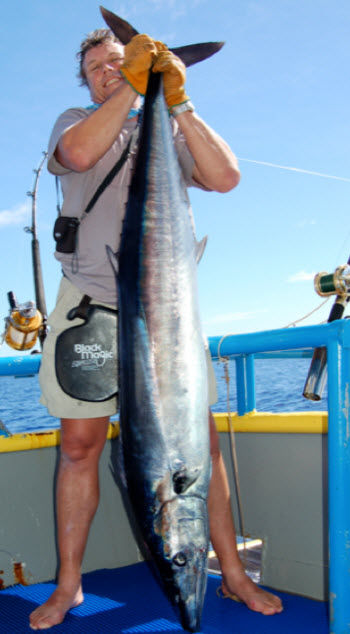
The trouble with Aotearoa is that it is isolated from the rest of the Pacific. If we had shallow reefs running all the way to New Caledonia off the top of New Zealand then we would see a steady and progressive increase in tropical fish species moving into lower Kiwi latitudes. This is exactly what happens in Australia. Some years they have good wahoo runs off Sydney, other years they don’t. The fish can move north and south as they please following the warm water and the continental shelf. Here, large expanses of open ocean must be traversed before coastal waters are reached. This eliminates the prospects of northern New Zealand suddenly developing a big fishery for any species that are not overtly oceanic. Therefore, mahimahi arrive in big numbers some years, but wahoo don’t, and unlike fishers in Victoria we can’t hope for a southward run of longtail bluefin tuna at the height of a sunny summer season.
Subtropical coastal pelagics are going to remain in the coastal subtropics, not here.
Exceptions occur when fish drift or swim here as ocean-going juveniles. Huge schools of sub-tropical fish can land and grow to adulthood in New Zealand waters. Many of the more delicate reef forms die off over the winter months but some of the more pelagic types seem to do well. There is a small tropical barracuda that regularly visits our shores that could become more common, as could Australian bonito, samson fish, and amberjack – all of which are common at Norfolk Island. Spotted groupers and convict groupers (Epinephalus sps.) may become a more frequent catch, but given that both are extremely voracious and easy to fish out, it is unlikely that they will ever sustain a major fishery.
Out in deepwater the impressive and huge ‘ruby snapper’ (Etilis carbunculs) may move south from its present haunts along the Norfolk Ridge and begin to be caught by mainland hapuku fishers. Again though, don’t hold your breath waiting for it to happen.
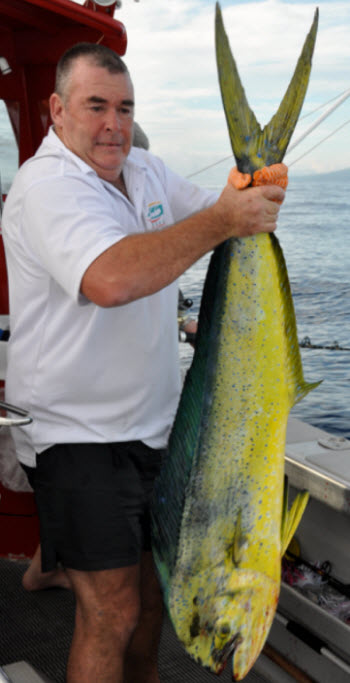
Changes to the catch rate of specific oceanic species are likely to be far more noticeable. Mahimahi is the most obvious species here. They like strong blue water flows and warm water. Accompanying them may be rainbow runners, sailfish and a few more wahoo. Pelagic tropical sharks such as oceanic white-tips and tiger sharks are high on the list of possibles. Blue marlin will begin to dominate in the high summer big-game catch records in the Far North – if, that is, this warming trend continues and the long-liners don’t get them first. As I said before, yours truly remains a sceptic.
A Blast From The Past!
|
October 1998 - by Craig Worthington |

Fishing Reports Visit Reports
Manukau/West Coast Fishing Report - 15/10/26
Big spring snapper in 60 metres. The El Niño weather pattern isn’t going to be... Read More >
Rotorua Fishing Report - 15/10/26
Solid start to the season! The Rotorua lakes have all started the season well, and... Read More >
Tutukaka Fishing Report - 15/10/26
Big snapper in shallow. Things remain relatively quiet on the fishing front out of Tutukaka,... Read More >
Tauranga Fishing Report - 15/10/26
Bait and temperature on the rise. It’s been great to get out and see some... Read More >


Monday 26 October 2026
Major Bites
 - -
- - Minor Bites
 -
-  -
- Tuesday 27 October 2026
Major Bites
- - Minor Bites
- -
Comments