
Catch Your Own Baitfish

The ability to catch your own baitfish can save you a lot of money. It can also be critical to your success – cut baits and livebaits are crucial when targeting predatory species – and it’s a whole lot of fun, writes Sam Mossman.
There are a wide variety of baitfish in New Zealand waters, and many approaches to catching them. Some methods can be more effective than others with different species, under different conditions.
The most common inshore species are: jack mackerel (yellowtail), koheru, blue (English/slimy) mackerel, piper (garfish), yellow-eye mullet (herring), grey mullet, kahawai, and pilchard. These may all be found in inshore waters and can often be caught from the shore or a wharf, as well as boats.
The grey mullet is an exception. Smoked, they are a popular table fish in some regions but are also a popular bait because of their oily nature and tough skin, which helps keep cut baits of this fish on a hook. Although I have caught the odd one when fly fishing for trout in estuarine waters, more realistically, they are a target for set or drag nets.
Another great bait species is skipjack tuna, and although I have sometimes caught them from small boats near the shore (on one notable occasion while soft baiting for snapper in 10 metres of water), they are mostly an offshore pelagic species so we will not deal with them further here.
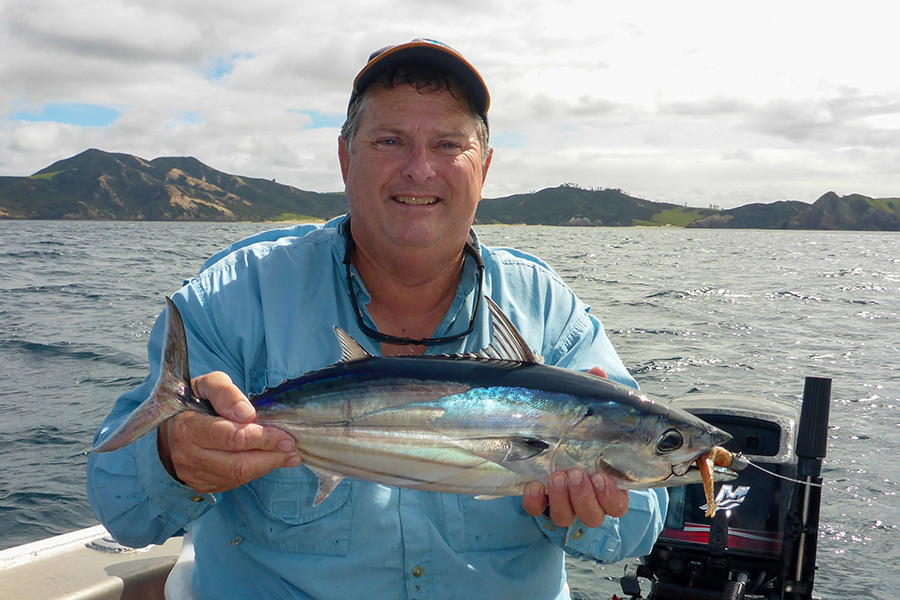
Skipjack tuna are mostly an offshore pelagic species but do regularly stray inshore.
Basic principles
Suit the hook size and bait size to the fish size. This applies to both baited hooks and sabiki rigs. If the fish are smaller, you must use smaller hooks and baits that they can take easily.
Fish where the fish are. If you do not present the hook to the fish, you will not catch them. This applies to the depth your hook is, just as much as the place you are fishing.
Attracting fish
When fishing for baitfish, attracting them to an area where they can be caught is a good plan. There are two main ways to do this: with light and with berley or using a combination of the two.
With light: Obviously it must be dark for this to work. Places where there are existing lights, such as wharves, can be great places to fish, especially towards the top of the tide. Another option is to use your own light, and many charter boats are equipped with bait lights that are shone on the water. These attract baitfish and the small organisms (such as krill and larval fish) that the baitfish feed on. Sometimes the baitfish can be wary, so try fishing on the fringes of the light.
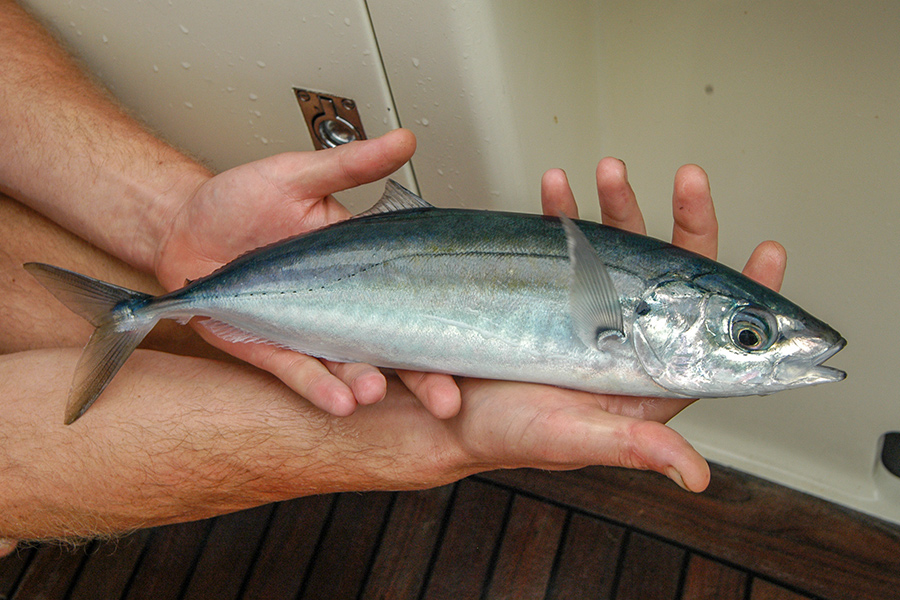
Koheru are a northern species that prefer oceanic water around offshore islands or capes.
One of the best rigs to use in this situation is a sabiki rig, a vast number of which can be found in most tackle stores. It is important to use them with a sinker on the end, or they can become tangled, especially when you catch more than one fish at a time. For the same reason, it is best to pull in a hooked fish immediately rather than wait for more to be hooked. Many sabiki flies have luminous beads and paint to help attract the fish. If using them at night, be sure to hold them under light from time to time to recharge them, so they glow better; this will help catch more fish. Try jigging and twitching the sabikis around gently (to make them look alive) and try different depths and actions until you start catching fish. Try to use the sabiki size that best suits the size of the baitfish. If you cannot catch the fish, try a smaller size.
With berley: Berley, or ground bait, can be made with anything that attracts fish. For baitfish, old bread, cooked potato, or rice can be mixed with squashed pilchard or other fish. Fish oil, tinned cat food, canned sardines, blood and bone, or berley pellets are other useful things to mix into berley. You can disperse berley in the water by regularly throwing in small amounts; or by hanging a mesh bag in the water on a cord. Fishing with an unweighted, baited hook underneath a quill float is a good way to catch piper (and other fish) attracted to the surface.
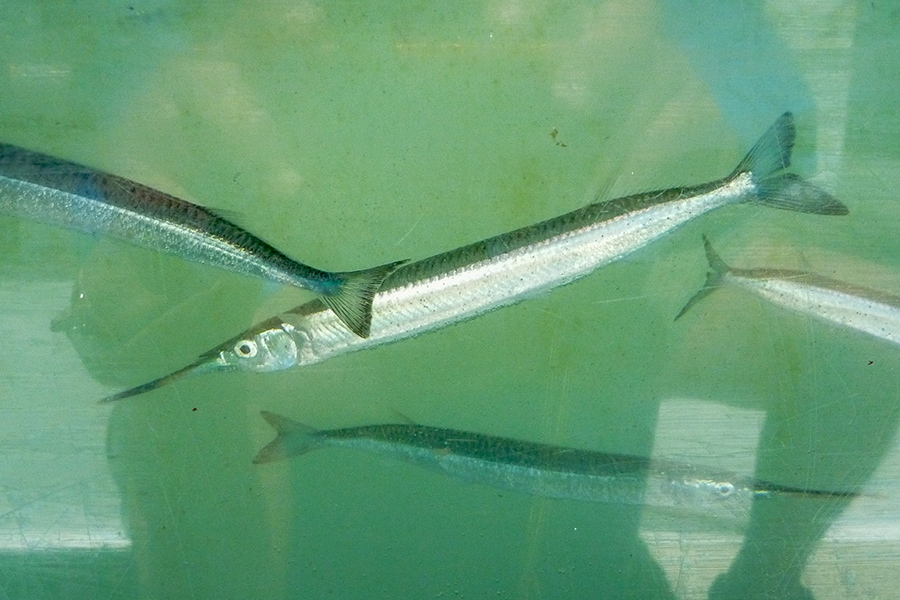
Piper (garfish) are found in coastal and estuarine waters.
Fish attracted by berley are best fished using a baited hook, either a single hook or with tiny baits added to the hooks of a set of sabiki flies. A combination of sabiki flies and berley can be very successful at night in conjunction with a light. Cut tiny pieces of bait, and again, try to suit bait and hook sizes to the fish. When fishing baited flies (or hooks), it is usually best not to jig them around like unbaited sabikis. Hold them still and wait for a bite. Again, try fishing at different depths until you find the fish.
If fish are wary, using a single tiny, baited hook can often be successful. Use light (say two or three-kilo mono) trace and add one or two small split shot 30cm or so above the hook. This should be just enough weight to make your bait sink slowly, but still look natural. Add a piece of bait and flick it out into the water. You may be able to see the fish take or the line jerk. Strike quickly to hook the fish.
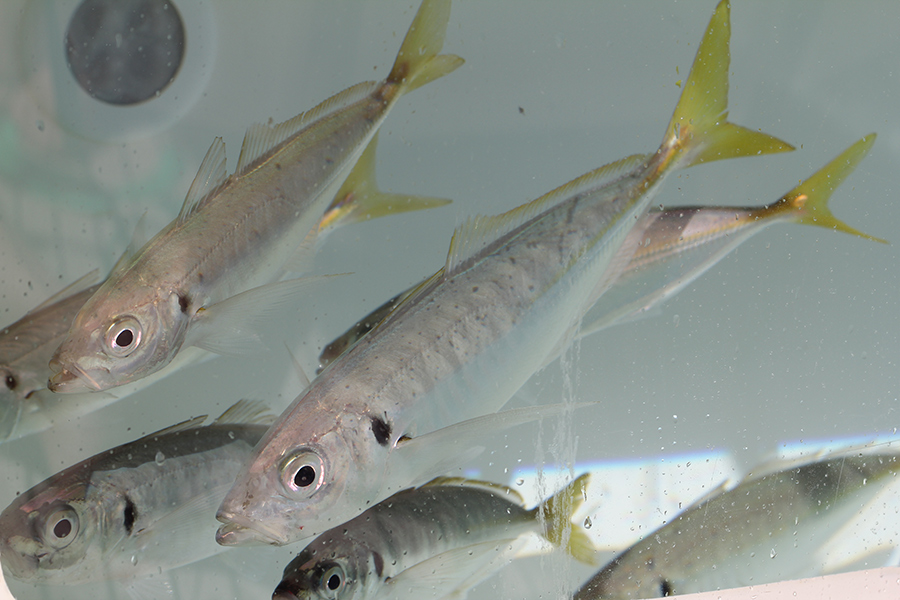
Jack mackerel are common in shallow bays, harbours and reefs around the North Island.
A small quill float a metre or so above the split shot will keep your bait in the surface water and is the rig of choice when targeting piper. The weight of split shot used should ‘cock’ the float – make it stand up without pulling it under the surface.
You can also make up a ledger rig with two or more hooks on branch lines and a sinker below them, but usually, a baited sabiki rig is more effective than this.
The techniques mentioned will take many of the small baitfish mentioned earlier, but there are a few exceptions.
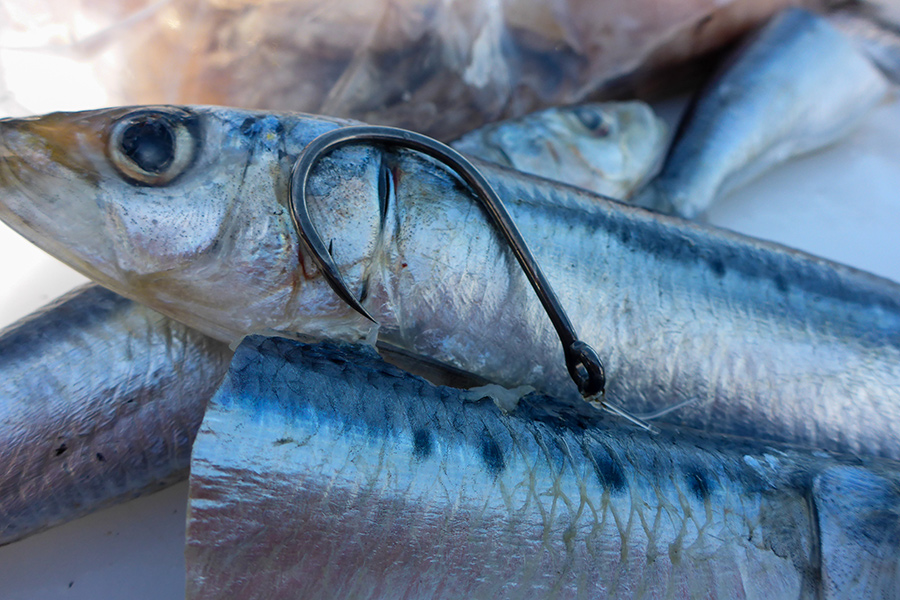
Pilchards are a great bait and can sometimes be caught on small sabiki rigs.
Larger kahawai, for example, can still be classed as baitfish. Although fine eating themselves, kahawai can still be used as cut baits or live baits for kingfish. There are many ways to catch the obliging kahawai: straylined baits, ledger rigs, and cast, trolled or jigged lures are some successful techniques, and less subtlety is required than is normally needed when fishing for the smaller baitfish species.
Pilchards, on the other hand, are plankton feeders, and should you be fortunate enough to get onto a school of them to catch them in numbers, you will need sabikis with hooks and traces smaller and finer than normal (except when they are very large specimens). We are talking hooks of size 16 or even less and leaders of 2kg or so. Such lightweight sabikis are uncommon, so if you ever spot any in a tackle store, grab a couple of packets against the day when you run into a school of pilchards – I always do!

April 2023 - Sam Mossman
New Zealand Fishing News Magazine.
Copyright: NZ Fishing Media Ltd.
Re-publishing elsewhere is prohibited
Fishing Reports Visit Reports
Raglan Fishing Report - 25/06/26
Trophy snapper in close The snapper fishing out deeper continues to be the most consistent... Read More >
Northland Fishing Report - 25/06/26
Swords aboard! With some of the smoothest seas and lowest winds we have seen in... Read More >
Bay of Islands Fishing Report - 25/06/26
Kingfish and snapper in the bay Having spent the week weighing kingfish, I decided that... Read More >
Tauranga Fishing Report - 25/06/26
Good variety on offer Great to have a couple of trips after a few quiet... Read More >



Major Bites
Minor Bites
Major Bites
Minor Bites
Comments