
Carp fishing techniques
 There was a tangible sense of anticipation as the dish was placed on the dinner table before us: fresh, crispy snapper.
“That looks absolutely beautiful,” said one of the guests. It did, but I still couldn't stop myself from muttering, “Bet it looked even better alive!” Such is the lot of the coarse fisherman, more rare than a honeybee at a long drop, who fishes for the pleasure of the play, not the pleasure of the plate.
I have been a keen angler for more than 20 years, and one of the hardest decisions I had to make on arriving in New Zealand was to hang up my rods. Or so I thought. New Zealand is renowned for its combative outdoor lifestyle: catch it, kill it, eat it – out of the sea and on to the barbie. But imagine my surprise when I was informed that this fair land has some of the best coarse fishing in the world!
Ironically, coarse fishing’s origins lie in the pursuit of food. In the sixteenth century, when the class system was at its most defined in Britain, the taste of freshwater fish other than trout and salmon was considered too coarse for the more refined palate of the gentry and so was left to the pursuit of the common majority. Inversely, coarse fishing is now perhaps the most specialised form of fishing in New Zealand today. You will catch bigger fish at sea, but for enjoyment, satisfaction and a test of skill pitting your wits against nature, coarse fishing is in a class of its own.
Now, fishermen have got a reputation for a tendency to exaggerate, so I took the descriptions of the wealth of New Zealand’s waters like I take my snapper: with a pinch of salt. My doubts were greeted with an understanding nod and a determined smile. “I’ll show you,” was all Steve said.
For you see, the goal of the coarse angler is to release a packed keep-net at the end of the day. But the Holy Grail of the coarse angler is the perfect day’s fishing: beautiful weather, picturesque surroundings and plenty, and I mean plenty, of big fish. And as I was soon to discover, of all the specimen fish in New Zealand waters, perhaps the most exciting sport is provided by the mighty carp.
The carp
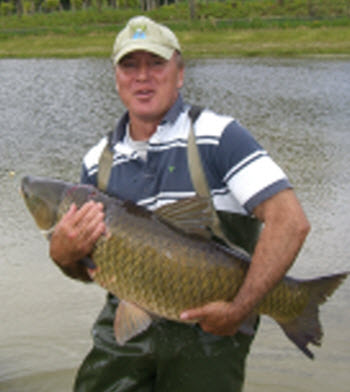
The carp (Cyprius carpio) is a wise and wily old creature. It has a lifespan of over 40 years, grows to weights in excess of 50kg in Europe, and in angling terms has long been considered the king of summer sport. The crafty carp grows large, fights hard and can tax the ingenuity of even the most skilled coarse angler.
To catch this seasoned campaigner, the angler must have both sound watercraft and an adequate understanding of the carp’s feeding habits. An examination of the carp’s mouth reveals two key attributes: first, its downturned mouth shows its natural feeding zone is the bottom; secondly, the four barbels around a carp’s mouth, which are packed with nerve endings and taste buds, show the carp to be both very sensitive to its surroundings, and also a sucker for a bait with flavour!
Like a cat uses its whiskers, the carp’s barbels, located two at the corners of the mouth and two smaller ones on the upper lip, pick up signals from the water about changes in its environment. A carp uses its barbels to great effect, exposing the discreet attempts of many a poor angler to fool it.
But as well as sensitive nerve ends, the barbs are brimming with taste buds. The carp’s taste senses are so acute that, as I can testify after a very mixed day’s sport recently, it can easily distinguish between salted and unsalted kidney beans! This creature’s taste in food borders on the connoisseur of haute cuisine!
Carp live in still waters of all kinds and also some slow-running rivers. Fry feed on plankton and water fleas, but adult carp with their sensitive feeler barbels and vacuum-like mouths are best suited to bottom feeding. In cooler weather they sift soft, muddy bottom sediments foraging for snails, crayfish, shrimps, mussels, bloodworms and also vegetable matter. A good indicator of a carp on the feed is the cloud of mud it throws up as it roots around the pool bottom for food.
However, in warmer weather they are also prone to forage in mid-water, and as can be spotted on lazy summer afternoons, they sometimes come up to the surface for floating food, sucking sounds and swirls a dead giveaway to their presence.
Boilies and other baits
Due to the continual bombardment of popular waters, the intelligent carp has grown used to familiar baits, so anglers have conditioned the fish to accept artificial baits including meats, potatoes, pulses, fruits and synthesised boilies. Boilies are specially flavoured high-protein balls, which can be coloured and flavoured differently each fishing trip to stay one step ahead of the cautious carp!
With a diameter of anywhere between 10 and 20mm, boilies have been developed by carp specialists to avert the unwanted attentions of smaller fish. After all, there are fewer more frustrating experiences for a carp angler than striking into a fish and feeling the sinuous squirms of an unwelcome eel!
Boilies have the advantage of a hard-boiled, shell-like exterior which does not crumble and attract smaller nuisance fish. They can easily be threaded onto sizes 4 to 8 hooks with the aid of similar diameter needle to keep the boilie intact.
Like boilies, sweetcorn – due to its size – is a selective bait that’s very effective for carp; their sensitive taste buds are stimulated by the sweet aroma the kernels give off. Tinned corn is not only yellower and therefore more attractive to carp, it is usually saturated in a sweet, sugary juice very much to our fishes’ liking. This juice can also be used to mix the groundbait into a paste. Fished over a bed of groundbait and loose bait, this sweet corn can often be a very effective enticement.
Groundbait
Groundbait (breadcrumb/biscuit crumb-based paste) and loose bait are essential in prompting feeding in warm, summer water. A little and often is a useful guideline, as the angler wants to tempt the fish into the swim without filling them up! It is best to be quite sparing in your baiting – perhaps only the odd ball of groundbait and a dozen sample loose baits every 10 minutes or so to provide a steady stream of feeding.
The carp hunt
In preparation for our carp hunt, Steve and I had baited the swims the night before, knowing that the optimum time to take carp is at dawn. The swims we had chosen were hidden in-cuts, surrounded by vegetation and the margins of a lily bed. Features, rather than open water, provide the perfect feeding ground and cover for carp.
The next day, under a growing blanket of heat and a glimmering sheen of sunshine, mad dogs and fishermen went out to have their fun. As ever, we approached the water stealthily. Swim spotting and baiting, like soft footfalls, is all part of the coarse angler’s watercraft armoury.
Excitingly, we spotted a good specimen shouldering its way through the weedbeds prospecting for food. Hugging a nearby patch of water lilies, the cautious fish was cruising like an unsullied, fat-bodied torpedo sucking the surface for a floating crust.
A hair-rigged size 8 hook to a 4lb trace with a raspberry boilie was Steve’s preferred method, the hair rig ensuring a more naturally presented bait. I opted for a size 6 hook embedded in a floating crust, perhaps one of the simplest and most enjoyable ways to catch carp. My trace of 5lb line was threaded from a weighted surface controller (like a weighted bubble float) to give the cast some distance. Casting beyond our swim and reeling back to avoid disturbance, we settled down amongst the vegetation, confident of a catch.
Action
We did not have to wait long. The fish we had spotted earlier was again patrolling our swim, so I reeled my bait closer to its course on the edge of the lilies. I temporarily lost sight of the bait, but after a brief wait, noticed my bubble float registering some activity. After several bobs the float gently sank from view. Following the lazy bite, and neat strike, the speed and strength of the run left me in no doubt that the quarry was a fleeing carp. The pace and power of the fish was awesome and presented me with a fearsome battle.
It headed immediately for the cover of the lilies and a sunken branch, I was faced with the decision of trying to halt the progress of the fish: not an easy decision given my light line. Knowing how easily carp are lost in snags, I decided to risk the turn. Slowing the outtake of line, it was all or nothing as I held my rod parallel to the water and nervously pulled against the racing fish. Fortunately, the carp turned and headed out into the depths of the pool. Every powerful tug and turn was reverberating through my light carbon rod.
After a lengthy and taxing fight, we landed the carp on the bank. Examining the ample specimen, it was little wonder the struggle had been so drawn out. The broad fins and muscular tail help to characterise the carp as both a good swimmer and a brave fighter.
The battle can be long and hard, and usually results in a long wait for the next cautious carp. Fortunately, Steve had chosen to fish deep just beyond my lily bed margin and did not have to wait long for an equally taxing struggle.
With a variety of rigs and baits, we managed to bank eight carp that session, all of healthy weights. Sitting in the sunshine on the edge of this beautiful and character-filled pool, I had to concede that sometimes fishermen don't exaggerate. New Zealand certainly does have some of the best coarse fishing in the world!
Your passport to this wealth of rich sport? A freshwater fishing license, available from most fishing tackle shops, or by phoning your local Fish and Game Council.
Here’s to many more Holy Grail days!
Coarse fish in New Zealand
New Zealand has several types of coarse fish available to anglers. Most species are quite widespread in still and slow moving waters. The North Island, particularly the Auckland and Waikato region, has the most comprehensive coarse fisheries and some waters are home to all species.
\Apart from carp (koi carp), other worthwhile angling species include tench, perch, rudd, goldfish, golden orfe, catfish and grass carp.
A Blast from the Past! This article originally appeared in NZ Fisherman magazine – February - 2000
A Blast From The Past!
|
February 2000 - by Ray Green |

Fishing Reports Visit Reports
Canterbury Fishing Report - 01/10/26
Freshwater season underway. Wow, it’s October already, and our freshwater season is underway, and the... Read More >
Top of the South Fishing Report - 01/10/26
Snapper about but not yet firing. It’s certainly nice to see daylight savings upon us... Read More >
Hauraki Gulf Fishing Report 01/10/26
Big reds in the shallows. The weather has made getting out on the water challenging... Read More >
Bay of Islands Fishing Report - 01/10/26
Snapper moving in. A few Pacific bluefin are still gracing the weigh stations with last... Read More >


Friday 2 October 2026
Major Bites
 - -
- - Minor Bites
 - -
- - Saturday 3 October 2026
Major Bites
 - -
- - Minor Bites
- -
Comments