
Beach fishing - Kontiki tips and tricks
- 3 Comments
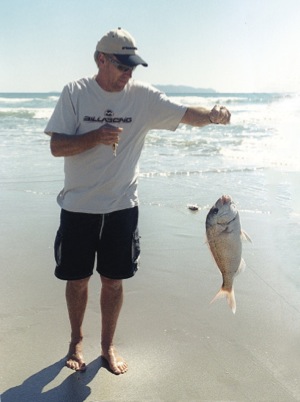
Accompanying the more pleasant conditions is an abundance of potential fish food gathering closer to shore in the form of various baitfish, small crabs, pipi and tuatua, small flatfish and so on. These morsels in turn coax predatory fish such as snapper, kingfish, trevally, kahawai, gurnard and smoothhounds into the reach of the beach angler.
However, not everyone has got the patience and time to become a successful surfcaster able to put a fresh fish meal on the table for family and friends. That’s where the kontiki comes in: it can increase your chances of success, while also providing an entertaining time for family and friends. What follows are some tips on tackle, baits, fishing location and fishing times, along with techniques I use or have seen used successfully to target desirable inshore fish species.
What's a kontiki?
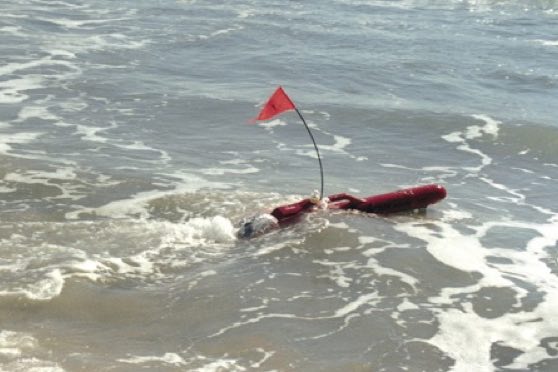
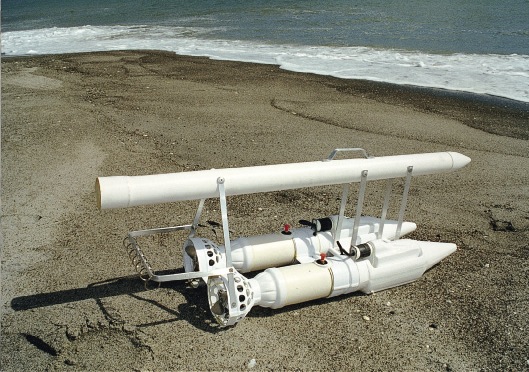
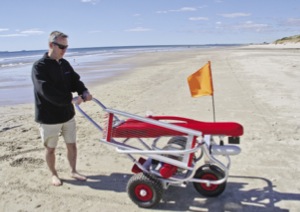
 A kontiki is a device used to tow a long-line armed with baited hooks through the surf into deeper water. It is propelled by either a sail in offshore wind conditions or, more commonly these days, an electric motor.
Motorised kontikis are becoming more technologically advanced. Generally powered by gel-cell batteries, they can be sent out in almost any sea and wind conditions, with GPS guidance enabling the correct course to be maintained. Having used this technology myself, I know it’s possible to consistently get a greater distance out of a time set – anywhere between 5 to 30 minutes and 300 metres to more than two kilometres – with less risk of crossing over other kontiki or surfcasters’ lines.
The kontiki tows out the baited hooks attached by either long-line clips in a crimped or stoppered section of line, or with triangles that enable baited traces to be set over a wider area. My friend Brian likes a combination of both clips and triangles, and he is a very successful kontiki fisher; it comes down to what works best for you and the area you’re fishing.
Between my long-line clipped traces, I attach 8oz weights: usually one at the start of my stoppered line, one in the middle, and one at the end. This keeps my baits near the bottom and slows the kontiki line’s drift once the kontiki has stopped at its programmed time. Then it’s a matter of waiting and watching the world go by until you retrieve your set.
There are no rules for how long you should leave your set – just be very wary if fishing a known hotspot, or you may end up catching more fish than you need or are allowed.
Tackle
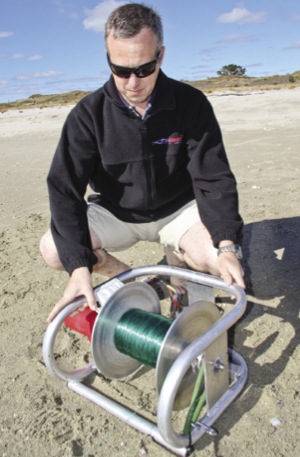
 The long-line reel: this should be either an electric winch or a hand reel ideally able to store up to – and in some cases over – 2000 metres of 140kg mainline. If you use a smaller reel that cannot hold that much line, then you may find you’re not able to deploy the kontiki to its longest timer settings due to lack of line.
An electric winch will haul your gear to shore much more easily, and saves good old ‘armstrong’ – especially for older folk, who might otherwise struggle to retrieve their line.
Long-line clips: The line should have a stoppered section around 150 metres back from your kontiki; now start clipping traces to this section – if you have 100 or more stoppers or crimps in your mainline, attach them three to four spacings apart. I prefer long-line clips myself, as they’re quicker and easier to attach/detach when setting a motorised kontiki that’s pulling out to sea at a fast walking pace. The only drawback is that all your traces are dumped in a 200-metre section; so, like my mate Brian, you could use both long-line clips and traces to mix it up a bit.
Traces: I like to use a trace line with a breaking strain of 18-27kg, and find Black Magic Tough or Fluorocarbon trace fits the bill just right. This brand possesses good wear-and-tear properties, holds its shape well, and presents the bait nicely.
I have started putting clear tubing onto my traces to stop them tangling while they’re heading out to sea and/or when fishing in more turbulent conditions. Tubing still allows a reasonably natural bait presentation and reduces the chance of nasties (sharks, eels etc) rolling up in your mainline. Also, I ‘bling’ up my traces with either small octopus/needlefish skirts or lumo tubing/beads set hard against the baited hook, same as with my surfcasting traces. I’ve said it before and I’ll say it again: lumo beads or lures charged up with a headlamp or torch as the traces are being deployed in the hours of darkness will out-fish non-lumo traces.
Hooks: The hooks I use are Tainawa circle-style long-line hooks in sizes 18 to 20, as: they hook neatly in the corner of a fish’s mouth (you can’t strike a fish on a long-line); their points stay sharper for much longer after being dragged over the shingle or sand many times over; they don’t rust as fast as chemically-sharpened hooks; and they cost about a third as much too.
Floats: Attaching a small float on your traces will keep baits off the bottom away from crabs and sea lice and can help your baits get noticed – but I seldom use them, preferring to use tougher, more durable baits instead.
Sinkers: As mentioned above, a few 8oz sinkers spread along the stoppered section between the traces is more than sufficient to keep baits near the ground and slow the line’s drift. I believe that setting one big sinker (say 24 to 32oz) not too far back from your kontiki is more likely to snag an obstruction. So if you’re concerned about getting fouled, attach the sinkers with a short length of light line (10-15kg) to a long-line clip/triangle to make it sacrificial.
Baits for species
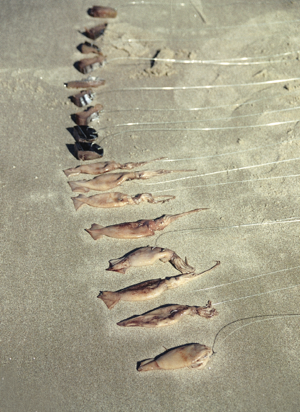
 A lot of this can depend on the locations you intend to fish and what inhabits them, but most species eat similar baits. Mullet, pilchard, mackerel, skipjack, kahawai, barracouta, trevally – all fish flesh baits – are eaten by snapper, kingfish, gurnard, trevally and cod, along with other less desirable fish such as barracouta, spiny sharks, eels (conger and blind), carpet sharks and rays. Baits like octopus and squid are fantastic for snapper, but rubbish for catching gurnard.
Shellfish baits such as mussels and tuatua will more likely be taken by fish like moki and trevally, but require bait-elastic to secure them to the hook, and still don’t last as long as fleshy baits.
Also, try paddle crab, raw prawns or crayfish tail baits, which attract moki, snapper and trevally, but provide the chance of catching some large smoothhounds or rig (lemonfish) too, which can grow in excess of 20kg and produce white, boneless fillets.
As you can see, the options are many and you have up to 25 hooks to fish with, so why not try a variety of them?
Another cost-effective option is to salt your baits down. For example, I like to salt down any surplus kahawai or barracouta fillets using rock salt. It firms up the flesh and preserves them for longer. Keeping them in the freezer rather than chucking them in a bucket on a shelf in the garage after salting keeps them in tip-top condition.
As far as bait size goes, about half the size of your index finger is just right. If you make them much larger, the baits spin and drag on the traces, causing more tangles.
Locations
 You can’t beat local knowledge, so if new to a fishing area, call in to a local tackle store and ask for some advice. Most outlets are more than happy to point you in the right direction and have staff with the expertise and knowledge, plus the latest reports on what’s being caught, where, how far to set, what baits to use, and which areas require care in relation to foul or snaggy ground.
The next best option is to purchase the Spot X book on surfcasting, which also has top kontiki spots specifically marked on it. It is a New Zealand-wide publication, so can be very handy when travelling around our coasts.
Always use binoculars to survey the area you’re about to fish, checking for any obvious surface obstructions such as cray pots or set nets, which on their own act as a snag, but can also indicate foul ground further offshore.
Also, be mindful of other beach users, especially surfcasters and other kontiki fishermen. Approach them for advice on where to set and find out which way the current’s going (if not using a GPS-equipped kontiki). They have as much right as you do to fish, so don’t be the silly bugger who crosses other lines for the sake of fishing exactly the same spot you had the great catch last time out. Beach etiquette – practice it, because some people aren’t as tolerant as others, and it can spoil a great day out.
Conditions
 The calmer the conditions, the better for kontiki fishing. It’s much easier to set and retrieve your gear when the swell’s low and the weather’s not blowing or raining. Also, the fishing’s harder in rougher, swelly, strong current conditions, your gear’s more likely to drift and possibly foul on a snag or another angler’s line, and the fish tend to be pushed further offshore. I’m not saying you won’t catch fish – after all, some of the biggest snapper I’ve seen caught have come out of rough conditions – but you generally catch fewer fish and more weed and rubbish.
Time of day
As with most fishing, change-of-light morning and night tend to produce better long-line hauls, with certain beaches – particularly from the Bay of Plenty north – fishing best in the hours of darkness using shorter sets (10 to 15 minutes). These beaches can require bigger sets during the day, but vary from location to location, so once again local knowledge is gold.
Safety
For your sake and others, it pays to erect a flag on the beach to indicate to other beach users nearby that you have a long-line set from shore. It also helps avoid crossovers. Use a strobe light for night-time sets, as your kontiki can become a hazard to boaties during darkness, while a brightly-coloured flag on the kontiki serves the same purpose throughout the daytime.
Take your time setting your kontiki in the surf, especially on steeply sloping shingle beaches notorious for strong undertows in rough conditions. In particular, pick your time to go down to the water’s edge to deploy the kontiki – wait for a lull in the swells, and if setting in rough conditions, it pays to wear a PFD (Personal Floatation Device) or lifejacket; your life isn’t worth losing for a fish.
As for a trace tangled while attaching it onto the mainline, it’s better to leave it as is, than possibly get a hook stuck in your index finger.
Snagged?
Hopefully you’ve done the practical things beforehand, insuring your fancy electric kontiki and labelling it all over with your details, so if lost to a snag, you’ll be able to replace it or it may be returned later on.
However, before getting to that point, if snagged, you may be able to rescue the situation. While pulling on the mainline to near breaking point is the common strategy, it can have its pitfalls. For a start, you may end up dragging the kontiki into the obstruction (sunken log, rock or wreck) so it doesn’t surface again, making it almost impossible to recover. So by all means pull hard, because you may have only fouled a couple of traces, but keep an eye on the kontiki – if it starts to pull under the water, stop straight away and look at other options.
Having a kayak as a standby is a good idea, as is phoning the local fishing club to see if a boatie can pick it up. Remember to reward the rescuer (I’ve had to do it in the past, and not just once either!).
Kontiki fishing can be a lot of fun; you never know what’s coming through the waves on your next hook. But remember, take only what you need if fortunate enough to have a good catch, and return any unwanted fish alive to the sea. Don’t leave them to rot on the beach, as they form part of the food chain, too.
 |
This article is reproduced with permission of |
Fishing Reports Visit Reports
Tauranga Fishing Report - 28/05/26
Tarakihi on the bite Trips are few and far between at this time of year,... Read More >
Canterbury Fishing Report - 28/05/26
Fresh and salt turning it on! It is not very often I get to say... Read More >
Bay of Islands Fishing Report - 28/05/26
Lures paying dividends We finally had a break in the SE winds that have been... Read More >
Manukau/West Coast Fishing Report - 28/05/26
Snapper and gurnard in the harbour The weather has finally taken a turn for the... Read More >


Major Bites
Minor Bites
Major Bites
Minor Bites
Comments