
Bait Fishing Basics

Like an occasional golfer, the average angler does not often find the time to do enough fishing to really work on their ‘handicap’. Sam Mossman runs through some of the basics that can make a difference to end-of-the-day results when bait fishing at sea.
A balanced rig
A rig is balanced when the rod, reel, line, trace and terminal tackle work well together and are customised to suit the particular fishing style they are being used for. Rods and reels are designed for differing fishing tasks, but there is considerable crossover. For example, a light spin rod with matching reel can be pressed into service spinning for kahawai, soft-baiting or stray-lining for snapper in moderate depths, catching baitfish like mackerel or yelloweye mullet, or casting for trout in fresh water.
Because of the wide range of possible requirements and applications, I suggest you find a knowledgeable and experienced staff member at your local tackle store and seek their advice. Explain the kind of fishing you want to do and give them an idea of what you are prepared to spend. New anglers may wish to start with a modestly-priced rig until they find out if they like fishing or not. But be aware that you get what you pay for, and reasonable quality tackle is easier to use than the cheap stuff, making the fishing itself more pleasurable.
.jpg)
Add a lumo bead or tube to your terminal tackle near the hook when fishing in deep water, where little light penetrates.
Presentations
There are no absolutes in fishing but, in general, fish are used to their food looking and behaving in a certain way. The more realistically you can mimic this natural presentation with your bait, the more likely the fish (especially the bigger specimens) are to bite.
Many people use trace material that is too thick. This makes it easier for the fish to detect and avoid. It is also stiff, which means the bait will not move naturally in the water. Taken to the extreme, when trying to loop hooks on to a ledger or dropper rig, the two thicknesses of line in the loop will not be able to fit through the hook’s eye. So, it is best to use lighter traces, but not so light that they cannot stand up to the teeth and skin of the fish, or to a little rubbing on rocks and weeds.
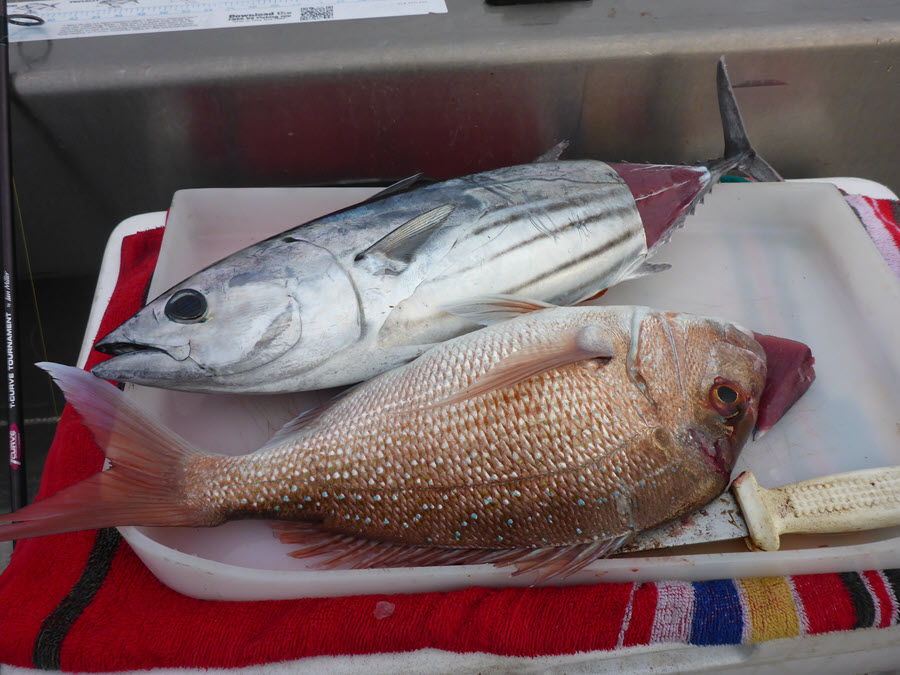
Skipjack tuna is a favourite cut bait for many species, including snapper.
Lighten up
It is relatively easy to catch small fish by using light line and trace, small hooks, and small baits. This is OK if you are trying to catch, say, jack mackerel or other baitfish; but is not a good strategy if you are fishing for species like snapper or blue cod. Many of the fish caught with small hooks will probably be undersized, and it would be necessary to return them. The handling, hook wound, and possible decompression damage caused might mean they do not survive and are wasted. Most table fish like snapper, blue cod, gurnard, tarakihi, kahawai, trevally etc, can be successfully targeted with hooks in the 4/0 to 6/0 sizes. Large snapper, hapuku and kingfish may require larger sizes from 7/0 to 9/0.
So, you need to find a balance – using an appropriate hook size, a leader thickness that is fine but still practical, and the lightest sinker that will get your line down to the fish in a reasonably efficient manner. However, your hooks, line and terminal tackle should not be so small, light, and fine that you catch a lot of undersized fish; and should be strong enough to handle bigger fish when you hook them.
Use modest leader weight (say 6kg for bait fish; 10-20kg for fish like snapper, cod, gurnard, kahawai etc; and 40kg for big fish like kingfish and hapuku/groper), hooks suited to catch legal plus-sized specimens of the species of fish you are after, and the lightest practical sinker. You’ll get more bites and catch more fish.
What bait?
Some fish will eat a wide range of food items and, consequently, there are some baits that can be used to catch many different fish species. These general-purpose baits include skipjack tuna (bonito), grey mullet, pilchard, and squid; along with baitfish like jack mackerel and piper – all good ones to start with.
Other species of fish prefer specific types of food like shellfish, crab or crayfish. These picky eaters include desirable species like blue moki and spotted smoothhound – which are well worth pursuing. Find out which are the common species of fish in your area and choose the best baits for them.
Some of these baits are easily bought at bait shops and petrol stations. Some baits you can catch yourself by gathering shellfish and crabs, or netting/hooking mackerel, mullet, piper, kahawai etc.
When rigging a bait on a hook there are several things to be aware of:
• Firstly, cut your bait in an elongated shape and hook it up at one end so that it streams nicely through the water and doesn’t spin. This will allow it to sink and be pulled in more easily, also helping reduce the chance of introducing twist into the line.
• If the bait is soft, use a piece with the skin still on and pass the hook through twice so the point and barb end up protruding from the flesh side. This will make the bait harder for the fish to pull off the hook (giving you a better chance of catching it).
• Don’t choke the hook with too much bait or you will reduce the chance of the hook point taking hold.
• After baiting the hook, check that you have no fish scales impaled on the point that can make it more difficult to hook the fish.
• Soft baits like shellfish, crayfish or pilchard can be bound to the hook with bait elastic or sewing cotton to make the bait more robust.

Cut baits in an elongated shape and hook them through one end so that they stream nicely.
Bigger baits, bigger fish
My home waters are primarily a snapper fishery. I fish mostly for the table and choose not to target the true monsters, preferring prime-eating fish in the two to four kilo range. While there are no absolutes in fishing, this is a truism: if you use bigger baits, you will, overall, catch bigger fish. This is partly because the smaller ones cannot take larger baits in their mouths, although they can nibble away at the edges. Another reason that bigger baits will help you avoid small fish is that you will need to use bigger hooks with big baits so that the hook points are not choked.
Large baits may be fished off ledger (dropper) rigs, running rigs, or under floats. You may need to beef up the trace and hook size to match your potential target. I like to cast out a big, tough bait such as half of a jack mackerel, rigged on two large hooks (one a circle hook), and set the rod in a holder, leaving it there until a fish hooks itself. This is so I am not enticed into striking too soon, before the fish has taken the bait properly. Although a reasonable drag needs to be set on the reel so the fish will hook itself, don’t set it so heavy that the line can be broken, or the rod dragged away if a big fish strikes.
Livebaits
The use of smaller, live fish as bait is a very effective technique, one that most predatory fish cannot resist. Common live baits include jack mackerel, yelloweye mullet, small kahawai, and piper, but most small fish can be used at a pinch (assuming they are of a legal size for the species).
Depending on the size of the bait fish, a wide range of predatory inshore fish can be hooked, including snapper, john dory, big kahawai and kingfish. Less popular live-bait catches are several different shark species, barracouta, and even stingrays, although the teeth of some of these fish will often allow them to bite through nylon monofilament traces.
Some ways of rigging live baits are shown hereabouts.
Time and tide
Although there are plenty of exceptions, fishing tends to be best early and late in the day. This is because the light levels are low – the sun is at an acute angle to the sea’s surface at these times, and much of the light is reflected away. When conditions are gloomy, predatory fish (usually the species you want to catch) take the opportunity to hunt. Also, your terminal tackle is harder for the fish to see.
The best tide to go fishing may vary from spot to spot, but tidal movement is the most important thing, as the current flow spreads a scent trail from your bait and berley, attracting fish and making it easier for them to find your offering. At beaches, wharves and other inshore areas, an incoming-to-high tide is thought to be best as it allows fish to hunt in rich feeding areas that were too shallow for them when the tide was lower.
Overall, the best conditions are usually when a productive tidal phase is combined with low light (early or late in the day).
.JPG)
Fishing tends to be best early and late in the day.
Berley
Make no mistake, when using baits or livebaits, the use of a berley trail to attract fish and get them feeding can make a huge difference to your fishing results.
When we were kids, we used to pulp stale bread with water and drop it in to attract yelloweye mullet at the local wharf. These days, we mince up old fish remains (preferably oily stuff such as skipjack) with any other marine remains (i.e., scallop frills, paua gut, old baitfish etc.), and maybe add fish oil and pig or chicken pellets to bulk it up. The resulting mishmash is frozen in ‘berley bombs,’ which can be deployed in net bags at the surface, or weighted and set down deeper, depending on the situation. Alternatively, you can buy the finished bomb at bait shops and service stations.
As the bomb slowly melts, it gives off a trail of scent and particles that drift off down the current. Any fish crossing the trail will swim up-current to its source, where your baited hooks hopefully are.
But, berley can be a double-edged sword. Do it wrong and you can berley fish away from you. For example, if deploying berley at the surface in a strong current and/or deep water when targeting bottom-feeding fish, the berley – and the gathering of fish it creates – will be a long, long way from where you are fishing by the time it sinks down to the seabed. Or, if you tie a berley bomb to your anchor chain when a side wind is holding the boat at an angle to the current, the berley trail will be off to the side of the boat – away from where your straylined baits are, directly down-current of the boat.
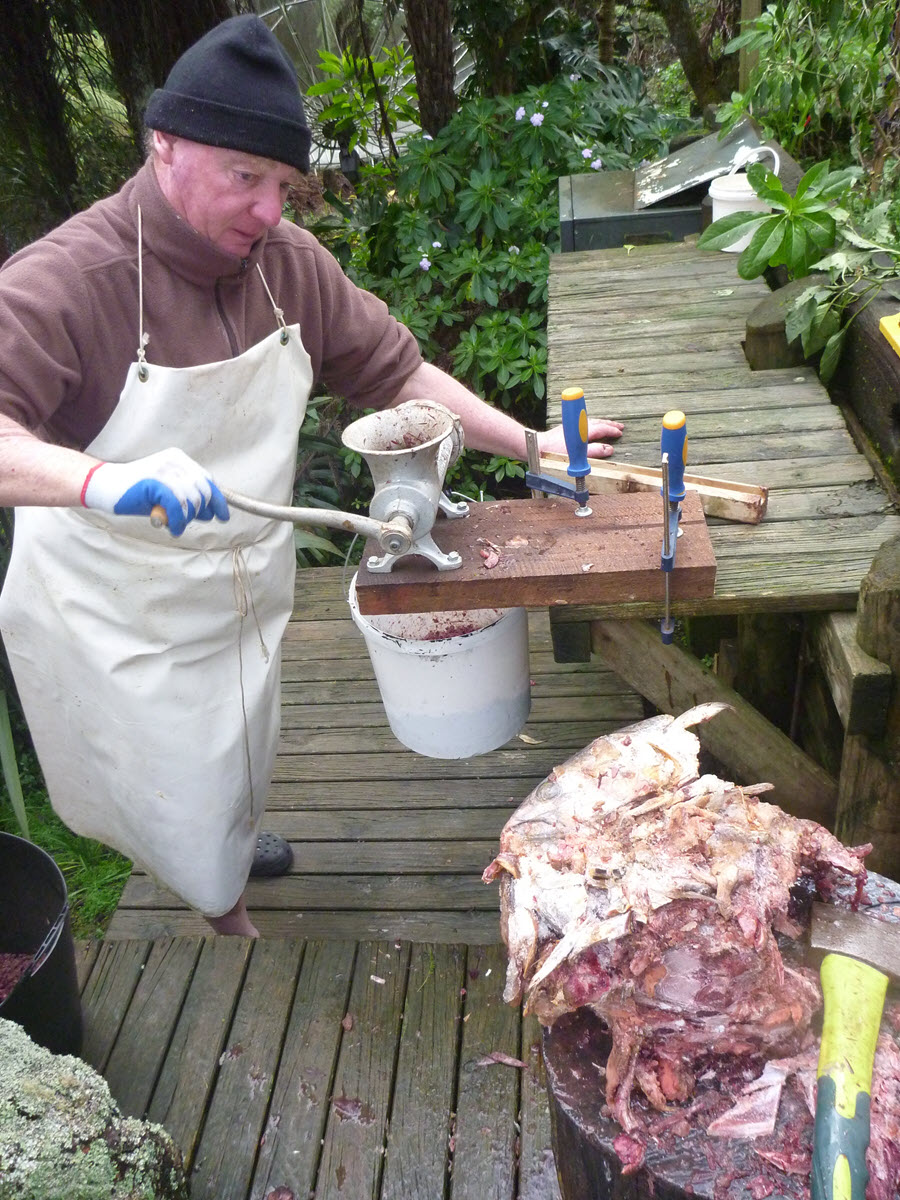
Mince up old fish frames with any other marine remains and add fish oil and pig or chicken pellets to make your own berley.
Let there be light
Small prey items like larval fish, shrimp, or krill fish are attracted to light, and larger fish are attracted to these gatherings. Just go out on any illuminated wharf at night and you will see what I mean.
While fish such as jack mackerel will come in around very bright lights, the subtle glow emitted by luminous beads and painted terminal tackle seems to be more attractive to fish such as snapper and gurnard than the bright light given off by sources like light sticks. It is always a good idea to add a lumo bead, tube (or sinker, depending on the rig) to your terminal tackle, especially near the hook, in low-light conditions and in deep water where little light penetrates.
Years ago, I started painting my running sinkers with glow-in-the-dark paint when stray-lining for snapper in the evening. It was a sure bet that the last couple of fish hooked as the light disappeared would be caught on an outfit with a glowing sinker.

June 2022 - Sam Mossman
New Zealand Fishing News Magazine.
Copyright: NZ Fishing Media Ltd.
Re-publishing elsewhere is prohibited
Fishing Reports Visit Reports
Canterbury Fishing Report - 01/10/26
Freshwater season underway. Wow, it’s October already, and our freshwater season is underway, and the... Read More >
Top of the South Fishing Report - 01/10/26
Snapper about but not yet firing. It’s certainly nice to see daylight savings upon us... Read More >
Hauraki Gulf Fishing Report 01/10/26
Big reds in the shallows. The weather has made getting out on the water challenging... Read More >
Bay of Islands Fishing Report - 01/10/26
Snapper moving in. A few Pacific bluefin are still gracing the weigh stations with last... Read More >


Thursday 15 October 2026
Major Bites
 - -
- - Minor Bites
 -
- Friday 16 October 2026
Major Bites
- - Minor Bites
-  -
-
Comments