
Analysing flies
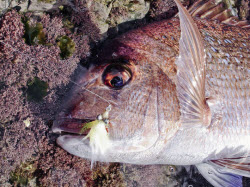 My client had picked a good day to go fishing. The weather was great and the swell conditions just right.
We were also starting to see some nice fish along the edge of the rocks. All I had to do was connect him with some of them.
This is where things started to go wrong.
Somehow, his flies weren’t working. The snapper were holding back and a little bit timid. It was hard to see what was going on. Eventually a nice snapper came up a little bit higher, charged at the fly and rejected it mere centimetres away from its nose.
This had me scratching my head. The flies he was using were his own home-tied creations modelled on some of my own favourite patterns. I had emailed him the instructions several weeks before the fishing day. Perplexed as to why they weren’t working, I asked if I could take a closer look.
A quick fly examination revealed commercial fibres I wasn’t familiar with: artificial marabou on the tail – not the real turkey-bum stuff – and expensive dumbbell eyes with inset holographic pupils that felt as light as aluminium. The fly looked good, but undoubtedly was not heavy enough, so was doing the wrong things in the water. Its sink rate was too slow and the mix of artificial fibres didn’t give it the same buoyancy characteristics in the tail as a marabou fly.
After a quick consultation with the client, I removed his fly and tied on one of my own. It was a stock-standard ‘Interceptor’ Clouser fly with a bright body skirt, solid dumbbell eyes and a big, thick marabou tail. This is a fly that I could guarantee to sink head-first. The dumbbell eyes on these flies are heavy enough to offset the extra buoyancy added by the marabou at the tail end. The head of the fly stays down, the hook is solidly inverted (hook point riding up), and the fibres of the marabou pulsate and wriggle upwards as the fly descends.
Once the fly gets down, the fly flicks head up/head down on the drift, with the marabou tail dancing wildly. This is thanks to the disparity between the buoyant tail and the heavy head of the fly. You don’t need to impart action into these flies, they just do it all themselves, even on what appears to be a ‘dead’ drift.
So I got the client to cast out this new fly, and we watched it go down. He followed my instructions to the letter: “a good cast, so the fly gets a decent drop into that deep hole, and no retrieve or resistance at all; just hold onto the line and be ready for the strike”. Sure enough, just as we were about to lose sight of the fly, a rusty-red snapper with glowing lavender fins came barrelling along from our right and absolutely nailed it. Fish on!
The client was mightily impressed. The guide was mightily relieved! The snapper was only about forty centimetres long, but it slammed the fly in a way that only snapper can, and put up a solid fly-rod bending battle. We were very happy to put it into the net.
That fish was very much a game changer. It was a strong reminder that “fly fishing success is not necessarily determined by what your fly looks like, but what it does in the water”.
At the fly-tying desk
It is at the fly-tying desk where the fishing success of all flies begins. If there is anything wrong with your fly – if it has come together with little thought to practical fishing application – then it may be a fly that represents nothing more than a wasted effort.
For example, it is important to match the dumbbell head weight in Clouser-style flies to the realised ‘keel’ weight of the hook bend and hook point. That is, the dumbbell eyes need to offset the weight and the keel effect of the hook bend and point in order to roll the hook over properly. If the dumbbell eyes are too light, the fly will travel on its side or, even worse, flick backwards and forwards from a hook-down to a hook-up position, depending on the speed of the retrieve at the time.
The dumbbell eyes can either be heavy enough to make the fly roll over, or light enough to allow the hook to remain in the hook-down configuration. Anything in-between gives you a fly that rolls around.
This dumbbell weight-selection process is very much influenced by the weight and gauge of the hook and the fly dressings attached to it. The original Clouser, for instance, was tied with bucktail deer hair on a fairly lightweight hook (Americans don’t have to deal with hook-crunching snapper). The deer hair is hollow and naturally buoyant. Tied as a wing across the gape of the hook, it encourages the point of the hook to sit in the upwards position. This allows quite light dumbbell eyes to be used, producing a fly that may be easier to cast and one that will have a quieter splash when it lands.
The bucktail is also a natural fibre that spreads upwards as the fly stops and then sucks back down as the fly moves, creating a ‘puffy’ style action with plenty of pulsating fibre movement. This is quite different to a Clouser-style fly tied with a stiff plastic artificial material with different suppleness and buoyancy characteristics. Sometimes artificial fibres simply aren’t a touch on the natural stuff.
So not all flies are equal – how a fly is constructed, and the materials used in its construction, all come together in a three-dimensional framework that determines how the fly will perform in the water and, ultimately, how good it will be at catching fish.
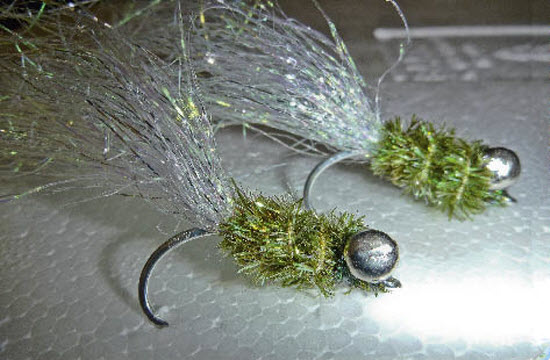
Not all good saltwater flies are complicated. This very simple pattern (I call it my ‘Frog’ fly) has proven very successful on kingfish and schooling snapper. It is extremely easy to tie. The Gamakatsu SL12S hook used in its construction is a moderately-heavy gauge hook. A solid pair of dumbbell eyes therefore ensures the fly rolls over in the hook ‘up’ position properly and that it sinks at a good rate.
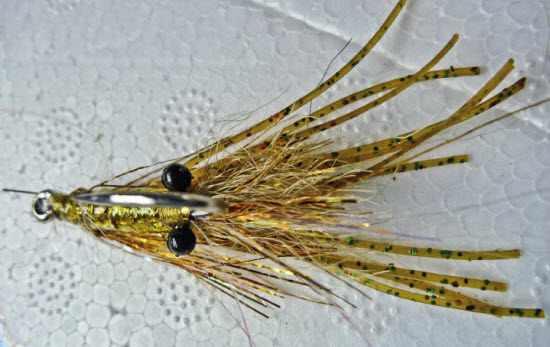
Sometimes good fly-tying ideas don’t go anywhere. This shrimp pattern had plenty of weight built into the body, but the extra buoyancy of the silicon legs rolled the fly onto its point when rested on the bottom. Since it was designed as a sand-skipping fly for species like porae and trevally, the fly was a failure. There is no sense in fishing a fly to a bottom-dwelling fish if the hook point is going to turn over and dig into the dirt.
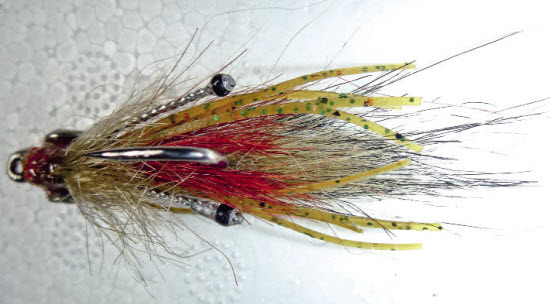
Experimental flies like this prawn pattern require plenty of testing before more are tied. First, it has to swim properly and then fish have to show their approval.
 |
This article is reproduced with express permission of
written by Craig Worthington - 2012 Originally published in New Zealand Fishing News |
Fishing Reports Visit Reports
Hauraki Gulf Fishing Report 11/06/26
Workups the best option mid-Gulf for quality snaps and kingfish Fishing across the Hauraki Gulf... Read More >
Bream Bay Fishing Report - 11/06/26
Normal transmission returns! It seems only the hardy have been wetting a line these last... Read More >
Raglan Fishing Report - 11/06/26
Solid snapper hook-ups out deep With the continuation of more settled weather there’s been some... Read More >
Canterbury Fishing Report - 11/06/26
Brave the cold, reap the rewards With a big southerly blow through here yesterday, it’s... Read More >


Major Bites
Minor Bites
Major Bites
Minor Bites
Comments