Trailers
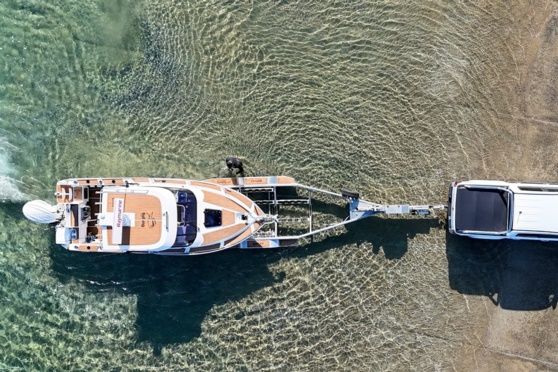
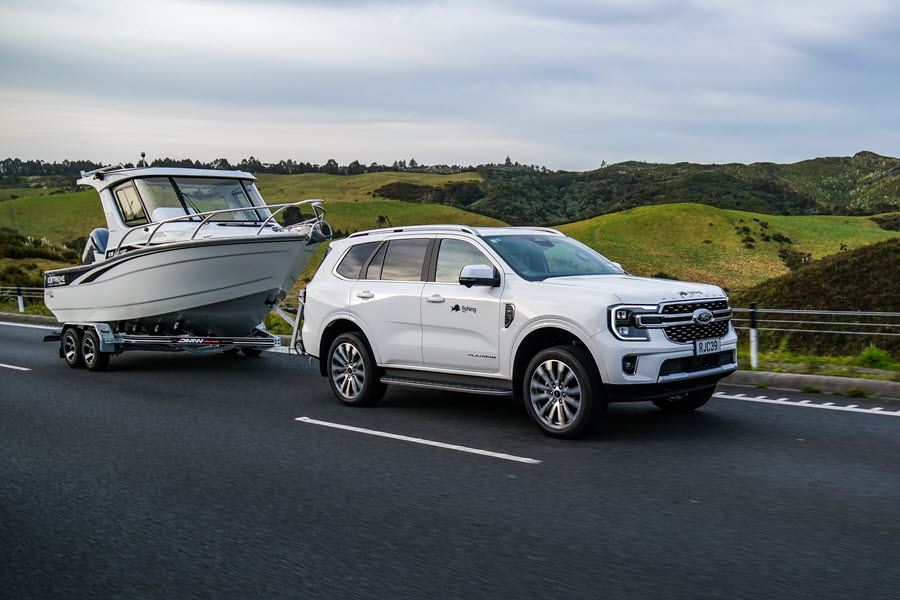
What is a trailerboat without a trailer? Obviously, you need one to get the boat to the water, and they allow a boat to be relatively easily and quickly moved to different areas of the country. A bluefin tuna bite at Waihau Bay? You could be fishing it tomorrow. A nice weekend looming? Off you go to Taupō or Wanaka. To take your boat any distance without hassles, a trailer needs to be robust, well-designed, and fit for purpose.
What kind of trailer?
In New Zealand, all trailers are made from either steel (galvanised to give protection from corrosion) or aluminium. More and more Kiwi buyers are choosing aluminium trailers to hold their pride and joy due to the material’s increased corrosion resistance and lighter weight over comparable steel designs.
Main frames are typically an ‘A’ shape and made from either box section, ‘C’ section, or ‘I’ section. While not as strong as box section of the same size, both ‘C’ and ‘I’ sections have the advantage of being easier to wash any salt off.
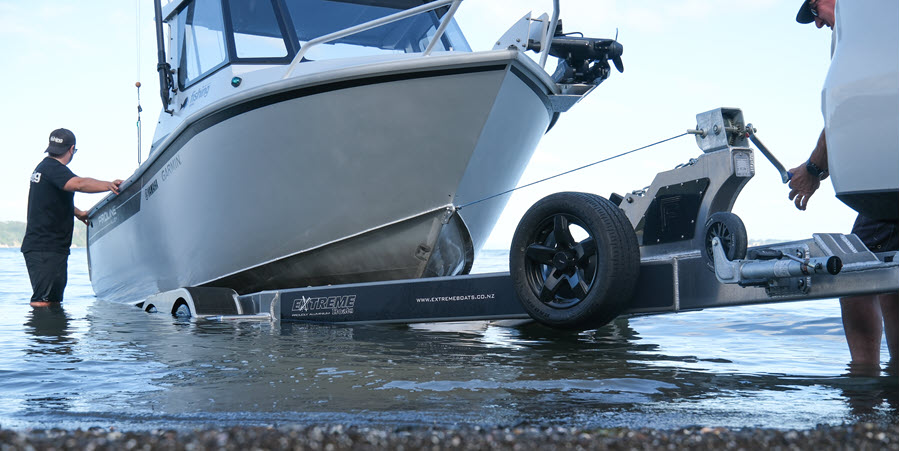
Extra strengthening can be added to a trailer by adding bracing, called ‘gusseting’, on sections where stress may be concentrated. There are some excellent New Zealand trailer manufacturers spread throughout the country, and some boat builders make trailers specifically for their boats.
Boat trailers may be fitted with single, tandem, or triple-axle suspension, depending on the weight of the boat. Suspension types are usually leaf spring or torsion. The number of leaves in the leaf spring type differs according to the weight of the boat. Torsion systems are more expensive, but leaf springs, despite being mostly zinc-protected, tend to rust out more quickly.
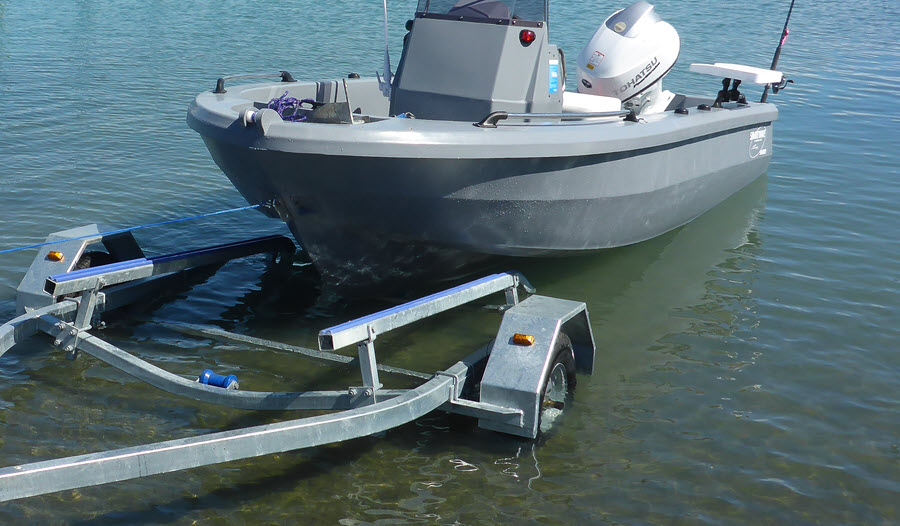
Most trailers are fitted with some combination of inline rollers, wobble rollers, or bunks (also called skids). These last are usually covered with a slippery plastic strip, like polyethylene or Teflon, to help the boat slide along them. Older boat trailers may use marine carpet. Bunks support the hull over a larger area and are preferable for plastic hulls, avoiding damage caused by pressure points; however, rollers make it easier to pull a medium to large trailerboat onto the trailer using a winch. Rollers, obviously, need to roll to do their job!
Loading options
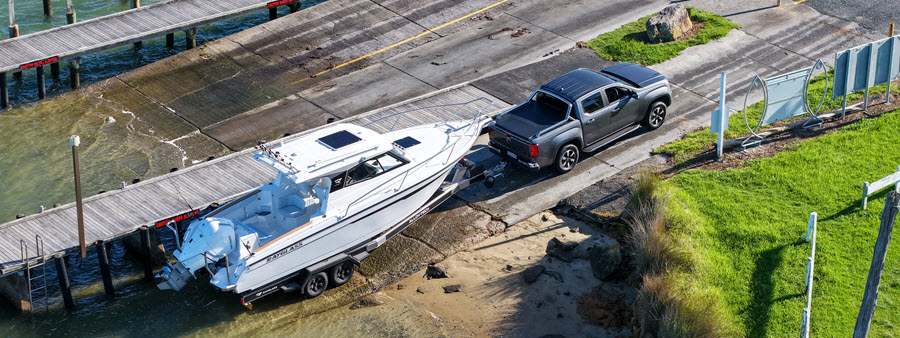
One way to put a boat on its trailer is to drive it on with the engine. Usually this is at a boat ramp. As long as the driver is experienced, conditions (wind, waves, and currents) are calm, there is sufficient slope/depth to protect the propeller, and local rules permit (this system is banned in some areas because of the damage caused by prop wash), driving a boat onto the trailer is a useful method, especially for larger craft with trailers incorporating a boat latch system.
Most commonly, especially with trailer boats below six metres, the boat is pulled onto the trailer with a manual winch mounted on a post at the front of the trailer. Larger winches often have two gears, so a lower ratio can be chosen if the boat is heavy.
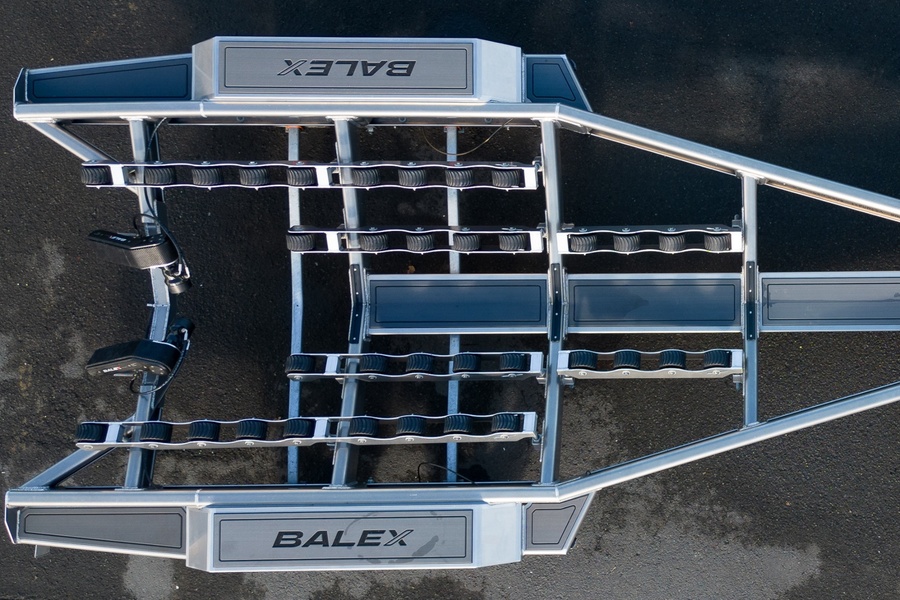
Heavier craft may need an electric winch to pull the boat onto the trailer, and this can be operated by a dedicated battery or the tow vehicle’s electric system.
A clever New Zealand invention is the Balex Automatic Boat Loader. This battery-operated system essentially consists of a pair of powerful remote-controlled miniature conveyor belts that lift and drive the boat onto the trailer in conjunction with the trailer’s rollers.
Guide poles, which project upward from the sides of the trailer, can be a useful aid to loading as they help guide the boat squarely onto the trailer when there is a side wind or current.
Check the coupling size
When buying a trailerboat, check the trailer coupling, as New Zealand uses two different towball sizes: the older 1⅞-inch standard and the newer 50mm metric size. While they look almost identical, they are not interchangeable. The towball fitted to your vehicle must match the coupling on the boat trailer exactly. While a 1⅞-inch coupling will not fit on a 50mm towball, using the smaller 1⅞-inch ball with a 50mm coupling, for example, can result in a dangerously loose connection and the trailer potentially becoming detached. Check the size stamped on the coupling and towball, and ensure both are correctly rated for the trailer's loaded weight. If you own multiple trailers with different coupling sizes, interchangeable or dual-size towballs are also available.
Other fittings
Jockey wheels, mostly wind-down models that help lower the coupling onto the tow ball and lift it off, are standard on most trailers. This can also be used to lift the boat’s bow on the trailer so the boat drains properly when washed.
Boat trailer lights are nearly always submersible LED types which are attached to the tow vehicle’s lighting system with a seven-pin flat plug. Be sure you have a compatible vehicle and trailer lighting system and that everything is working okay.
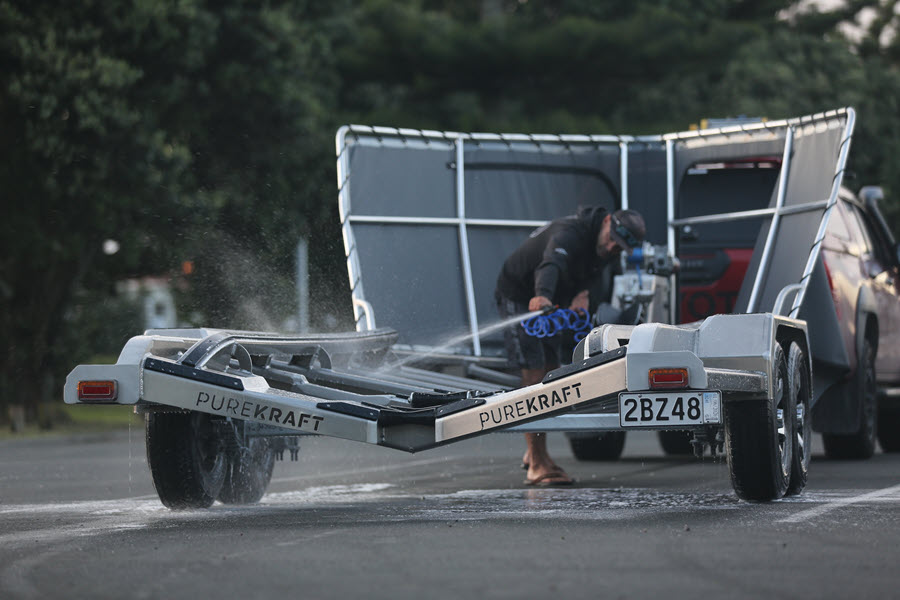
Some trailers are fitted with a central walk board that makes it easier to walk out and attach the winch cable to the front of the boat when retrieving; useful in some cases, especially if you are trying to avoid a wave over the top of your gumboots!
A spare tyre provides peace of mind for longer road trips, and some new trailer models include washdown tanks/systems or plugs to help keep the salt away.
Trailer brakes and safety chains
New Zealand’s trailer braking requirements depend on the trailer's gross laden weight (GLW). Trailer loads weighing up to 2,000kg must have either a securely attached safety chain, or a breakaway brake. Trailers over 2,000kg require service brakes (direct or indirect) acting on each wheel of at least one axle. They must also have either two safety chains that cross when connected or a breakaway brake. Trailers weighing 2,500-3,500kg also require a parking brake acting on at least one complete axle. Check that brakes, couplings, and chains are in good condition, correctly rated, and securely fitted, and that the towing vehicle is rated for the boat and trailer's laden weight. Whatever the setup, the law requires that every light vehicle and trailer combination must be capable of stopping the towing combination within seven metres from a speed of 30km/h.
Besides the braking regulations for the trailer, be sure the tow vehicle is rated over the tow weight of the rig. The maximum open-road speed when towing in New Zealand is 90km/h, although conditions may require travelling slower, and trailers with under 3,500kg GLW must have a current Warrant of Fitness (WoF) and registration (rego).
Click here for a more complete rundown on the New Zealand rules and regulations for light trailers (under 3,500kg GLW).
Towing the big guns
Once the trailer's GLW exceeds 3,500kg, it is classed as a heavy trailer (Class TD), and towing requirements become more involved.
- Driver licence: You need a Class 2 licence to tow a heavy trailer behind a heavy rigid vehicle, subject to the licence class and combination requirements.
- Towing vehicle: The tow vehicle must be rated and legally configured for the weight of the trailer and combination. A heavy trailer cannot simply be towed by any vehicle with a large, advertised towing capacity.
- Brakes: Heavy trailers have more stringent braking, parking brake, and coupling requirements, and must meet the relevant heavy-vehicle standards.
- Certification: Heavy trailers are subject to Certificate of Fitness (CoF) requirements rather than the light-trailer WoF regime.
- Mass and dimensions: Axle loads, gross vehicle mass, dimensions, load security, and potentially road-user charges (RUC) become relevant.
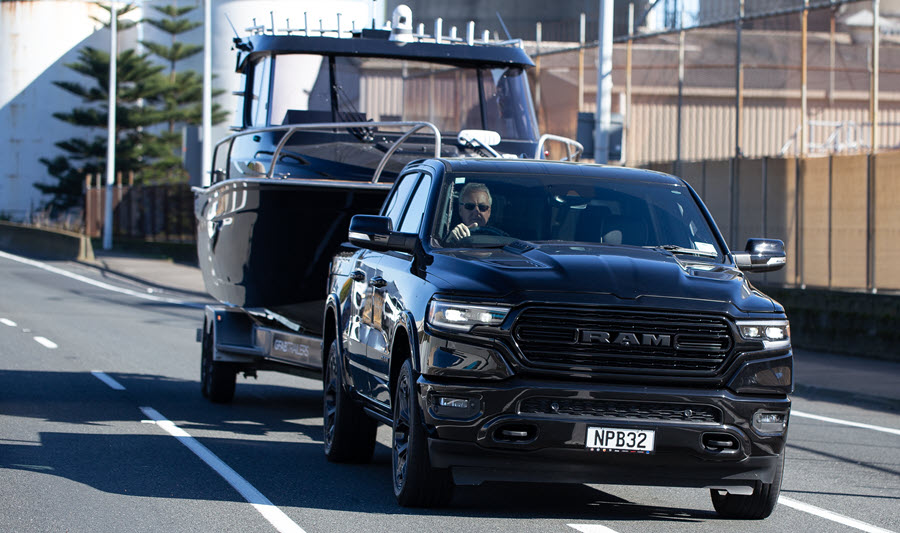
For trailerboat owners, the practical takeaway is that a boat and trailer exceeding 3,500kg loaded calls for a distinct towing vehicle, licensing, trailer certification, and compliance arrangements. Don't rely solely on the tow vehicle's advertised towing capacity!
‘Get out of jail’ towing kit
- Trailer/vehicle jack
- Wheel chocks
- Tyre iron
- Spare tyre
- Rag
- CRC/lubricant spray
- Spare prop flag
- Adjustable spanner
- Headlamp
Common Questions
Should I choose an aluminium or galvanised steel boat trailer?
Aluminium and galvanised steel both have advantages when it comes to boat trailers. Aluminium is lighter and offers excellent corrosion resistance, making it particularly attractive for boats regularly launched in saltwater. Galvanised steel is generally less expensive and offers good strength and durability, although it is heavier and can be more susceptible to corrosion over time. The best choice depends on your boat's weight, intended use and budget.
What is the best way to load a boat onto its trailer?
Most smaller trailerboats are retrieved using a manual winch, which pulls the boat onto the trailer via a bow-mounted cable or strap. Larger and heavier boats may benefit from an electric winch or automatic boat-loading system. Rollers make it easier to winch a boat onto a trailer, while bunks provide greater hull support. Guide poles can also help keep the boat correctly aligned during retrieval, particularly in crosswinds or currents.
What safety requirements apply to boat trailers in New Zealand?
Boat trailers in New Zealand must meet requirements for braking systems, safety chains, coupling connections, lighting, registration and warrants of fitness. Requirements depend on the trailer's gross laden weight (GLW). Trailers up to 2,000kg GLW must have a securely attached safety chain or breakaway brake, while heavier trailers have additional braking and safety requirements. It's also essential to ensure your tow vehicle is rated to safely tow the fully loaded boat and trailer.
Continue Reading


Sunday 29 November 2026
Major Bites
 -
 -
Minor Bites
 - -
Monday 30 November 2026
Major Bites
- - Minor Bites
- -