
Electronics

Modern trailerboats are increasingly well equipped with electronics, but with so many different products, technologies, and acronyms on the market, knowing what does what can be confusing. Whether you're setting up a new boat or upgrading an existing installation, understanding the basics will help you choose equipment that suits the way you fish and boat.
Chartplotters and fishfinders
Although often combined in one unit, chartplotters and fishfinders perform two quite different functions. A chartplotter uses electronic charts and GPS positioning to show where you are, where you're going, and the underwater contours around you. It allows you to mark fishing spots, create routes, follow tracks, and navigate safely.
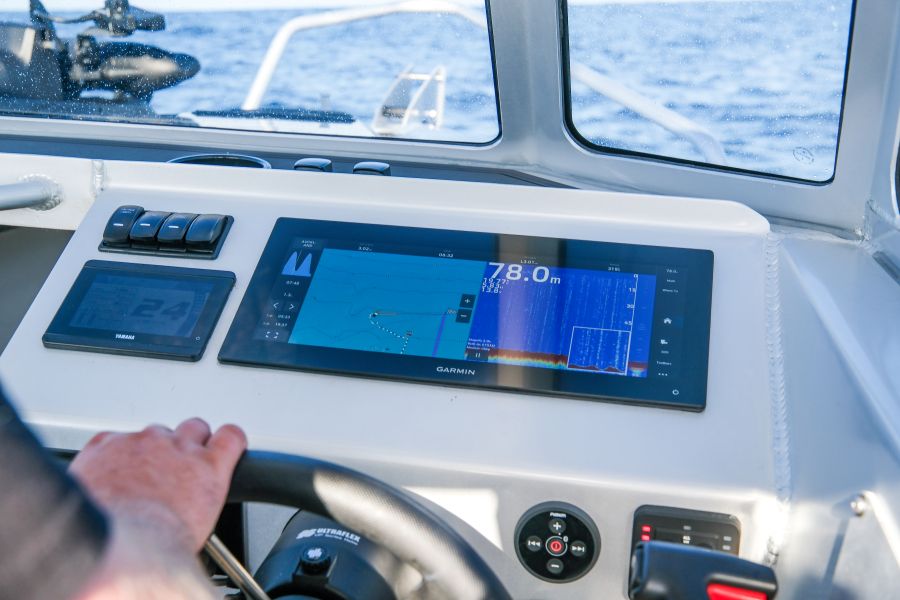
A fishfinder uses sonar to send sound waves beneath the boat and interpret the returning echoes. This reveals bottom structure, depth, bait schools and, depending on the technology and settings, individual fish. Depending on the model, Traditional, CHIRP, DownScan and SideScan, and Live sonar offer different ways of viewing what's beneath or alongside the boat.
Multifunction displays (MFDs)
An MFD brings several electronics functions together on one screen. Depending on the equipment connected, it can display charts, sonar, radar, engine information, autopilot data, audio, cameras, tides, weather, oceanographic conditions, and other onboard systems. Rather than having separate screens for every function, an MFD provides a central hub for managing the boat's electronics. Compatibility between manufacturers and products is important, so check networking requirements before purchasing. NMEA 2000 is a common networking standard that allows compatible devices to share information.
Transducers
The transducer is the component that makes sonar possible. It converts electrical energy into sound waves and receives their returning echoes. Transducer choice and mounting have a significant influence on fishfinder performance. A quality transducer installed incorrectly can perform worse than a cheaper model fitted properly.
Transom-mounted transducers are popular on trailerboats because they are relatively easy to install and maintain. Through-hull models generally provide excellent sonar performance but require a permanent hull installation. In-hull transducers transmit through the hull without penetrating it, although they are not suitable for every hull construction. Other options include trolling-motor-mounted transducers and specialised high-frequency models.
There are a wide variety of frequency, power, and beam angle transducer options available, and it pays to speak to a professional about what depths and styles of fishing you’re most interested in to ascertain the best option. For example, a narrow-beam, 1kW transducer might be great for hāpuku or swordfish fishing but might not perform well if looking for snapper in shallow water.
Radar
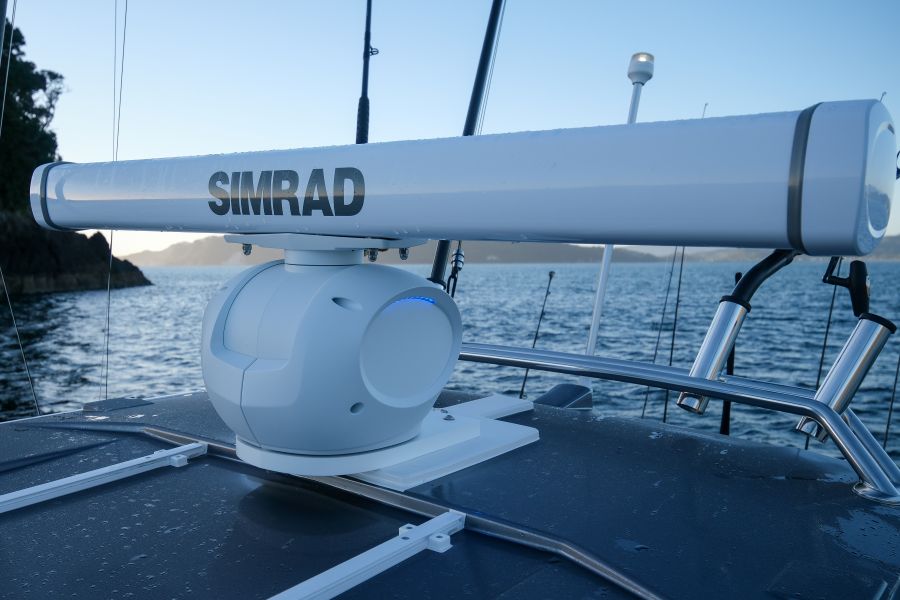
Radar uses radio waves to detect objects around the boat, making it particularly useful for navigation in darkness, fog, or poor visibility. It can identify other vessels, land masses, buoys, and weather systems, depending on the unit and conditions. Modern solid-state broadband and open-array radars offer different levels of performance, range, and resolution. For trailerboats, compact radar domes are a popular choice, providing useful capability without the size of larger commercial-style installations.
Communications
Communications should consist of at least two forms of communication, usually a VHF marine radio and a cell phone in a waterproof case or bag. A marine VHF radio is an essential safety item. It allows communication with other vessels, marinas, and Coastguard, as well as access to emergency channels. Fixed-mount units generally offer greater transmitting power than handheld radios, while a suitable antenna is critical for effective range.
Single sideband (SSB) radio provides longer-distance communication beyond normal VHF range, making it more relevant to offshore and extended-range boating.
Satellite communication devices and satellite messengers offer another option when outside conventional mobile coverage. Depending on the system, they can provide two-way messaging, weather information, tracking and emergency SOS functions. Some mobile providers like One NZ also allow satellite connectivity through compatible smartphones.
Wireless chargers or USB/USB-C ports for charging phones and other devices are a handy addition on any boat.
Emergency equipment
Emergency Position-Indicating Radio Beacons (EPIRBs) and Personal Locator Beacons (PLBs) provide a vital means of raising the alarm in an emergency. These devices communicate through the international Cospas-Sarsat satellite system and are particularly important when operating beyond reliable VHF or mobile coverage. They are safety equipment rather than general communications devices and should be considered an essential part of offshore boating preparation.
Batteries
Your boat’s battery setup is a critical installation. If you are running a decent amount of electrical equipment (or extra peace of mind), you will need a separate ‘house’ (deep cycle) battery which is independent of the engine start battery. Some larger boats with multiple engines and lots of electrical devices have three or more batteries. These should be connected via an isolating switching system that allows them to be linked if necessary.
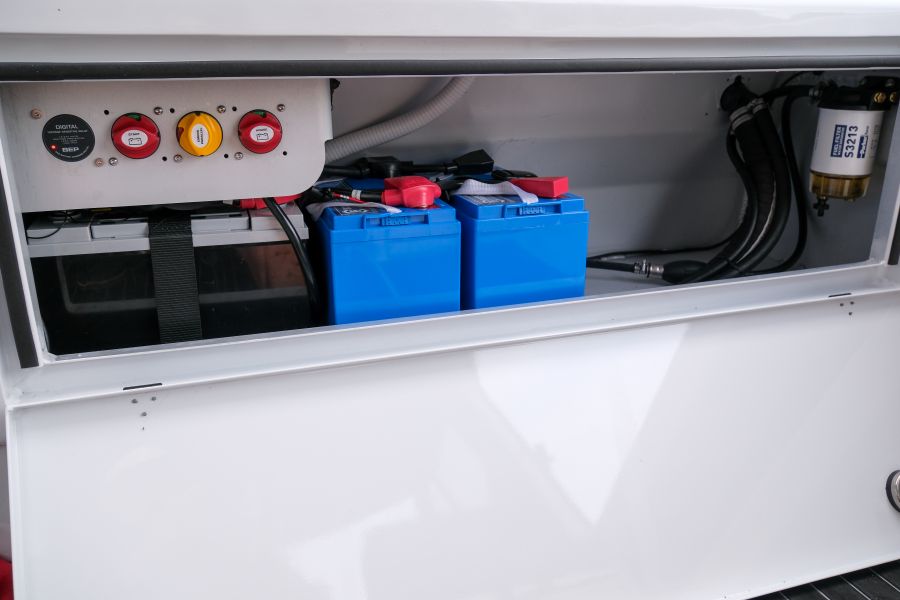
Be sure to use proper marine batteries, as they are built with heavier plates and bedding systems that can better tolerate vibration and hull-pounding than standard batteries.
The batteries need to be positioned in a raised position that is protected against swamping. A sealed locker in the transom wall is a good spot, preferably with the batteries strapped down inside a battery box. In centre consoles, often the batteries will be stored in the console itself to aid with weight distribution.
Electric Trolling Motors
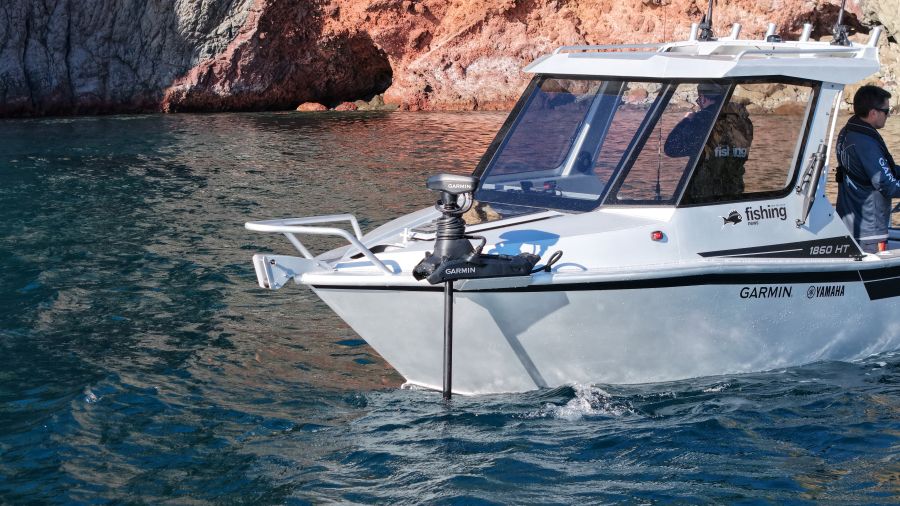
Increasingly popular among serious fishers, electric trolling motors provide precise, quiet boat positioning without running the main engine. Often mounted on the bow, they can hold a boat in position using GPS-based anchoring functions, follow contours, or maintain a set heading. Battery capacity, thrust, shaft length, and compatibility with existing electronics are important considerations.
Unlike conventional marine electronics, which generally draw relatively little power, trolling motors can consume considerable amounts of electricity, particularly when holding a boat against wind, current, or tide. Most electric trolling motors operate on 12V, 24V, or 36V systems. Smaller motors may run on a single 12V battery, while larger, more powerful models typically require 24V or 36V.
Lithium iron phosphate batteries have become increasingly popular for trolling motors. They are lighter than traditional lead-acid or AGM batteries, offer a greater proportion of usable capacity, and maintain relatively consistent voltage as they discharge. Their higher initial purchase price can be offset by longer service life and reduced weight.
It is also important to consider charging. Trolling motor batteries should ideally have a dedicated charging arrangement, such as a suitable onboard multi-bank charger, rather than relying on the boat's starting battery. Some systems can also incorporate alternator charging or DC-to-DC chargers.
Audio systems
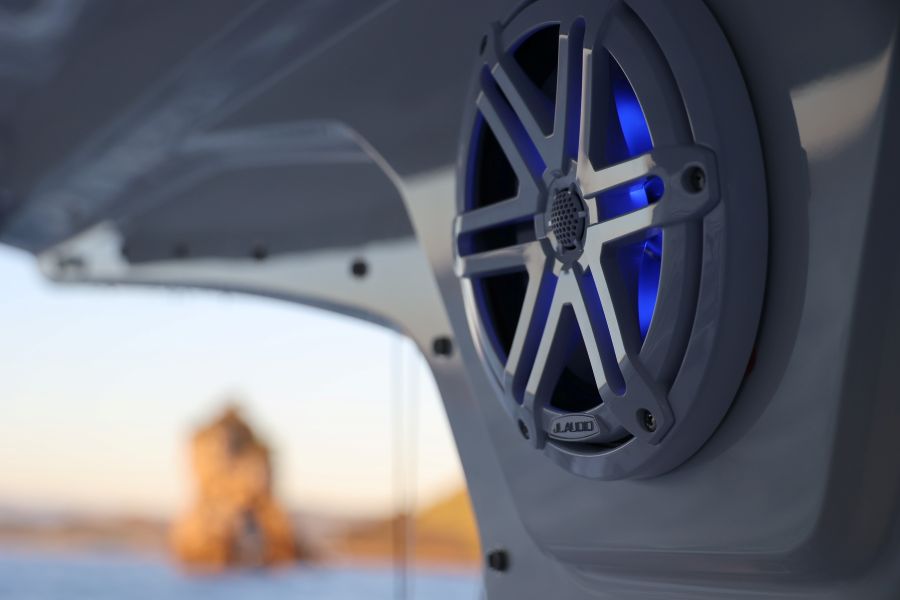
Marine entertainment systems have also become considerably more sophisticated. Dedicated marine head units, waterproof speakers, and subwoofers can provide high-quality audio while withstanding the harsh marine environment. Many systems offer Bluetooth connectivity and integration with multifunction displays. As with all onboard electronics, choosing equipment designed for marine use is important.
Autopilots
Once largely the preserve of larger launches and offshore boats, autopilots are increasingly available for trailerboats. They use GPS, heading sensors, and steering interfaces to maintain a selected heading or follow a programmed route. This can be particularly useful when travelling longer distances or trolling lures, allowing the skipper to concentrate on other tasks. Some systems can also integrate with chartplotters, making waypoint navigation straightforward.
Thermal imaging cameras
A relatively specialised option, thermal cameras detect heat rather than visible light. They can help identify vessels, people, and other warm objects in darkness or reduced visibility. While more commonly associated with larger offshore vessels, compact marine thermal cameras are becoming increasingly accessible for trailerboat owners. They can be particularly useful for offshore anglers making long runs before daylight or returning after dark.
Common Questions
What marine electronics do I need on a trailer boat?
The essential electronics for most trailerboats include a GPS chartplotter, fishfinder, marine VHF radio and suitable battery system. A combined chartplotter and fishfinder can provide navigation, depth information and underwater detail on a single screen. Depending on where and how you fish, additional equipment such as radar, an EPIRB or PLB, autopilot and electric trolling motor may also be worthwhile.
What is the difference between a chartplotter and a fishfinder?
A chartplotter uses GPS positioning and electronic charts to show your location, navigation routes, waypoints and underwater contours. A fishfinder uses sonar to identify bottom structure, depth, bait schools and fish beneath the boat. Although many modern units combine both functions in one display, they perform different jobs and use different technologies.
How do I choose the right transducer for my boat?
Choosing the right transducer depends on the type of fishing you do, the depths you fish and the sonar technology you want to use. Factors such as frequency, power, beam angle and mounting position all influence performance. Transom-mounted transducers are popular on trailerboats because they are relatively easy to install, while through-hull and in-hull options offer alternatives depending on the boat's construction. A correctly selected and installed transducer is essential for getting the best performance from your fishfinder.
Continue Reading


Sunday 29 November 2026
Major Bites
 -
 -
Minor Bites
 - -
Monday 30 November 2026
Major Bites
- - Minor Bites
- -