
Engines

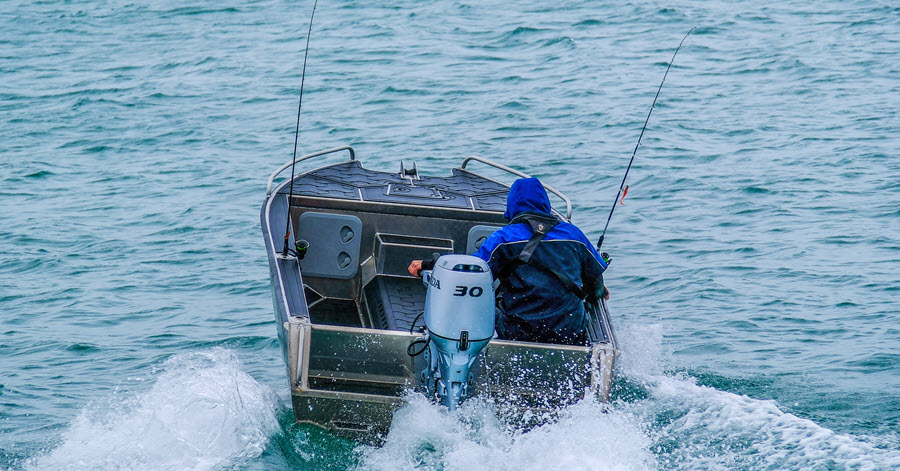
Smaller boats and outboard engines go together like cheese and crackers, but before the advent of the large outboards available today, bigger trailerboats needed to be powered by inboard engines, usually with tilting stern legs for launching and retrieving.
Outboard or inboard?
Diesel engines used to be preferred over petrol for larger boats because they were more economical to run, had a greater range, and the danger of fire or explosion was much reduced by the less volatile fuel. Many gamefishers also believe that the lower-frequency sound produced by diesels raises fish like striped marlin better.
But there are some downsides to inboards (as opposed to outboards): they are heavier, eat up cockpit space, and they can be trickier to service and repair due to tight installations. The capital outlay is higher too, so you may have to do a whole lot of running hours to claw back the higher initial cost of a diesel inboard engine through fuel savings. Diesel prices have also been catching up with petrol prices over time!
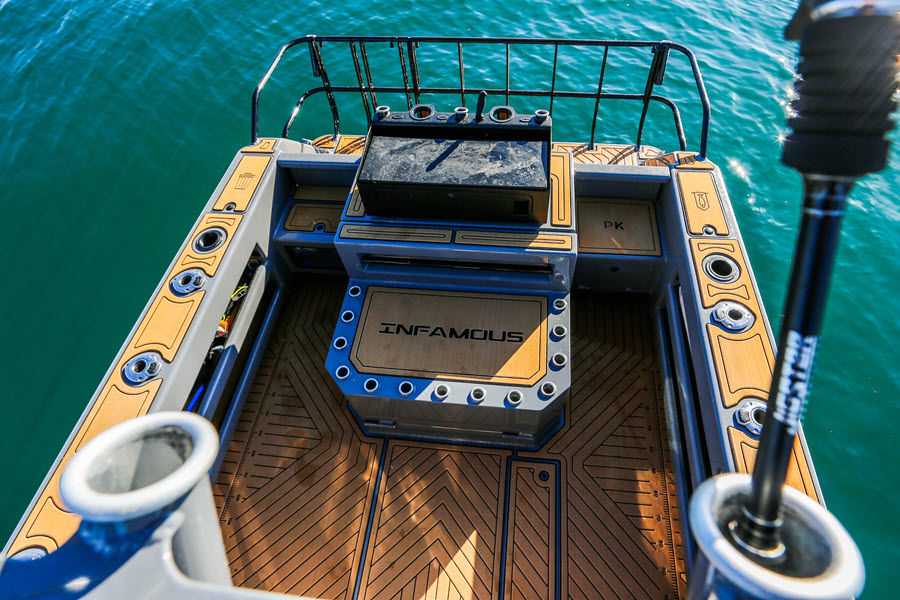
These days, the gap between inboards and outboards is closing. Diesel inboards are much more compact than they used to be, and engine/leg installations that run through the transom or include an under-deck jack shaft greatly lessen the impact on cockpit space. Outboards, on the other hand, offer increasingly higher horsepower, and their fuel efficiency keeps improving as engine technology advances.
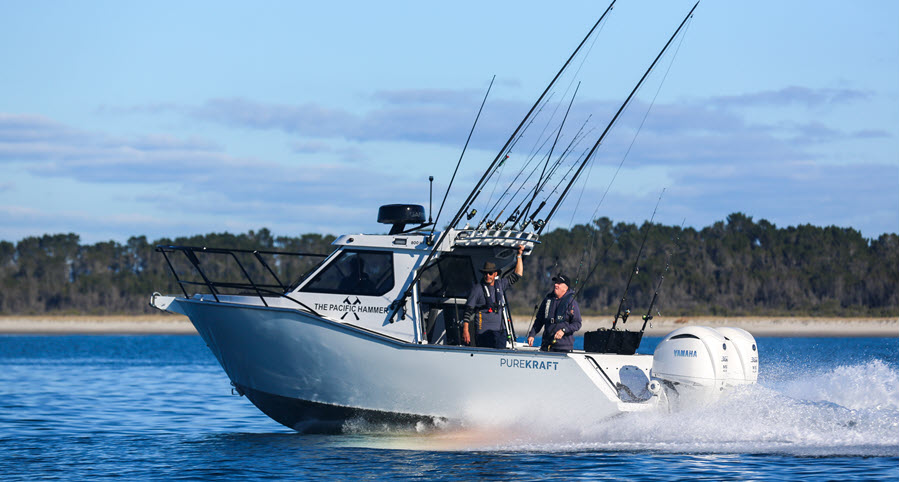
Most major manufacturers now produce V6-V12 four-stroke outboards in the 350-600hp range. Outboards can be set up in multiple installations as well. Twin outboards are particularly suited to catamarans where a pair of engines is set up with the propellers turning in opposite directions, cancelling out the torque and making the boat easier to steer. Along with more power, there is the perceived security of having two engines – if one breaks down, hopefully the other will get you home.
Two-strokes
While the only new two-stroke outboards now available are in the low horsepower class, there are still plenty of second-hand boats with larger two-strokes bolted on. Be aware that two-strokes can be more temperamental to start, louder, smokier, and more expensive to run (in terms of both oil and fuel) than four-stroke equivalents.
Horsepower
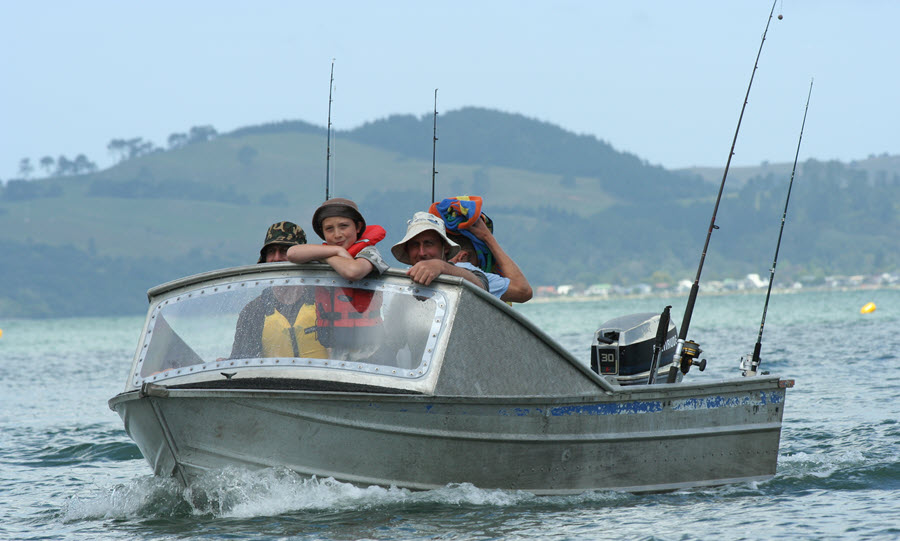
Most boat manufacturers will provide a recommended horsepower rating for their hulls, something like, say, ’90-130hp’. The lesser number should provide reasonable performance, lifting the boat onto the plane without struggling and providing a reasonable cruising speed. A smaller engine has a lower capital cost, but if it is struggling a bit and running at the top end of its rev range a lot (especially when it gets a decent load of people, fuel, and equipment aboard), it may end up using more fuel than a larger engine which produces the same performance at more modest revs.
It’s a bit of a balancing act, but it can be a false economy to buy a smaller engine if it uses more fuel (this not only costs more but reduces the range of the boat) and wears out more quickly because it is running at high revs all the time. As a rough rule of thumb, look for an engine that will produce 24-28 knots at cruising revs, which is about 3800-4200rpm on most outboards. If you are carrying heavy loads, for example a crew of divers and their gear, you will be better off with a bigger engine as well.
Engine monitoring
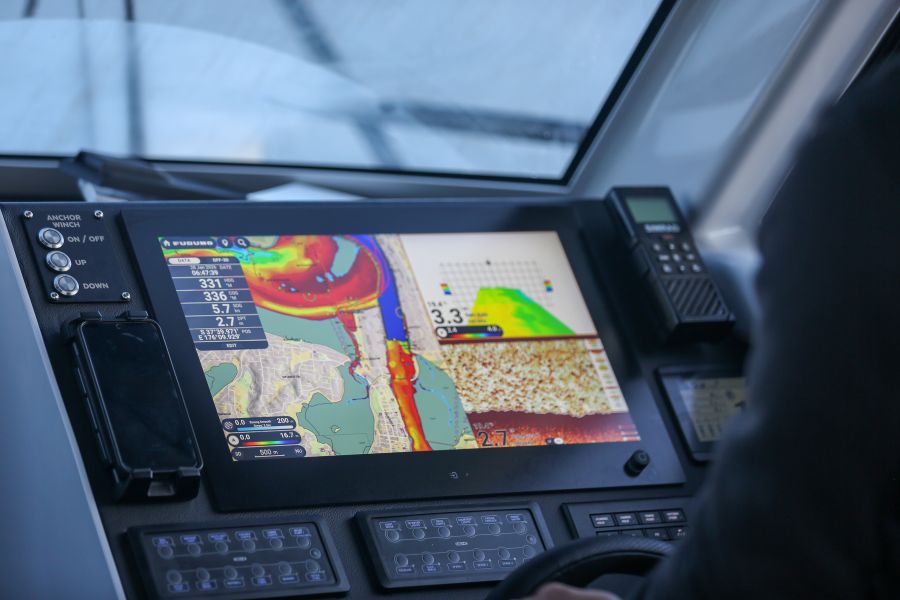
Modern outboards increasingly incorporate electronic engine management and digital instrumentation. Network connections such as NMEA 2000 allow engine information, including RPM, fuel consumption, temperature, oil pressure, and engine warnings, to be displayed on a compatible digital display or multifunction display (MFD).
Propellors
Once you start looking into the subject of propellers, you will strike a whole lot of terminology and concepts bordering on the black arts: blade face, leading edge, rake, pitch, hole shot, blade root, slippage, trailing edge, cupping, ventilation, cavitation,, and aspiration are just some of the terms and concepts. But don’t worry, we will stick to the basics!
While inboard props are usually bronze, or a nickel-bronze-aluminium alloy, most outboard props are made from either aluminium or stainless steel. Aluminium is cheap but more easily damaged (although it is repairable) and more flexible, so it doesn’t provide the propeller performance of stainless. Stainless steel is more expensive, but much tougher, repairable, at least five times longer lasting, and thinner. It gives higher levels of performance as it doesn’t flex as much. Most larger, higher-performance outboards use stainless steel props these days, while smaller engines often come fitted with aluminium props.
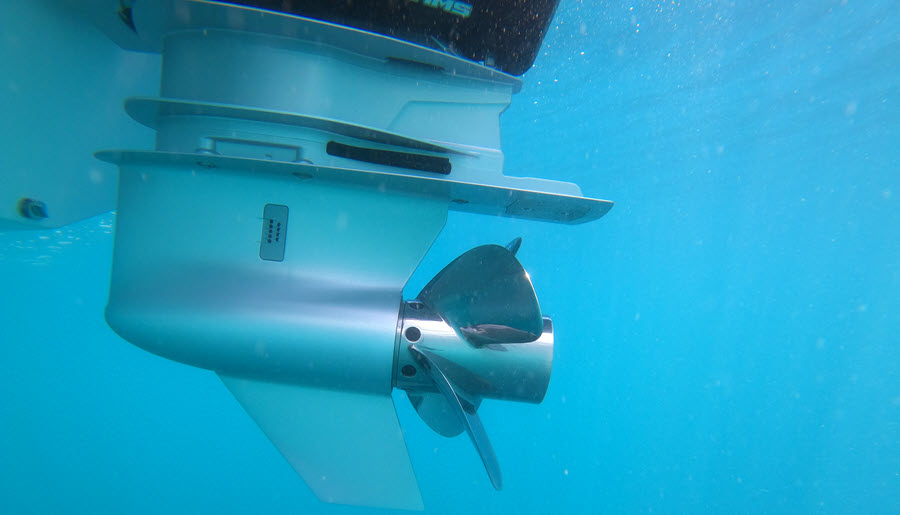
Commonly, outboard props have three (or sometimes four) blades, and if a single engine is fitted, they turn clockwise. If there are two engines, one prop will spin counterclockwise to balance the torque and make steering easier.
Props are often stamped with two numbers, such as ‘14X17’ for example, or with a serial number and something like ‘17P’. In the first example, the first number is the diameter of the prop, in inches, to the outside of the prop tips. The outboard design will largely determine just what diameter prop can be fitted in the same way that certain-sized tires are suited to a particular car.
The second number, and the second example, is the pitch rating. Pitch is important to engine (and boat) performance and is the theoretical forward distance, in inches, that a given propeller travels during one revolution.
So how do you choose an appropriately pitched propeller for your engine and boat? If a dealer or manufacturer has set up similar boats previously, they will probably have a good idea of a suitable engine power and prop model, but here’s the drill if you want to make changes yourself.
Look in the ‘specifications’ section of your engine’s handbook or online, and you will find a maximum rev range for your engine. In an outboard it may be something like, say, ‘5400-6000rpm,’ or less in an inboard. If your outboard revs are operating outside this range at Wide Open Throttle (WOT) on the water, you may need to change your prop to one with a better-suited pitch.
If the engine is over-revving it may become damaged, and going to a coarser pitched (higher numbered) prop will help. Each inch that the pitch is increased should decrease the RPM by 150-200. If the engine is under-revving – “lugging” and struggling to produce the performance it should – a finer-pitched prop will increase the revs by 150-200rpm for each inch of reduced pitch.
By picking the correct pitch, you can adjust engine performance for your boat’s intended use. For example, if you need instant acceleration (such as when crossing a bar or popping a skier out of the water) but are less concerned about maximum speed, your engine should be operating towards the top of the maximum rev range. If, however, you are looking for more economy and a higher top speed, adjust towards the bottom end of the maximum rev range.
Avoiding engine problems
Most marine engine issues are related to two things: electricity or fuel. To stay safe out there in an average-sized, outboard-powered boat, get a good-quality, modern four-stroke and maintain it well; install an extra fuel filter in the fuel line; use a dual battery electrical system with isolation switching that is installed in a protected position above deck level; invest in good communications equipment; and buy a Coastguard membership.
All major engine brands are very reliable these days, and since most manufacturers offer comparable models, choice of engine is often down to an owner’s brand preference, price, a boat manufacturer’s affiliations and, importantly, the quality of service from, and overall reputation of, a regional agent.
Steering
Suitable steering is important to the safety of the boat and the comfort of the helmsman. There are several steering systems available: tiller steering with an outboard is fine for small craft, while cable steering is cheap and suited to smaller to medium trailerboats when the helm is remote from the outboard. Heavier or multiple outboards usually require a hydraulic system for smooth, comfortable steering. These are more expensive than cable steering, and some manufacturers of larger engines supply additional power assist systems.
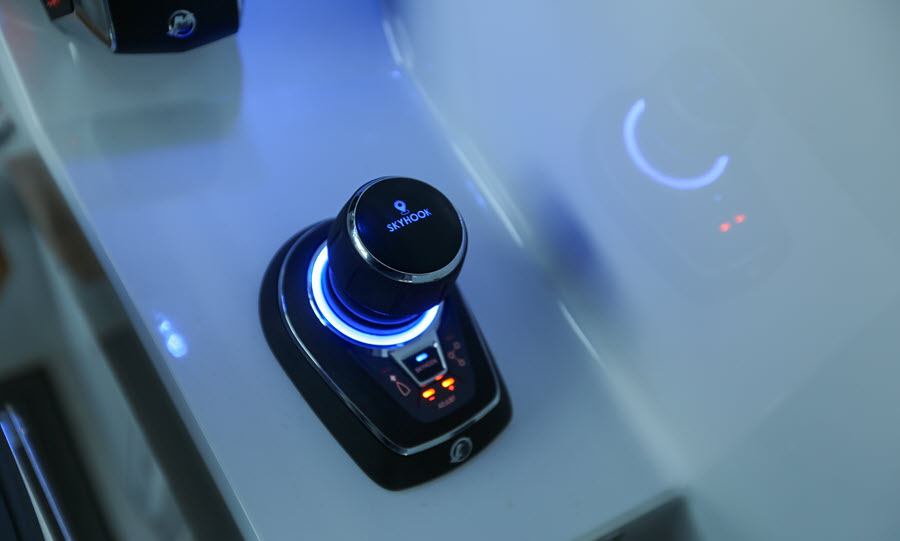
Top of the heap in both performance and cost is ‘fly-by-wire’ (or what some brands call electric or digital electric steering), where the steering is controlled by an electronic actuator with no cables or hydraulics involved. Fly-by-wire steering systems eliminate traditional hydraulic pumps, hoses, and fluids, meaning less maintenance and, importantly for anglers, less clutter around the transom to maximise fishing space. These systems can also incorporate additional tech such as integrated autopiloting, joystick control, and position-hold functionalities.
Regardless of what system suits the boat and budget, check that the steering is smooth, positive (not much ‘slop’), and not too heavy when the boat is underway. The ‘feel’ of the steering can vary a bit on any boat, depending on speed and the tilt and trim being applied. Any tendency to pull to one side (usually caused by propeller torque) can normally be adjusted out by altering the angle of the skeg on the cavitation plate.
Fuel
Fuel capacity, tank configuration, and accessibility are worth considering when buying a trailerboat. Check out the manufacturer's recommended octane rating and ethanol compatibility to determine the appropriate fuel choice for petrol outboards. Smaller trailerboats often use portable fuel (tote) tanks, while larger models generally have permanently installed underfloor or underfloor-accessible tanks. Fixed tanks offer greater capacity and a tidier installation, but make inspection and maintenance more important. There should be sufficient capacity for your intended boating without carrying unnecessary weight. Also consider whether the fuel gauge(s) are reliable for monitoring consumption and remaining range.
Look at the tank's construction, fill point, breather, fuel lines, and connections to the engine. Fuel systems should be properly secured, well-ventilated where required, and fitted with appropriate filters and water separators. Check that fuel lines and connectors are marine-rated and compatible with the fuel being used.
Common Questions
Should I choose an inboard or outboard engine for my trailer boat?
Outboard engines are popular for trailerboats because they are generally easier to service, take up less internal space and offer good performance and fuel efficiency. Inboard engines, particularly diesel models, can be more economical for boats covering long distances and clocking up substantial running hours. However, they are heavier, more expensive to install and can reduce cockpit space. The best choice depends on the size of the boat, intended use and running costs.
How much horsepower does my trailer boat need?
The ideal horsepower depends on the boat's size, weight, hull design and intended use. Most boat manufacturers provide a recommended horsepower range for each hull. A smaller engine may cost less initially, but if it has to work hard to carry a full load of people, fuel and equipment, it can use more fuel and experience greater wear. Consider the boat's typical load and look for an engine that provides comfortable cruising performance without constantly operating at high revs.
How do I choose the right propeller for my boat engine?
Choosing the correct propeller involves matching its diameter, pitch and blade design to your engine and boat. Pitch is the theoretical distance a propeller moves forward during one revolution, measured in inches. A higher-pitched prop generally reduces engine RPM, while a lower-pitched prop increases RPM. The correct propeller should allow the engine to operate within its manufacturer's recommended wide-open-throttle (WOT) rev range, delivering the right balance of acceleration, cruising economy and top speed.
Continue Reading


Sunday 29 November 2026
Major Bites
 -
 -
Minor Bites
 - -
Monday 30 November 2026
Major Bites
- - Minor Bites
- -