
Trim Systems

Modifying a boat's trim changes how the hull sits in the water when underway. Trim directly impacts handling, comfort, speed, and fuel efficiency for planing vessels. Hulls achieve optimal performance when correctly trimmed in terms of both front-to-back (pitch) and side-to-side (roll), and fortunately there are systems to help make it easier for the skipper!
Powerboats rely on adjustable thrust angles (drive trim), trim systems, and ballast to adjust their running attitude.
Drive trim
Most outboard-powered craft and sterndrive vessels have drives with adjustable trim, giving the skipper a great deal of control over the boat’s pitch. Outboards of 30hp and larger usually come with power trim and tilt. Power tilt is used to lift the leg clear of the water for storage or trailering; power trim adjusts the angle of thrust while the boat is underway. The majority of outboards and sterndrives use a two-stage hydraulic ram for both tasks, but some systems are electric.
Trimming the engine leg outwards, away from the boat’s transom, thrusts the transom downwards into the water, raising the bow. Trimming the engine leg inwards towards the transom lifts the stern and pushes the bow down.
Although trimming is a fundamental powerboat skill, some boaters never come to grips with it. The basics of using power trim are simple: tuck the leg in to keep the bow down before accelerating onto the plane and then trim it out a bit once you get going. This lifts the nose, allowing the boat to plane on the flatter sections of the hull towards the stern. Less wetted surface means less friction, more speed, and better fuel economy.
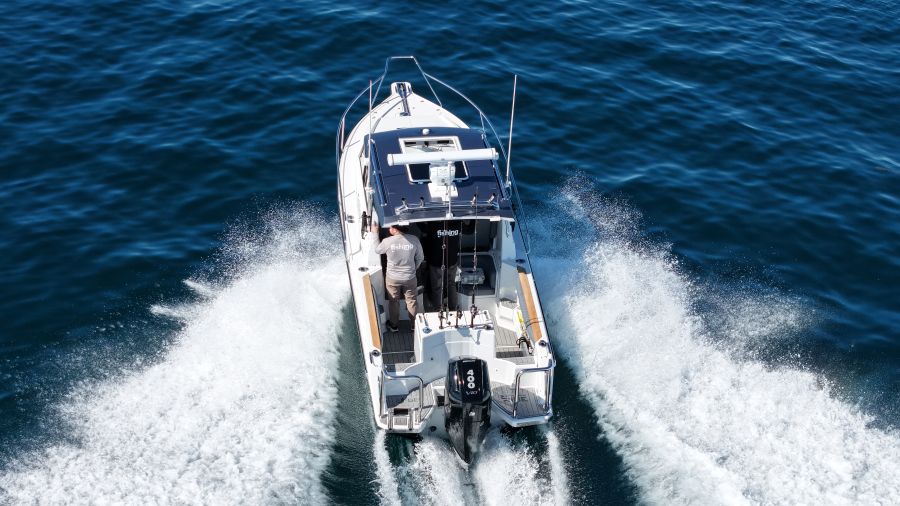
The faster the boat travels, the further the engine can be trimmed out, but only up to a point; too much positive trim can leave so little of the hull in contact with the water that the boat becomes dangerously unstable and difficult to control. Take care in windy conditions, too, as wind getting under the bow can cause a loss of control. Other symptoms of excessive trimming out include hull porpoising and the propeller sucking air from the water’s surface (ventilation).
Altering your drive trim according to the sea conditions and travelling angle is an important boating skill. Trim the bow up in a following sea or when overtaking waves to avoid ploughing into troughs. On the other hand, when heading into the sea (particularly when it’s rough), push the bow down so the deepest part of the V slices through the waves first. This will help reduce slamming from water hitting the flatter sections of the boat aft of the bow. But be careful, as too much trimming in can result in bow-steer (when the bow is too low in the water and it catches waves, pushing the boat around and affecting steering) and poor performance/fuel economy.
Tuck the leg in a touch before beginning the turn to ensure the propeller and hull maintain their grip on the water. When pulling water toys or skiers, keep the bow trimmed in a bit more than usual to help the boat maintain speed in sharp turns. Once the apex of the turn is reached, add some positive trim as you straighten the wheel and accelerate away. Be careful not to overdo negative trim when turning because the boat’s chine could grab, throwing the boat occupants about and potentially pitching the vessel end for end.
Some high-end outboards also offer automated drive trim functionality, which continuously adjusts engine trim angle based on boat speed and RPM to maintain the best running attitude when planing, decelerating, or turning.
Trim tabs and trim systems
Larger trailerboats over 6.5m generally have trim tabs or trim systems fitted at the intersection of the bottom of the hull and the transom. Conventional trim tabs are individually adjustable plates that can be tilted down to alter the hull’s angle of attack by lifting the transom and pushing the bow down.
Interceptor trim tabs are quite different. Interceptor trim tabs work by interrupting the laminar flow of water passing over a planing hull by extending a rectangular transom-mounted plate vertically into the water flow. The interruption to the laminar flow of water lifts the transom and lowers the bow.
Trim tabs are used to adjust both pitch and roll, and fine adjustments are possible, using one tab or the other, or both together. Make adjustments in small increments to avoid throwing the boat over on one chine or the other. Trim tabs are particularly useful for adjusting side-to-side trim, and are usually labelled ‘port’ and ‘starboard’, ‘up’ and ‘down’, or similar. Automatic trim tabs are also available.
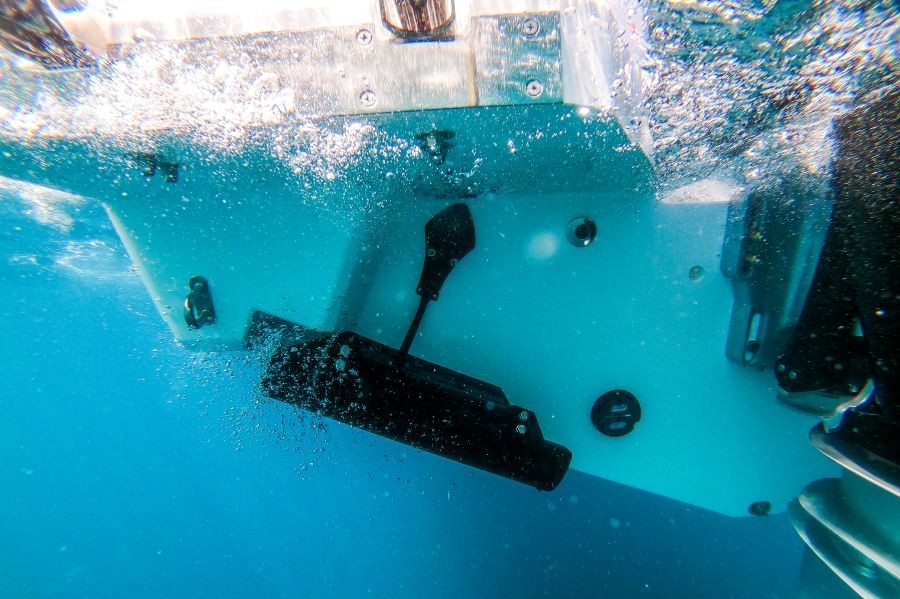
Technology in the trimming space has recently been revolutionised with Seakeeper Ride. It’s a first-of-its-kind intelligent ride control system that automatically corrects the boat’s movement while underway. Ride uses a pair of transom-mounted controllers, each incorporating a rapidly actuated rotary blade that deploys into the water flow beneath the hull. Sensors and proprietary software monitor the boat’s movement across three axes: pitch, the bow rising and falling; roll, the boat leaning from side to side; and yaw, the bow swinging laterally. Aside from automation, Seakeeper’s advantage also lies in its speed of response; Seakeeper states the system is capable of up to 100 adjustments per second, with blade deployment speeds of up to 300mm per second.
Trimming modest vessels
Outboard motors under 25hp seldom feature power trim, and trim tabs are seldom seen on boats under 5.5m. Nevertheless, small boats still benefit from trim adjustment. The easiest way to adjust trim is to shift weight around inside the boat. Shifting a spare fuel tank forward can help keep the bow down when negotiating a head sea; moving it back can help when running the boat downhill. Moving your buddy to one side of the boat can keep the boat riding level in a crosswind, while shifting him forward or back can greatly improve the boat’s ride (or ability to get on the plane). Drive trim can also be adjusted on small engines via a pin on the outboard bracket that changes the angle of the outboard leg in relation to the transom.
Common Questions
What does power trim do on an outboard motor?
Power trim adjusts the angle of the outboard motor in relation to the boat's transom, changing how the hull sits in the water. Trimming the engine in pushes the bow down, helping the boat get onto the plane, while trimming it out raises the bow and reduces the amount of hull in contact with the water. Correct adjustment improves handling, speed and fuel efficiency. Power tilt, by comparison, raises the motor clear of the water for storage or trailering.
How should I trim my boat in different sea conditions?
The correct trim setting depends on the direction and condition of the sea. When travelling into rough seas, trim the bow down so the deeper V-section of the hull cuts through the waves, helping reduce slamming. In a following sea, raising the bow helps prevent the boat from ploughing into wave troughs. When cruising in calmer conditions, adjust the trim to achieve a comfortable, level ride and efficient planing. Avoid excessive trimming in either direction, as this can affect stability, steering and fuel economy.
What are trim tabs and how do they improve boat performance?
Trim tabs are adjustable plates or interceptor systems fitted to the transom of a boat. They work by altering the flow of water beneath the hull, allowing the skipper to adjust the boat's front-to-back pitch and side-to-side roll. Trim tabs can help a boat get onto the plane more easily, correct uneven loading, compensate for crosswinds and improve stability and ride comfort. They are particularly useful on larger trailerboats, although smaller boats can often achieve similar adjustments by redistributing weight.
Continue Reading


Sunday 29 November 2026
Major Bites
 -
 -
Minor Bites
 - -
Monday 30 November 2026
Major Bites
- - Minor Bites
- -