Anchoring off a reef for fishing...
Printed From: The Fishing Website
Category: Saltwater Fishing
Forum Name: Hints,Tips and How To's
Forum Description: Rigs, tackle, baits, angling techniques, tips and hints & your DIY projects here
URL: https://www.fishing.net.nz/forum/forum_posts.asp?TID=81332
Printed Date: 28 May 2026 at 7:03am
Topic: Anchoring off a reef for fishing...
Posted By: Maydogg
Subject: Anchoring off a reef for fishing...
Date Posted: 10 Aug 2012 at 10:14pm
|
Hey guys, Just a quick querry - I want to have a crack at some shallow reef fishing for some winter snaps, berleying up and straylining back into it with the tide etc. What is a good/ safe distance to anchor back off say the edge of the reef e.g. if you were 60-80m off would the berley attract fish out that far or should you go in a bit further and let your baits drift back a little as opposed to a cast from longer distance? Any thoughts welcome :) Cheers, Jason
|
Replies:
Posted By: Don18025
Date Posted: 10 Aug 2012 at 10:34pm
|
May, the challenge is to calculate the scenario. Here are the variables; - Depth of the reef. - Depth of water you are intending to anchor in. - Amount of current, which is dependent on the time of the tide. (rules of twelves applies - http://www.sailingissues.com/navcourse7.html - Direction of the current _ The fishing gear you are using - how much weight your sinkers are or are you straylining only. - Where you are intending to fish? some guys fish a floating bait down to the top of the reef others want their bait to land just a short distance upcurrent of the reef. Depends where the fish are! - what gear are using? Soft baiters are happy drifting across the reef. - type of reef, is a bloody great huge rock or ledge a metre of the bottom? You put all the variables in the computer (your brain) and then anchor your boat in the best position you believe to catch fish.....then get your gear in the water>>> which leads to fish in the boat. I am not the only guy who hates those who turn up on a reef, anchor, haul up, have another go, then anchor again, not happy haul up, re-anchor - and still do not have any gear in the water! good fishing |
Posted By: smudge
Date Posted: 10 Aug 2012 at 11:19pm
|
If conditions allow I would be closer than that....safety first though! The main thing is for the burley to be running into the reef system where you are casting to |
Posted By: footey
Date Posted: 11 Aug 2012 at 10:04am
| I would be closer than that in water under 30-40 meters but happy to be up to 80 meters away on deeper spots with good current. A good burley trail travels a long way and will pull fish away from a reef system. It just takes a good current and consistent flow of the right burley |
Posted By: johnybegood
Date Posted: 11 Aug 2012 at 12:28pm
|
Depends how deep the reef is as to how close you can safely get to it... We fish off reefs in our 6m Ali and feel safe getting into a few metres of water and stray-lining. Once you know your way around the reef/bay you can get in really close and fish the entire area without sinkers if the current allows ------------- I just want to jig |
Posted By: tmmo
Date Posted: 11 Aug 2012 at 12:55pm
| when straylining i usually anchor so I can comfortably land my bait around 5m from rocks, but get to know an area first, have a good look around the first time you go in and see where rocks etc are, best to do this when good visability! |
Posted By: Maydogg
Date Posted: 15 Aug 2012 at 8:38am
|
Ok the reef is in auckland harbour. It's an area of rock/reef with mostly sand around it - the water is around 4-6m I would say at high. The rock would be just under an awash type of rock, but dont believe it would ever be a drying rock. I would most likely fish incoming and sit on the seaward side and cast / drift berley and bait into it. Was thinking about using light gear around 6kg ish - and perhaps using a light trace like a 15lb vanishing fluro with smaller hooks with smaller baits and very little if no wieght at all. After having a little read I had thought of doing this as the fish tend to be more shy this time of year and get spooked more easily? Hence making my gear as light as possible, without getting silly. What are your thoughts on hook and trace? I was going to go for a trace as long as the rod and smaller baits? Cheers, Jason
|
Posted By: Keith C
Date Posted: 15 Aug 2012 at 9:39am
|
Hi Jason I do most of my winter fishing in the harbour in the situation you describe. I fish 4-6 kg mono and 15-20 lb fluoro without any weight and baits down to cubes of pillie if needed. I don't go smaller than 6/0 - 8/0 circle or J-hooks but ensure that they are fine gauge. Mustad Demon or Penetrator have been the most readily available but there are others in that same category. I always use a double in my mono and about a metre of trace with no swivels or anything else e.g. clips, connectors etc. Biggest snaps landed in the harbour have been between 15-17 lbs and never bitten off (yet!). I do lose tackle to stingrays especially when using bigger baits. I have my drag light (only set at 1/3 breaking strain) but am prepared to move the boat if needed once hooked up. Hope that helps.
|
Posted By: Maydogg
Date Posted: 15 Aug 2012 at 10:30am
|
Morning Keith, Cheers for that - so by double you mean making the 1 metre trace 2 metres and doubling back to tie each end? So tying a normal knot on one end and a knot using the loop at the other? Cheers,
|
Posted By: Keith C
Date Posted: 15 Aug 2012 at 10:16pm
Here is a diagram. I double the main and then I join it directly to the trace (no leader). Main is doubled to bring it to an equivalent thickness of the trace. My personal preference (out of habit) are spider hitch and blood knots.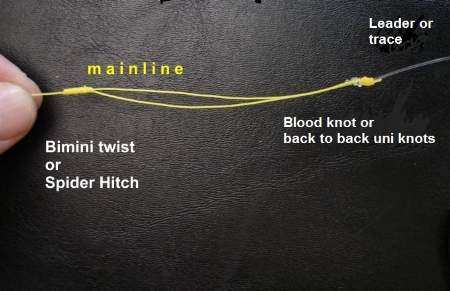 |
Posted By: Maydogg
Date Posted: 15 Aug 2012 at 11:11pm
|
Cheers mate, Looks good - can I ask what is the point of a short piece of double before the leader? |
Posted By: feijoa
Date Posted: 16 Aug 2012 at 9:37am
|
I understand its to bring it to equiv thickness of leader |
Posted By: JOLLY
Date Posted: 21 Aug 2012 at 8:38pm
| Improved knot strength |