When to strike on a Dry Fly?
Printed From: The Fishing Website
Category: Freshwater Fishing
Forum Name: Freshwater Fission
Forum Description: The place to discuss all matters related to freshwater fishing!
URL: https://www.fishing.net.nz/forum/forum_posts.asp?TID=37835
Printed Date: 26 Sep 2026 at 8:32am
Topic: When to strike on a Dry Fly?
Posted By: TheBadger
Subject: When to strike on a Dry Fly?
Date Posted: 11 Feb 2009 at 6:06pm
| When talking to other anglers or watching fishing videos there seems to be a remarkable variation in when people strike after a fish has taken their dry fly. I know the old maxim is 'God save the queen', however I personally find this to be too slow and that often the trout will have spat the fly by then or that it doesn't hook up properly. My technique for dry fly fishing is to say the word 'Bum' once the fish has taken the fly, and then strike (although by now I no longer say the word bum, it is simply instinctual). This seems to work extremely well for me as I hook 90% of all fish that take my dries. However I know that many other people will use different techniques to similar, or perhaps better, effect. So I'm asking people to write down a short description of their dry fly setting technique, why they use this technique and in what situations they might change their technique. |
Replies:
Posted By: Onecast
Date Posted: 11 Feb 2009 at 8:37pm
|
TheBadger; Tightening into a trout that has accepted your dry fly can vary considerably according to the type of water you are fishing. A fly taken by a trout in Slow almost still water. will require a much longer Pause before you tighten into the fish, than a fly taken in faster flowing water such as a Riffle or Rapid where setting the hook will be almost immediatly the fly is taken.
Asyou say instinct plays a big part in how you tighten into a fish, and that is part of the delights of our sport. Flying by the seat of your pants as it were, is great fun and keeps the mind sharp. Have Fun. Jax ------------- A man is only as big as the things that annoy him RIP 'Onecast' Jax Murray |
Posted By: TheBadger
Date Posted: 12 Feb 2009 at 4:00am
| Yeah thought that was the case, however I've done very little dry fly fishing on slower waters so I couldn't personally vouch for the technique. On even the slowest pool in a river I tend to strike relatively quickly, and yet the trout almost without exception are hooked, it is only when I think to myself 'I'll try the slower technique' that I lose fish. Still, its interesting to hear different peoples opinions on the matter |
Posted By: Fishb8
Date Posted: 12 Feb 2009 at 5:09am
|
I just watch until the fly has disappeared, then slowly tighten up. ------------- Be yourself; everyone else is already taken |
Posted By: Fishsnatcher
Date Posted: 12 Feb 2009 at 7:48pm
|
I'm only a beginner fly-angler but when I was using a dry beetly imitation [ humpy or a cochybondhu] I struck almost immediatly after the fish took the fly, this was in still water, and I lost 2 fish by doing that so yeah I would tend to agree with 'Oncecast'
Lately I have been doing more lure patterns and a wee bit of nymphing, Might try indicator nymhing as I have just been using a bead headed pheasant tail on my line, and have lost a couple of good fishing because of striking to late
|
Posted By: Fish Mad
Date Posted: 12 Feb 2009 at 7:57pm
|
Same as Fishb8.
Count to 3,rather quickly,and strike!! ------------- ~~REMEMBER;FISH HAVE TAILS AND THEY USE THEM?~~ |
Posted By: TheBadger
Date Posted: 12 Feb 2009 at 8:08pm
If you wanna get into indicator nymphing I'd recommend buying some C&F 'Air Cell' Indicators in a small or super small size. They're incredibly good floaters and are sufficiently small as to not spook fish. Sounds like its more the speed of what you say than what you actually say
|
Posted By: Fishsnatcher
Date Posted: 12 Feb 2009 at 9:42pm
| Ok thanks, what about putting a small thing piece of tube through a small piece of foam to use as an indicator? Idiot proof to make, super cheap, and would work? |
Posted By: bazza
Date Posted: 12 Feb 2009 at 9:59pm
|
Before using any type of indicator make sure
it is of legal construction for the area being fished.
The Taupo region for instance only permits yarn indicators.
|
Posted By: TheBadger
Date Posted: 12 Feb 2009 at 10:53pm
| If it works then use it for sure. These ones are yarn Bazza. http://www.manictackleproject.com/index.cfm/pageid/73/ViewPage/Indicators . Absolutely beautiful little indicators, float through anything and easy as anything to see. Plus their small design means they don't inhibit casting. I'm predicting them to revolutionise indicator nymphing. Only problem is the cost...they ain't cheap... However, they do last for a long time and because of their mode of attachment they can be reused time and time again. If you've got a spare few bucks lying around and your local store stocks them then I'd highly recommend giving them a go...you won't go back |
Posted By: bazza
Date Posted: 13 Feb 2009 at 9:51am
Thanks for that info Badger, can see how they should work in theory
but cannot understand why they would be expensive. After all they
appear to be a standard "O" ring yarn indicator bound at the top as
well as the base.
One minor disavantage occurs to me is that they do not lend themselves
to trimming back where/when a smaller indicator is called for but this
could be overcome by carrying a range of sizes.
Have you noticed different coloured yarn seems to stand out more under
various conditions therefore pays to carry a variety. White is near useless
if any sort of foam line apparent & strangely enough black seems to suit
dark conditions.
Am sufficiently intrigued by the possible advantages of the added "top
binding" to try tying some or adapting some existing ones to trial.
Cheers
P.S. Will send you a pm report on the recent trip to the Wairarapa, pleased
to say was far more successful this time. Will send you some sketches of
where found the fish to be mainly as I found could fish for a long way
without any action, then land 3 or 5 in a 50mtr. stretch which may have been
due to the extreme heat. Have heard the hatches can be prolific at that time
of year but found them to be very minor & shortlived on the few occassions
they did occur.
|
 TheBadger wrote:
Posted By: TheBadger
Date Posted: 13 Feb 2009 at 1:58pm
| Haha one reason why they're expensive... C&F makes them! Yeah you can't trim them, but honestly, buy the small size, you won't need to trim them. Orange is definitely my favourite colour for indicators. Glad to hear this trip was much more successful, look forward to hearing about it Bazza. I've had a trip up to the Taupo region lately, fishing the Hinemaia, Tauranga-Taupo and Tongariro. I'll Pm you some info on that when I've a little more time, caught lots of fish though, but nothing much over 4lbs. |
Posted By: Pole Dancer
Date Posted: 14 Feb 2009 at 9:50am
|
Striking on the dry fly is a simple matter once you understand the why of the steps involved but often the reasons why we strike a certain way are not explained.
For years the old "God Save the Queen" was the taught mantra. I often used "Take that ya *******"..
 It doesn't work and teaches you nothing about why you should strike with a delay at all, just that there should be a delay.... usually...
It also doesn't work because some people talk quickly and some are really slow in speech so while my "God Save the queen" may be 1/2 a second another's might be a second and a half.
So what is the right timing?
First you have understand how a trout eats off the surface. If it simply came up to the fly and closed it mouth over it it would actually push the insect away from it with the water that is displaced. SO in order to ingest the fly it has to also suck in water with it. There is a gill flare and ingestion of water that occurs as it takes the fly. It has to be head down and moving forward to then swallow the insect and displace the excess water out through the gills. If it tried to do this before turning down the insect would simply go out of the gills with the excess water so the mouth remains open until the fish has turned down. This is why m,any newer dry fly anglers often feel no resistance when they strike too early... the fly simply comes out of the open mouth which is still packed with excess water.
So, and this is the important bit because it will teach you 100% how to strike a fish properly on the dry fly, knowing that the fish has to turn down and be moving forward before it closes it's mouth and displaces the water you simply have to picture when it has turned down and closed it mouth and is moving forward ( in your minds eye if you can't see the fish) and then set the hook... FISH ON!
Now, it may seem difficult to picture this but it isn't, you'll see next time you are on the river. You automatically will calculate it all based on the speed of the water, type of insect, etc. Browns are notoriously slow, rainbows most often fast. Browns on slow water take a lot of self control to get right, rainbows in fast water are hard to get wrong. ------------- http://www.clarkreid.co.nz" rel="nofollow - www.clarkreid.co.nz FFF Certified Casting Instructor / Umpqua Designer Tier 
|
Posted By: hookerpuka
Date Posted: 14 Feb 2009 at 10:12am
| Fish has to be heading back down before you strike. the smaller this fish the quicker this will happen. also generally the faster the water the quicker this will happen. |
Posted By: Snap T
Date Posted: 18 Feb 2009 at 11:15pm
|
Over the last few seasons I've thought alot more about what I'm doing while hooking up on a dry fly, judging water speed and assessing the fish movement etc. I felt at this stage I was getting pretty comfortable with my timing and completely disregarded the "God save the queen" method to continue with my new found more educated approach............. so I thought............. Today was my first chance to fish with Cicadas this season and everything I thought I could do right, went wrong when trying to set these Cicada imitations. Small blowfly patterns were hooking up perfect all morning, but once the cicadas came out, I changed to Clark's classic Deer Hair Cicada. The fly was of course being constently taken however using the same strike technique as my blowflys the hook would not stick. I thought possibly the larger, thicker hook needed more of a positive strike to set, but I still couldn't get a true hook up. I swapped to a size 12 olive crystal stimulator which looks Cicada-ish and with what I thought to be perfect timing and tightening I could still not stick a hook. I came to a nice fish which took a Deer Hair Cicada and with once again (what I thought was perefect timing and tightenting) no stick. Luckily the fish appeared to not be spooked and returned to the same feeding spot very quickly. However the Cicada would not be sniffed at again. I returned to using the Blowfly pattern (in a similar size hook as the Cicada I had just used). The trout came and took the Blowfly and using near enough the same strike timing/speed/force etc as with the Cicada the same trout previously took, it finally stuck. So now i'm completely confused, it seems from my frustrating day (I call it an experimental day) that Trout slurp down Cicadas different to other insects. I often hear anglers describe the trout as "Smashing" the dryfly when talking about Cicada fishing. And it seemed to me today I needed to be alot more "smashful" with my strikes. Still awaiting the trout to turn down after the take but then apply more of a Nymphing type strike and quicker than what I'd normally do with any other dry fly. This would turn "God save the queen" followed by a slow smooth rod lift ........................to a gibberish "GODSAVETHEQUE..!!!" STRIKE!!!! I may be completely wrong about this, but it seemed very coincidental that today I only struggled to Stick the hook when the trout were taking a Cicada imitation. So...... My question is do trout take Cicadas off the surface different to other Insects?? Has anyone else noticed anything like this when using Cicada patterns??? Having to adjust the strike techniques you'd use with any other dryfly ??? Clark you pretty much pioneered the pattern any thoughts???? Anyhow, clearly I spent alot of time thinking about this today, it kind of overshaddowed the fact that it was still a great days fishing. |
Posted By: TheBadger
Date Posted: 19 Feb 2009 at 12:25am
| Just speaking from my experience of a few weeks ago in Taupo, but it seemed to me that the rainbows I was fishing were hitting the fly so aggressively and fast that a very quick strike was all that was required. may also be that I was fishing reasonably fast moving water. Is that consistent with your findings Snap? |
Posted By: Pole Dancer
Date Posted: 19 Feb 2009 at 2:04am
|
There's a number of interesting points raised here... but the vital information I need to answer it is not really here... did you notice any difference in the way the fish rose, speed, timing to return to moving forward and down etc... those things are the critical elements where the key will lie...
It is important because while I don't believe there is a hugely significant take on Cicadas specifially, large terrestrials in general are often taken differently.
If the area is heavily fished and you think these fish may have been fooled on a few cicadas they can often be very quick to eject them... try a Turk's Tarantula... something different they are not shown a lot....
Much is made of aggressive takes on terrestrials but my experience is that Cicada and many terrestrial takes are often pretty leisurely... Blowfly takes can be more positive because some do fly away... get them before they do is often important. Once on the water Cicadas are pretty much stuffed and rarely get away and while one cicada and two fish in a pool will cause a fair amount of aggression a fish within it's own space will not usually waste a heap of energy in taking one. Browns in particular often slurp down cicadas with little more effort than they approach a willow grub.
Ok, that aside I have seen some behaviors, particularly from Rainbows, where they slap the living bejeezus out of an insect before eating it... I believe they do try and kill some of those large insects, or at least stun and drown then a bit. There are a lot of variables but the essential rules of timing outlined in my post above all still apply... but you have to watch the riseforms.
Very early on in my flyfishing days I was put onto a book called "In the ring of the rise" by Vincent Marinaro. In that he studies various riseforms and feeding habits of fish feeding from the surface. There is a lot of information in there but even more importantly there is an unseen road map, if that makes sense, that encourages anglers to take the time to sit down and study trout and wacth the various rising styles on different insects. I cannot emphasise the benefits of this enough.
Matt, I suggest the next time you find yourself in this situation... just find a feeding fish and sit down and watch it like a hawk for 30 minutes or so... i reckon you'll get the answer to your problem yourself and those lessons are way more valuable and last longer.
let me know how you go... if worst comes to worst I may have to fly down and have a go at those aggressive cicada eaters... i can think of worse things.
 and if I was being precious I'd also ask you to define "pretty much".  ------------- http://www.clarkreid.co.nz" rel="nofollow - www.clarkreid.co.nz FFF Certified Casting Instructor / Umpqua Designer Tier
|
Posted By: hookerpuka
Date Posted: 19 Feb 2009 at 6:48am
|
Lake O is a prime example of queer fish behaviour on Cicada's. they will 9 out of 10 times if you twitch it on the surface swirl under the fly to drown it then come back and sit under it to see if it moves. as soon as it does.... wham. only place Ive ever seen them do it though.
On the rivers I'm with Clark.... I don't think they expel any more energy on a cicada to hit it than any other dry..... but I have seen them travel 20ft to come and smack one on the odd occasion.
I also feel you get away with allot more bad presentation on cicada than what would with any other form of dry fly fishing. big clumsy bug hitting the surface I guess they kind of expect it lol.
|
Posted By: Fishsnatcher
Date Posted: 19 Feb 2009 at 7:59am
| I have even heard if it being slapped on the surfcace of the water on purpose to attract attention. |
Posted By: Snap T
Date Posted: 19 Feb 2009 at 9:41pm
|
The trout all appeared to rise and take the cicada in the same manner as any other dry on that particular day. The difference seemed to be sub-surface, more the trout taking the fly with no worries but then quickly spitting it out in a sudden uncertainty. I just assumed once they commit to take the fly, it was all on! Clark you're probably right with the idea that the fish were already aware of certain patterns from angler pressure and were quicker to test and spit before I could strike. (Maybe time to invent another breakthrough pattern???) And sorry about the "pretty much"  |
Posted By: Pole Dancer
Date Posted: 19 Feb 2009 at 11:45pm
|
It's "probably" invented just not released commercially... I use "probably" like you use pretty much .
In fact over the years I've tied a wide number of what I would call "Personal patterns" and only about three of them are produced by Umpqua Feather Merchants. I haven't submitted a new pattern to them for 8 years or so... I should probably do something this year.
It's one of those things... the Clark's Cicada was such an outstanding commercial success people tend to forget or not know what else you have done...
I'll post some. In fact the original tied properly still works but the commercial version has changed subtley but importantly over the years. I have firm views about how it should be tied and might even start a thread to explain it. Tying them in various colours, mottling the deerhair etc are all techniques and then there's the new fly... the megafugly...
Ben Hall, a Poronui guide and good barstard, once said the commercial Cicada should have a warning on the box...
"Will catch heaps of fish but is just as likely to scare the hell out of a few too". ------------- http://www.clarkreid.co.nz" rel="nofollow - www.clarkreid.co.nz FFF Certified Casting Instructor / Umpqua Designer Tier
|
Posted By: PTN
Date Posted: 20 Feb 2009 at 8:15am
| A friend of mine was fishing cicada on a dam in the maniototo. He was striking on each take and missing the fish. Like Clark said above he rememberd hearing that fish some times drown or slap the cicada before taking it so he resitated striking the first time and would strike on the second take just a few seconds later. His whole day changed. |
Posted By: Fishsnatcher
Date Posted: 20 Feb 2009 at 3:27pm
|
Pretty cold atm looks and the nice drenching of rain we are having will up the rivers |
Posted By: Pole Dancer
Date Posted: 20 Feb 2009 at 8:57pm
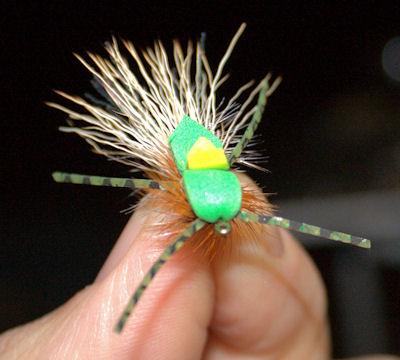
The Megafugly....
 ------------- http://www.clarkreid.co.nz" rel="nofollow - www.clarkreid.co.nz FFF Certified Casting Instructor / Umpqua Designer Tier
|
Posted By: Snap T
Date Posted: 20 Feb 2009 at 9:24pm
One hell of a fly Clark! Looks like it would pretty much work!  |
Posted By: Troutzilla
Date Posted: 21 Feb 2009 at 11:04am
|
Hey Snap
had same scenario down south a few times, especially pressured fish seem to try to kill cicada on first hit then actually eat it later. Rise form is quick and almost an explosive SMACK! had it on both rainbows and brownies. In fact on one crystal clear backcountry river in march ( so would have most likely been caned ) i was watching a fish that rose to a natural tussock cicada only to spook rapidly under the bank! from a natural! |
Posted By: Fishsnatcher
Date Posted: 21 Feb 2009 at 11:12am
|
Paranoid trout?
|
Posted By: Snap T
Date Posted: 21 Feb 2009 at 12:17pm
|
Actually poolburn Dam, central Otago is prime example of this aggressive feeding. I've seen trout come to a Cicada accelerate to the surface then half a foot or so before the fly they'd turn down and their tail or part of their body would come out of the water and slap the fly under. Then the trout would turn a second later to take the fly. I guess the trout version of a "body slam"?
About the paranoid trout... I've observed the same. While watching a trout before even casting a line, I've seen them rise to a natural only to then spook at the surface. I've always assumed that as they have risen to the surface the change of reflection / refraction or something (I can't remember physics) may have exposed my silhouette into the trouts line of sight.
|
Posted By: Fishsnatcher
Date Posted: 21 Feb 2009 at 1:01pm
|
Possibly Snap, Many a time I have when I have spooked a trout when spinning, yet it continues to follow my lure regardless, any theory why that is? The last time that happened was when I was on the clutha a few weeks back.
A 2-3 lb brown continued to follow my lure and not bite, it must have seen me I was 2 metres away from its nose....though it was a bright sunny day.
|
Posted By: Snap T
Date Posted: 21 Feb 2009 at 7:27pm
|
Hard to say FS, Waters with high angler pressure can achieve different types of spooked fish I think. You get those ones that will dart away at the first sight of any person or line. Or you get those ones that stay where they are but limit their tail movement and stop their feeding. Or you get the ones that know you are standing there with a rod, and continue to feed but are more careful about what they actually are feeding on, they appear to not be spooked at all. You'll often hear "A big trout was just right there!!!!.... and I hadn't spooked it!, he just stayed feeding but no matter what I threw at him he wouldn't take.!!!!!!"................ well that trout knew exactly what was going on which is why he wouldn't take what was thrown at him! He gets it nearly every weekend. If trout did shoot off at lightning speed everytime an angler came into view surely they'd never have any time or energy to feed at all with the pressure on some rivers these days. As for you Clutha trout FS, I'd say if you were swinging the lure downstream and retrieving up the trout would have been following curiously right across the river and up your side until hew spotted you. I have found with spey fishing the Clutha swinging streamers across and down if you don't hook the fish at the end of the swing or within the first few strips then it won't strike at all. They still follow the streamer upstream, butit's like they are almost just escorting the intruding small fry away from their territory. Then they end up near your feet and thats the last you see of them. Who knows he may have just been trying to tease you.... "HAHA I see you!!"  |
Posted By: Fishsnatcher
Date Posted: 21 Feb 2009 at 8:42pm
|
Actually it was still water, a lovely wee backwash near Balclutha, did manage to get a nice 3lb'er anway. |
Posted By: Snap T
Date Posted: 22 Feb 2009 at 7:47pm
OH  forget that theory then. forget that theory then.May need to come down those ways to investigate! |
Posted By: Fishsnatcher
Date Posted: 22 Feb 2009 at 8:03pm
|
Oh wait now that you mention it it WAS on the main flow way up by Wanaka
|
Posted By: bazza
Date Posted: 22 Feb 2009 at 9:26pm
To hell with the trout ..... they look good enough to eat instead
of chocolates .......... do they come in any other flavours than
peppermint????
|