Big Butterfish?
Printed From: The Fishing Website
Category: Diving
Forum Name: Spearo's Corner
Forum Description: Free-divers & spearos chat about their sport
URL: https://www.fishing.net.nz/forum/forum_posts.asp?TID=29293
Printed Date: 31 May 2026 at 6:36am
Topic: Big Butterfish?
Posted By: Lizzie
Subject: Big Butterfish?
Date Posted: 13 May 2008 at 7:08pm
|
Hi All,
I am doing a study on butterfish (greenbone) at auckland uni, and i am looking for photos of any big butterfish that people may have caught (picture with a scale for size). The biggest we have caught was in Fiordland 55.4cm total length and the heaviest was 2.75kg in Stewart Island - has anyone caught a butterfish bigger than that ?
Thanks heaps!
cheers
Liz
|
Replies:
Posted By: KeriBOI
Date Posted: 13 May 2008 at 7:12pm
|
record is around 4.79kgs I think. ------------- Before you judge a man, walk a mile in his shoes; after that, who cares?! He's a mile away and you've got his shoes! |
Posted By: herby
Date Posted: 13 May 2008 at 7:16pm
|
Rusky got a big one at Gt Barrier last year that was 57cm total length I think.
LJ got a horse on video at the Chathams a few weeks ago too. It had big fat rolls under its chin.
|
Posted By: long john
Date Posted: 13 May 2008 at 7:37pm
|
tell us about them. I read that herbivory in fish is much more viable in warm water and that as the water gets cold, being a meatatarian is the go and yet butters break the mould? What's the craic with that?
------------- Proud member of the Glen Innes Spearfishing Club |
Posted By: long john
Date Posted: 13 May 2008 at 7:47pm
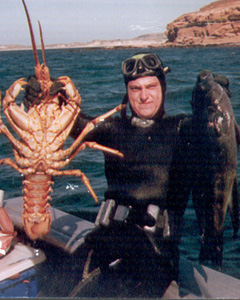 chathams butter. dunno how big but, er,.....big! ------------- Proud member of the Glen Innes Spearfishing Club |
Posted By: Besty.
Date Posted: 13 May 2008 at 7:54pm
| hey around banks peninsula they tend to max at around 58, once they hit that they just seem to get height and width. If i go out and grab a doz of the biggest ones over a few different kelp beds they pretty much fit the same mold. The bigger ones I've seen here are about 5-6lb. I guess down here they'd eat more bull kelp then anything else and are often concentrated around a pinnacle covered with bull kelp. |
Posted By: Omebic
Date Posted: 13 May 2008 at 8:49pm
| LJ that is a big butter but how big was the cray? |
Posted By: long john
Date Posted: 13 May 2008 at 8:52pm
|
dunno. I've seen an 18lb red. It ain't anything like that big. I'd say 5 and a half kaygee?
------------- Proud member of the Glen Innes Spearfishing Club |
Posted By: Scotty B
Date Posted: 13 May 2008 at 10:47pm
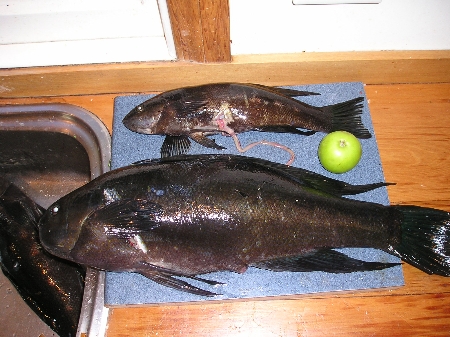 Shot in front of my house on the southcoast of Wellington last year, the big female is bigger than 60cm and i didnt weight it. Note the big round head, nice and fat too. Hope this helps. Scott
|
Posted By: TheSnapperWhisperer
Date Posted: 14 May 2008 at 9:59am
|
faaaarrrr out that's a big fatty ------------- http://www.facebook.com/TheSnapperWhisperer |
Posted By: Azazel
Date Posted: 14 May 2008 at 11:11am
| I pinged a ~60cm butter off sunken a couple of months back. I think a friend may have some photos... |
Posted By: Lizzie
Date Posted: 14 May 2008 at 12:57pm
|
Hi All, thanks for all that info that's fantastic !
Azazel, if you had a photo of that 60cm fish with a scale that would be awsome.
Scottyb, that IS a big butter! would you be able by any chance to measure the wooden beam / window frame at the back of the sink ? i'm just trying to measure the fish and using the apple, i get a size of 60cm if i assume the apple is about 6cm across or i get 79cm if i assume the apple is 8cm.... would be of great help
PaulB, what you describe is exactly what i've been finding too. after they stop growing in length they continue to grow in weight and when they get older they tend to show big fat chins on them. I found so far that they actually live around twice as long in the south (stewart is) in the colder waters as they do up here and we found many fish with a deep chin down there (we didn't get many fish with a deep chin around the hauraki, and they live less long here ).
LJ, that's a very good question you raised here! that's actually exactly what our project is about, we are trying to understand how a herbivorous fish like butterfish can survive in colder waters when it is assumed that eating seaweed is constrained in low temperature environments. Most studies which have said that being a meat-eater is better in colder waters are based either on terrestrial herbivores or on omnivorous fish (meaning that they eat meat and plants). those fish switch to eating more meat when it's colder so people have assumed that eating seaweed is not good enough to survive in the cold. butterfish are true herbivores in that they eat only seaweed (mostly brown kelp, some red algae) so their rate of digestion is limited by the rate at which the microbes in their guts ferments the food. fermentation can be slower in colder waters but this can be overcome by having bigger guts so more bacteria. this could explain why they are a bit heavier in the colder waters maybe?
sorry about the long reply! hope i'm not too boring..! i've been working on this for a couple of years now... feel free to ask any more questions if you're interested.
And again, thanks to anyone for any photo of any big butterfish (with a scale bar). If any of you shot a really big one, i could also age them if you keep the head that would be fantastic (i use the ear bones, and cut them to count the rings like in a tree). i'd just need total length, weight, where you shot it, and the frozen head .
Cheers
Liz
|
Posted By: Besty.
Date Posted: 14 May 2008 at 2:39pm
|
Lizzie i would be interested to see some age to length stats if you have that kind of information at hand. I would also be interested to know how far they move or do the same fish reside in the same kelp bed for life? |
Posted By: Lizzie
Date Posted: 14 May 2008 at 5:26pm
|
Hi Paul I have size at age information but i can't really post my data on the web.. i'd have to kill you otherwise!! haha. What i can say is that in the Hauraki Gulf it takes them about 3 years to reach legal size. Is that what you were interested in? Regarding their movements, they are sedentary fish, and move around their territory. i am not sure anyone has actually looked at that in detail, but i think they stay in the same area of kelp for life.
Cheers
|
Posted By: Besty.
Date Posted: 14 May 2008 at 9:02pm
| I'll normally take a couple of the biggest from various kelp beds and wanted to know how long it would take the smaller ones to replace the ones i take. I've watched populations of smaller kelp beds and they don't appear to replace fish very quickly, the kelp beds aren't refreshed as cray holes seem to be. |
Posted By: MurrayC
Date Posted: 15 May 2008 at 1:07pm
|
How long is your study going for? We shoot A fair number off Kapiti Island - but mostly over summer. I can send you fish heads by the bucketload come Oct/November, tagged with size and weight measurements. I think most guys here would be interested in any results you finally conclude. |
Posted By: Minksta
Date Posted: 15 May 2008 at 3:50pm
|
Hey Lizzie, ive noticed the parasite type things in the mouths of butters, could they in anyway help with the processing of the seaweed the fish eat. Or perhaps they accidently swallow one every now and then for a quick protein shot?? Very interesting stuff good luck with the study! |
Posted By: Lizzie
Date Posted: 16 May 2008 at 10:29am
|
i'm starting to analyse the data and writing up so i'm hoping to finish this study at the end of the year or early next year.. cross fingers! so bucket loads of heads would be too much for me (i wouldn't have the time to process them all), but if you got a fish above 60cm, i would definetely be VERY interested! please keep me posted MurrayC i've seen many butterfish with parasites in their mouths, but more so in the south, and they get from when they're as small as less than 10cm. obviously the size of the parasite grows with the size of the fish, and in the bigger fish i've often seen the female parasite (isopod) with the male inside the mouth at the same time and the female is much bigger than the male. They are parasites, so all they do is that they take advantage of the butterfish for food and shelter. they feed on what the butters ingest and butterfish don't get anything out of this relationship.. |
Posted By: Azazel
Date Posted: 18 May 2008 at 11:16am
|
It'll be interesting to see the findings; so little research is done on fish that aren't commercially important. This butter was taken off Makara earlier this year. The knife in the photo is 40cm long, which makes the fish a bit above 55cm by my numbers. 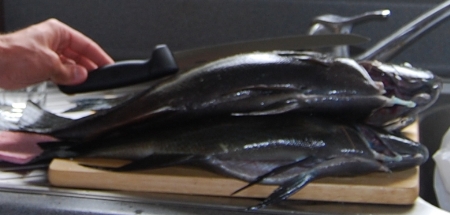 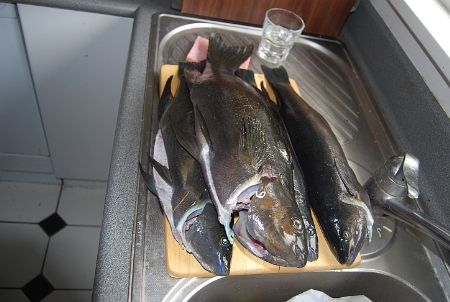 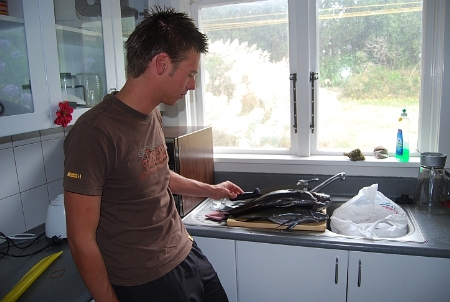 |
Posted By: Drexciya
Date Posted: 22 May 2008 at 1:01am
|
Interesting stuff Lizzie. I was watching big Butters today feeding with other reef fish on the floaty eggy stuff (thats the scientific name) that was clouding a bay on the South Coast of Wellington. I havent seen fish feeding on this stuff before like they were today... they just couldnt get enough of it! And it seemed to make them fearless or slow... big butters usually are very shy, but they couldn't care less today. Neither could the cod and moki in my fridge. One butter in particular was swimming in unusual patterns, showing its belly etc. Even a nice kahawai was feeding on the stuff and acting all drunk and cheeky, almost had him. ------------- “If you think about it, water is the most powerful element, the sea is full of uncharted territories. It’s a mental thing, but when the polar cap melts, everybody’s gonna live in Drexciya..." |
Posted By: Moki Marko
Date Posted: 24 May 2008 at 9:53pm
|
|
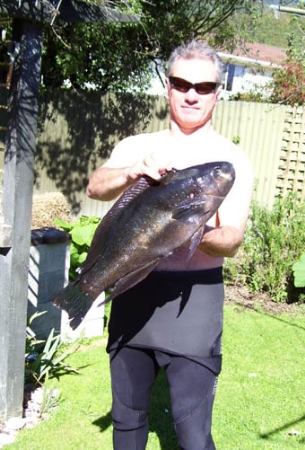 this one was around 3.5kg (maybe 3.2) from memory. Queen Charlotte Sound. Butterfish are very habitat vulnerable and aren't as plentiful as people think. Because they aren't high commercial value they don't get considered. The 15 or 20 bag limit (depending on area) needs to be reduced before they're all gone. What's the general view on this one??
Posted By: Mtn Breeze
Date Posted: 24 May 2008 at 10:12pm
|
Hi Mark.....about time you came onto the forum...... Spearo of your experience will have a positive input I'm sure. And another Mainlander to help counteract them fellas on the other island !!!! ------------- www.wildnaturenewzealand.co.nz" rel="nofollow - http://www.wildnaturenewzealand.co.nz |

Posted By: herby
Date Posted: 25 May 2008 at 11:23am
Wawa wee wa, solid fish!
 I agree, I reckon ALL bag limits should be reduced (especially comms - but thats a whole different can o' worms).
It certianly wouldn't be a bad thing.
The two main recreational ways for catching butters is spearing and netting? I can't imagine many spearos (if any) taking anywhere near their limit, which leaves netting. Nets are pretty ruthless, so if a net got dropped in an area where heaps of butters are and more than the limit were taken, excess fish would have to be dumped anyway, many would be dead from net injuries?
|
 Moki Marko wrote: