Riding the swell?
Printed From: The Fishing Website
Category: General Forums
Forum Name: The Boat Shed
Forum Description: Discuss all things boating.
URL: https://www.fishing.net.nz/forum/forum_posts.asp?TID=138156
Printed Date: 04 Jun 2026 at 10:38pm
Topic: Riding the swell?
Posted By: MB
Subject: Riding the swell?
Date Posted: 12 Jan 2024 at 12:14pm
|
Confession time. This is probably a psychological issue more than anything else... I have a 5.6m boat which I've owned for nearly a year. It's been great, no dramas. My problem is that I have a strong aversion to swell even if conditions are otherwise good. It comes from 5 years of kayaking and 7 years of jetski fishing. From the kayak days, I remember that feeling of surfing down the swell was often followed by an unplanned swim. Now, even riding a small swell in a bigger, heavier vessel, I find myself shifting my position (like it's going to do anything!), clenching buttocks and sweating! I'm not talking about bar crossings, just regular days when there is any swell over a metre. I understand where the boat should be in relation to the waves, but most other boaties seem to gun it home regardless. I'm keen to do some more game fishing, so need to get on top of this! Any thoughts?
|
Replies:
Posted By: Pcj
Date Posted: 12 Jan 2024 at 1:06pm
|
Each vessel rides differently, I slow down for comfort and better control, the hard thumping some do cant be good.
------------- "Times up" |
Posted By: MB
Date Posted: 12 Jan 2024 at 1:11pm
| Thanks mate. I'm open to all input here, but it's not a "thumping" issue, it's that feeling of surfing a wave. Slowing down often makes that feeling worse. Hope that makes sense. |
Posted By: Pcj
Date Posted: 12 Jan 2024 at 1:17pm
Last time out,due to travelling with swell ended up quartering it rather than dead downhill,travelled slighty further distance but found it more comfortable.(wife waiting on back surgery so got to take it easy) ------------- "Times up" |
 MB wrote:
Posted By: Kandrew
Date Posted: 12 Jan 2024 at 1:27pm
|
What’s the boat and motor, I see your up Whangarei way the sea conditions out at the mouth can be tricky on some days up there. Remember boats like to quarter seas in stead of smashing them head on, but sometimes not easy in a following sea. Getting the trim and speed right is the main thing, getting the nose of the boat at the right trim. Some boats love to bow steer down a swell, mine love to and if I’m not careful when I come down the swell and hit the bottom of the swell, my boat can slow down to much so the swell behind me catches me up and I start to broach which can give you the sh!ts if you’re not ready for it. So for me it’s a combination of speed, trim and angle in relationship to the direction of the swell. It’s takes a bit of practice but I like to get my boat in to the groove so I can just cruise home as Paul said above. |
Posted By: MB
Date Posted: 12 Jan 2024 at 3:01pm
Thanks. It is all about control and that's what I'm struggling with. Might try quartering, but don't want to broach. I normally head for land to get out the swell and then make my way home, but that obviously won't help offshore.
|
Posted By: MB
Date Posted: 12 Jan 2024 at 3:11pm
Thanks for the reply. I have a FC560 CC with a Mercury 115. I have no doubts about the boat, just the captain! Whangarei Harbour entrance can be gnarly, often worse than the open ocean, but if the swell is NE, that at least isn't too much of a problem. A direct E swell can be very unpleasant and I nearly got caught out on the jetski once. I'm far happier going in to swell than a following sea. It may be a silly question, but if it's a big slow rolling swell, do you just sit behind a wave even if it takes you a long time to get home? And another question, I find it really hard to judge where I am in relation to the top of a large non-breaking wave. Any hints?
|
Posted By: Fish Addict
Date Posted: 12 Jan 2024 at 3:59pm
Some of the comments above are perhaps confusing wind sea with swell. They are not the same.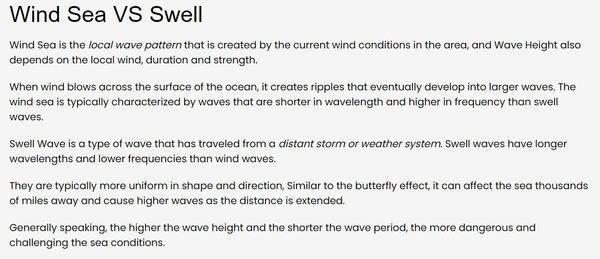
I've always found that swells in open water were travelling faster than my boat was. I don't fancy surfing down the face of a swell and for that reason I let the swells give me a bit of a push but happy for them to pass underneath me. The longer the swell period the faster it's travelling. A 20 second swell period is travelling at 30 knots.
|
Posted By: Griff the dog.
Date Posted: 12 Jan 2024 at 6:31pm
|
Surfing down the face of a swell ? A boat that does not broach ? I have surfed on the jet raiders wake at 30 knots. It was exhilarating. The ride was totally safe and predicable . But maybe the boat I had did not have the same handling issues as some boats do. This might get me some hate. If you get swamped or rolled having a popular "safe" pontoon boat brand will not save you from a swim . Having a deep v and fine entry will not https://www.google.com/search?sca_esv=597709555&rlz=1C1CHBF_enNZ1079NZ1079&sxsrf=ACQVn09E_ha5g-UR0gllRNOEbZg1ZkVNNQ:1705036388267&q=necessarily&spell=1&sa=X&ved=2ahUKEwicrYHCi9eDAxV8sFYBHcp0BPMQkeECKAB6BAgIEAI" rel="nofollow - necessarily be the best option when it gets knarly if it is inclined to dig the bow in and broach or try's to bury the bow and become a submarine .
|
Posted By: krow
Date Posted: 12 Jan 2024 at 9:42pm
|
Rule of thumb travel slower than the following sea. If the swell is small all good to overtake. I'm out wide off Tuts heaps. Old boat 5.5m now 6m. Experience is all you need. Know how your boat handles various conditions. Let the sea catch up and give you a push then slide under you. Be active on the helm. What may happen is you end up "stuck" on the back of that wave but just change direction/speed or wait and it will move on for the next push. How a boat handles has a lot of variables including the height of the swell and the wind on it. Following sea is more dangerous than head on IMHO so you are right to be cautious. If the swell is big enough to make you surf DOWN the face you are in danger. 99% of the time you don't go if the conditions aren't favourable. Swell on the East coast isn't usually big enough to be an issue on it's own. When I'm looking at going I'm way more concerned on the wind forecast than the swell. Wind against swell is not pleasant either as it stands the waves up and creates a "confused" sea.
|
Posted By: MB
Date Posted: 12 Jan 2024 at 9:53pm
Thanks Krow, that all makes sense. The problem is getting experience and staying alive 
|
Posted By: Pcj
Date Posted: 14 Jan 2024 at 7:23pm
|
Just a thought MB,waterline length plats a part too. Coming back from Mania Harbour,nw 10 knt wind against tide produced a sloppy wave condition on top of slight swell,normally can do 25 head on but with slop veered of a bit with wave hitting 2to 3 ft from bow smoother ride ,with tidal push we actually ended up going straight so things worked out
------------- "Times up" |
Posted By: smudge
Date Posted: 14 Jan 2024 at 8:35pm
|
Some great answers here. Most of my experience with swells are on bar crossings which is outside of your question but fwiw. I much prefer to stay on the back of a wave. It's not a pleasant experience when a wave catches and pushes you. I p[refer to stay on the back of a swell until it disappears and then I tackle the next one ------------- Best gurnard fisherman in my street |
Posted By: Reel Deal
Date Posted: 15 Jan 2024 at 6:08pm
|
I surf when I can, some swells travelling well over 20 knots. I’m sure it had to save gas as the motor isn’t working so hard. If I fall off the back I try and catch the one behind. Different story on a bar of coarse. You need to have control of your steering at all times. If they are jacking I’ll sit on the back if they are smallish I go hard out and bonus across the tops. I’m in your area MB and about to do some game fishing as well in trailer boat, yell out if you want and we can team up for contact and shared info while out there. ------------- The gods do not subtract from the allotted span of men's lives the hours spent on fishing - Assyrian Proverb |
Posted By: shaneg
Date Posted: 15 Jan 2024 at 10:01pm
|
Hull design can be of assistance. Our small stabi 490 rides pretty good with the swell and is predictable in a following sea. It has only felt like broaching once in 20 years and that was on manukau bar with cresting wave that came off the side of the bar unexpectedly as we were going out, and forced us to turn sideways.It broke on starboard aft side sending boat careering down the wave. Pontoons popped our nose out … but was frightening. And my point is it’s likely going to be unexpected swell which causes you a problem or catches you out. And you need to be alert enough to turn boat across the top of problem wave if necessary, while keeping enough power on so you don’t lose control or get rolled over. A few years ago we came back into Tuts entrance at low tide in the One Base with a really big swell running. I took it really slow and sat between 2 big waves (same as we used to coming into Muriwai) and got in unscathed. Kiwi Angler on the other hand, a much bigger more capable 40 foot boat wth Rex Smith, an expert skipper, came past us and got caught by a big wave. I watched with concern as Kiwi Angler ended up almost 90 degrees with most of the starboard side in water up to its gunnels for a few seconds. I know Rex was a little shaken by this episode. So like driving car it pays to drive to conditions and pay attention to what sea is doing and be prepared to take evasive action should the unexpected occur. Practise makes perfect but probably complacency is biggest issue for most of us. |
Posted By: MB
Date Posted: 16 Jan 2024 at 8:01am
| Thanks for all the replies. Some food for thought. Thanks for the offer Real Deal. Luckily, I have a small circle of boating mates including one who has 30 years experience of bar crossings. I'll get some tuition from him next time we come back in over the Kaipara or Hokianga bars on a good day. |
Posted By: terrafish
Date Posted: 17 Jan 2024 at 12:24am
|
I'll adjust both throttle and trim, in a following lazy large swell. Trim up a touch and throttle back a bit when approaching the bottom and then trim back down and reapply revs right as you get to the bottom. Very quickly get a feel for the sea and boat and basically do it automatically. Bit more hairy if it is a short swell period so quartering it and taking a longer route is better option. You will get a feel for what the boats telling you pretty guick and as others have said, being active on the helm helps. All 3 that is steering, trim, and throttle come into play, so don't "set and forget" Coming home on sunday we were going from 14 to 28kn, averaging 20, on 1.5m of swell and never once felt uncomfortable yet alone sketchy. Swell period was about 11sec once it gets down to 8 or 9 sec then we quarter ------------- Part time Devils Advocate, Fulltime procrastinator |
Posted By: Dagwood
Date Posted: 17 Jan 2024 at 8:56am
Nothing wrong with going out with someone like that specifically for some intensive training and experience. IE leave the rods at home. You'd gain far more competence and confidence per trip that way and then you can build on it with experience... Another option could be to talk to Andy https://powerboat-training.co.nz/" rel="nofollow - Powerboat Training (powerboat-training.co.nz) about some own boat tuition. Not only does he know his stuff, he knows how to teach it. These are 2 different skill sets.
|
Posted By: MB
Date Posted: 17 Jan 2024 at 3:30pm
|
Thanks, more good advice. |