3 blade vs 4 blade prop selection
Printed From: The Fishing Website
Category: General Forums
Forum Name: The Boat Shed
Forum Description: Discuss all things boating.
URL: https://www.fishing.net.nz/forum/forum_posts.asp?TID=121243
Printed Date: 11 Jun 2026 at 3:36pm
Topic: 3 blade vs 4 blade prop selection
Posted By: Popeye.
Subject: 3 blade vs 4 blade prop selection
Date Posted: 20 Sep 2016 at 10:25pm
|
I have a 5.5m stabicraft with a '07 johnson 90hp 2stroke which had a 3 blade 14*15.3 (prop scan) which had been through the wars. Around this time last year i put a solas 13.5*15 amita 3 blade which has a progressive blade shape and resulted in marginally better top end speed at the same WOT. I use the boat for either snapper fishing on the east coast in the gulf and when weather permits game fishing on the west coast over the manukau bar. the budget at this stage does not allow a re-power and hence the leadin to the question. Fuel use is fine when snapper fishing in simple terms cruise out, fish and cruise back and relatively fuel efficient at cruise speeds. In terms of trolling for mr beaky trolling at 6.5knts to try to keep rpms low enough say(1800rpm) at around 10L/h. Is there any merit in a 4 blade prop in terms of a combination of the following:
I would be happy trolling at 6.5knots at slightly lower rpms and sacrifice top end speed (which rarely gets used on the west coast). At the time weighed the boat and borrowed an old 4 blade prop (12.5*15 which was an old stainless prop and very flat bade shape) and did some trials for lightly loaded and heavily loaded for all three props. Has anyone considered this scenario before or am I barking up the wrong tree? Any thoughts or suggestions? |
Replies:
Posted By: Popeye.
Date Posted: 20 Sep 2016 at 11:14pm
| Updated engine year to 07. Had written hull year by accident. |
Posted By: Steps
Date Posted: 21 Sep 2016 at 9:06am
|
A 4 blade is generally cupped more (more grip this slip for a given total blade area compared to a larger 3 blade ie lets take the 13 spline johnson... a 13 1/4 4 blade has less blade surface area than a 14 " or even a 14 1/2" (if they made such a prop in 13 spline) but very similar grip. Also with 4 blades they tend t throw in a little more rake, which lifts the stern little more.. this is a sort leverage thing... a wider thrust out the rear breaks the water surface sooner, so the top edge of the 'push' is not there and the bottom of the push levers up the bow more. having more grip (less slip) , espec at low rpms, gives less slip at low speeds and cruise... hence better in rough seas, bars and better economy... but at WoT loads up the outboard more... so having the boat well powered is essential to maintain at least 15 to 20% of surplus power at any given rpm ....And in rough weather and espec bars stuff ESSENTIAL for safety.. if u dont when you need that grunt to climb a wave, power out of something it will not be there... A racing boat.. like a drag race car, has a lot of slip in lower rpms.. till it hit the full power rpm range.. with boats this is in the prop.. in the car a torque converter....hit the throttle, the prop/ torque converter , slips like hell the rpms climb very fast to power range, the prop/ converter grips and the neck snaps back Similar action with the driver with a manual/ clutch car. Also race boats usually only have 2 blades.. The extra grip at low rpms gives excellent manoeuvrability in reefs , rocks, moorings etc. Id have a boat min powered, and not no need hitting WoT, or not going to hit rough weather / bar crossing... one can get substantially more out of in performance and economy with a 4 smaller 4 blade... This is because most 2S have a fast power to rpm curve in lower rpms... so potential to over prop a little... to the lower margins of the manufactures recommend WoT rev range has advantages. But avoid loads above cruise. It is this basic principle that when take to extreme one can move a heavy slow moving barge/ boat effectively and economically... but its not going to handle a bar crossing well. If the boat is under powered.. you WILL load up the engine, shorten its life dramatically.. nothing will 'fix' this issue... performance/ economy/ engine loading is all bad.. often ppl will add a P/trim to a selected prop.. yep helps the numbers/ performce but that just loads up the leg/ power head even more. If over powered, one can cruise at very low rpms eg 40+ mph at 3600/ 3800 rpms....but issues arise, even with good grip.. accelerate slightly and the stern hangs out like a V8 doing so on a wet road to 50 mph .. nee to trim down.. and WoT forget it one has potential for 50/ 60 mph in hulls not designed to be stable at those speeds, and chances are gear is not stowed in such a manner. A 4 blade allows one to increase the pitch with smaller diam prop with less surface than than the equivalent 3 blade without decreasing grip for low to mid range rpms. unfortunately far to many.. maybe enough to be 'most' boats sold, new and 2nd hand are either min powered or under powered... and many offical ratings on boats the min rating is under powered....its about selling the biggest possible boat the person can afford with the smallest engine to meet their budget... its about sales volume not quality of sales far too often. |
Posted By: Black Max
Date Posted: 21 Sep 2016 at 5:34pm
|
Four blades should give you better grip on acceleration, and on some
hulls will attain better fuel efficiency at cruising speed as it lifts the
stern and can hold the boat on plane at a lower speed.
Four blades will have worse propulsion and direction control when in
reverse than a three blade. For trolling speed - I would focus on the propeller pitch, not the
number of blades at that engine speed, if both props are 15 (15 inches of
travel) the boat speed should stay the
same. My 2 cents - a good stainless steel three blade prop would work best – go for diameter and not too much rake. |
Posted By: Bigfishbob
Date Posted: 21 Sep 2016 at 10:04pm
|
Go the 4 blade, the lower planing speed allows you to cruise at lower speeds when its rough. Offshore boats don't need to be fast, but they do need to handle. You have an aluminium hull which have stuff all inherent hull lift. Lifting the stern with a 4 blade prop makes the boat run flatter. You'll find that you'll lose a knot or so of top speed, but probably improve your trolling fuel economy. You get less slip at slower revs with a 4 blade prop. Just make sure that you know what your optimum rev range for your engine is and that you prop it to get the top end of that range. Do all that and you'll think you have a new boat. ------------- www.waikatosportfishing.co.nz |
Posted By: Popeye.
Date Posted: 21 Sep 2016 at 10:48pm
|
Hi Steps Thank you for the explanation, which i think i understand. Great way of explaining it to. I want to clarify a couple of things as follows: o the only reason i referenced WOT above was to check that the new 3B prop was within the engine WOT range of 4500-5500rpm o my general cruise rpm is usually 3500rpm when weather permits. In terms of fuel efficiency l/h increases significantly over that rpm based on the above i think it is reasonably well propped for the solas 3B (I’m no expert) How do you tell if a boat is underpowered / overpowered if its not a silly question. Some info that may help as below: o 820kgs dry hull & motor o 160kgs motor o boat loading o 340kg - 1POB fuel & gear - snapper fishing o 790kg - 1POB fuel & gear - game fishing o hull rating o max 130hp o no min hp stated o capacity 950kg If I understand correctly I need to make use of the extra grip / less slip of a 4B at low and cruise rpms without any long term damage to the engine as I would still be doing bar crossings and may well require on occasion loads above cruise rpm.
I'm not mechanically minded so be kind if i stuff this part up. the boat mechanic told me that the carb'd motor has like a three stage fuel delivery rate so to speak ie idle, lets say moderate acceleration and full accleration (not his words). I’m guessing that I’m in the upper range of the “moderate acceleration” when trolling at 6.5knts and rpm range of 1850 to 2000. That in tandem with the hull shape is not good if a 3B prop has more slip at low rpms.
|
Posted By: Popeye.
Date Posted: 21 Sep 2016 at 11:05pm
|
Hi Bigfishbob
thanks for the reply.
I tried a random borrowed an old 4B prop (12.5*15) and it didn't give any benefit when compared aginst the 3B prop at the similar rpm's.
the was no science to the size prop selection just one i could borrow an try. that said it looked like an old design.
At this stage i'm not sure how to select a 4B prop without it being a very expensive trial and error learning excercise.
i was told to go stainless in a 4B prop as well.
|
Posted By: Steps
Date Posted: 22 Sep 2016 at 8:11am
|
the only reason i referenced WOT above was to check that the new 3B prop was within the engine WOT range of 4500-5500rpm Max hp is usually in the middle.. and drops off after that.. so going over that (5000) power drops off , u go faster and basically loading the engine more. IF one went up a pitch, dropped Wot rpms from 5500 to max power at 5000 rpms , because of the pitch change your will go faster.. if the slip is correct. You will also increase your cruise speed. or use less rpms for the same speed...improved economy. my general cruise rpm is usually 3500rpm when weather permits. In terms of fuel efficiency l/h increases significantly over that rpm based on the above i think it is reasonably well propped for the solas 3B (I’m no expert) If well powered .. top end yes.. generall cruise is around the 3800/ 4000.. its a balance between a few more rpms (more avaible hp at the prop) and being able to have les throttle.
Sort of.. sounds impressive right.. put that way its mechanic complicating things when they shouldnt...a carb be it on a 1950s 2 cyclnder jowett braford, a a 4 barrel holly on a hot rod... basically not 3 stage.. but 3 individual carbs in one. A idle carb...when idle butterflies closed a circuit to leack fuel at a constant rate past then and the main jets. Off idle.. thru to WoT.. butterflies open the amount of air sucked into the engine (think of it as a pump) by venturi effect sucks the fuel thru jets mixes with the air into the engine. And acceleration.. when hit the accelerator is pushed down, the engine needs a rich mixture to speed up.. so a pump squirts more in, operated off the accelerator. And then have the choke.. which basally chokes off air flow at idle making a rich mixture to fire up the engine on.. engines require rich mixture.. sort of like the above with the accelerator pump to accelerate. This is nothing 'special' for outboards or make what ever.. its just how all carbs work....not the2 mixture screws on your lawn mow / chain saw? same thing
Hang on just make another expresso Yep the more grip u have down low the better control you have.. trolling, manoeuvring in moorings or inside a reef now one else would dare to go A race or even max rpms set up will have around 28 or even 38% slip at troll to cruise.. WoT when the grip kicks in this drops to around 5% (see explanation compared to a race torque converter a nd shopping basket car torque converter previous post) The shopping basket (general use trolling cruise boat, at cruise you are looking at around the 10 to 14% at cruise.. trolling at the bottom end. Side not here.. this is why so many lake boats (trout and stuff) have aux motors.. the main engine is professionally propped for max rpms and dont have control bottom end is the boat underpowerd (guessing its not overpowered). How do you work out the 15 to 20% of surplus power that you mentioned? s the boat underpowerd (guessing its not overpowered). How do you work out the 15 to 20% of surplus power that you mentioned? will a 4B prop suit the boat/motor giving extra grip at lower rpms resulting in trolling speed of 6.5knts at a lower rpm than that of a 3B prop When one buys a boat or repowers a reputable sales person WILL ask 1/what the total gross weight will be when used 99% of the time. 2/And what the boat is going to be used or 3/And the primary expectations of the new owner troll , cruise, race etc. 4/ Then using formula works out the correct powered engine to move that weight at given rpms on the power/ rpms curve the correct powered engine plus 15 to 20% 5/ then from the gearbox ratio, the expectations of trolling, cruise wot speeds/ rpms choose the appropriate prop with the appropriate rake, cupping, pitch and diameter to meet those expectations. 6/That prop will be trailed under the full gross load for THAT customer rpms / speed performance numbers taken and IF NEED BE the final correct prop installed. IF any of the above is not meet , even on the 1st prop, then the engine is min or under powered for that boat....and most boats sold are in this category... wonder why boat shops become cagey AFTER the sale? Ok lets start doing this with your boat So lets take the heavy load 1st So all up say 1650 kg with bait tank full (???) we need to know some numbers. Cant see them above... Engine model type hp and gearbox ratio. min speed at plain, at best trim up and rpms in flat as water From there increase approx every 1000 rpms , re trim to best speed , verge of porpoising, or just doing so in flat water.. set, do 100m let things settle in then read speed and rpms. the next till WoT. Important rpms and speed (gps best) are accurate The specs of the current prop brand diameter and pitch. Then sit down and crunch some real numbers A larger 3 well cupped 3 blade is very similar in behaviour to a smaller 4 blade... but the larger 3 blade the outer edge speed is far greater. Some maintain a 4 blade is hopeless at reverse..?I think this has come about because some have used 4 blades with a LOT of rake.. too much.. any prop 3 or 4 blade with alot of rake will loose a bit of reverse manoeuvrability...or if using with a P/trim ould have that effect also. my experience with a well chosen 4 blade ...." you can go into reefs where even jet skis dont go in a 5.5 m cabin boat nps (subject to wind and swells.. lets be sensible here) So grab those numbers and lets go from there... It is easy for people to simply say " you need this" or "this will do the job" but so many who do dont say why. |
Posted By: CEEBEE
Date Posted: 22 Sep 2016 at 10:52am
|
I have used bothe 3 bladed prop and 4 bladed prop on the same rig and only benefit was holeshot acceleration and virtually no prop slip on tight high speed cornering. ------------- I STARTED THE DAY WITH NO FISH AND I STILL HAVE PLENTY LEFT |
Posted By: Steps
Date Posted: 22 Sep 2016 at 12:55pm
|
The results you get as explained above will depend on the boat, speed, how well powered, if height right FOR THAT pop, the rake of the prop... And "virtually no prop slip on tight high speed cornering." will not be slip but ventilation (not cavitation) all 3 very different things... and good chance not because of the 4 blades but the diameter and/ or rake of the 2 props. only benefit was holeshot acceleration Playing down this, in my books rightly so... fast hole shot is for race/ drag boats.. general use family boats, sending someone over the stern, or "hold on tight guys" is ego BS and sales/ marketing/ propaganda BS. It is best practice to lean on the throttle power slow.. dumping the power on to " blow the cob webs out is a myth..doing so creates high cylinder temps.. and all the crap build up from idling out thru moorings or trolling whatever, doest get burnt off but glazed on. It is only after considerable distances this slowly burns off... use cheap oils and the issue is even greater. Same applies in a car.. after 20 odd miles the car seems to hit a nice groove... that can be greatly shortened by hitting the highway and slowly increase speed/ throttle. |
Posted By: MikeAqua
Date Posted: 22 Sep 2016 at 2:24pm
|
I think it's handy to have a boat that comfortably gets up and onto the plane. You can choose to be gentle with the throttle (a considerate skipper) and you have 'hole shot' in reserve if you go over your normal load. My boat (2 x 70HP 2S) has 14 x 17 OMC props. When loaded for a two person fishing trip it ease up onto the plane at about 1/2 throttle. It would be dangerous to use full throttle to get it up onto the plane. One could argue it has too much hole shot. But when loaded with 4 divers, their gear, 8 tanks and two boatmen it will still get up onto the plane easily. |
Posted By: Steps
Date Posted: 22 Sep 2016 at 4:36pm
|
I think it's handy to have a boat that comfortably gets up and onto the plane. Of coarse.. and that just what a "well powered plaining hull should do" It would be dangerous to use full throttle to get it up onto the plane. One could argue it has too much hole shot. Or like mine a bit over powered... I put about 1/4 throttle in.. let go the throttle, it climbs up over the bow wave, then starts to take off, and if left would hit 30+ mph so throttle back.... then ease in a little more, cruise around the 36/ 38 mph 3800/ 3900 rpms with a 11% slip Im looking around for a OMC 15 spline 14" to 14" 3/4 diamx 22 or 23 pitch or a 13 1/2 to 13 3/4 " 4 blade 22/ 23 pitch slow the hole shot down, and decrease cruise rpms to around 3500 rpms....At that rpm and down I still have around 15 to 17% hp margin up my sleeve But WoT.. just dont want to go there...even on the current prop...way over 50 mph |
Posted By: otdrmn
Date Posted: 22 Sep 2016 at 5:32pm
|
Here's a prop calculator I made a few years ago where you can change a couple of variables. http://www.lineman.co.nz/OTDRMN%20Prop%20calculator.xlsx" rel="nofollow - http://www.lineman.co.nz/OTDRMN Prop calculator.xlsx ------------- The 4 R's ~ Rods, Reels, Rifles, Rooting |
Posted By: Bigfishbob
Date Posted: 22 Sep 2016 at 8:38pm
|
There are some amazingly friendly prop suppliers around, Propeller services at papamoa, outboard marine technologies in Auckland and Fish City in Hamilton were very helpful in lending me props to try. Frankly all this philosophical stuff and calculations are all well and good. But the simple rules that I stated previously and just trying stuff out is all you can do. If you are achieving the top end of your optimum rev range with the pitchiest prop you can get and you see no difference in handling between a 3 blade and 4 blade prop then save your bucks and go for the 3 blade prop. If you are achieving the top end of your rev range you are very unlikely to be overworking your engine. NOTE also that various models of props also have varying rake angles, the bigger the rake angle, the less stern lift you get. Try different models of Prop. 4 blade props can have more rake angle than 3 blade props because the extra blade gives you more stern lift. As others have said, various models of prop also have different levels of cup, which is generally good for reducing slip, but then the more cup you get, the less stern lift you'll have. It's bloody good fun trying different props, and it's refreshing how helpful dealers can be.
------------- www.waikatosportfishing.co.nz |
Posted By: MikeAqua
Date Posted: 23 Sep 2016 at 8:22am
|
There are new props in my future too. My engines would over rev (6200) if I let them with a regular load so I'm going up in pitch. I'll keep the current props 14 x 17 as spares and if I ever have to make trip with heavy load I can put them back on. Looking for 14 x 18 in OMC 13 spline. Haven't found any yet, so I might have try 14 x 19, or 4-blade 14 x 17. |
Posted By: Steps
Date Posted: 23 Sep 2016 at 9:19am
|
OMC and most go up in 2" increments Merc and couple other after market with changeable hubs can get between.. but that gets expensive expect around a drop of approx 150 to 200 rpms per 2" of pitch increase... around 100 to 150 rpm drop per 1/3" increase of a 3 blade or going from 3 to 4 with 1/4 to 1/2" drop in diameter. Mike if going that far over, and going from estimated weights of the boat, unloaded you are likely to find going out to a 21 inch pitch more appropriate.... but before jumping in and messing with pitch and stuff.. sort out the slip issues 1st..... In automotive terms its a waste of time trying to sort tyres that grip if the clutch is knackered and slips like hell. |
Posted By: MikeAqua
Date Posted: 23 Sep 2016 at 12:45pm
|
How does one sort slip without changing pitch? My engine height is correct - dribbling cav plate at high trim. I don't think I can increase propeller width (engine spacing). If I use full throttle for testing purposes I get 6,200 rpm. Should be 5,000 - 6,000. So arguably I could do with losing 500 - 700 rpm. |
Posted By: MikeAqua
Date Posted: 23 Sep 2016 at 1:08pm
|
 MikeAqua wrote:
Posted By: Steps
Date Posted: 23 Sep 2016 at 4:02pm
|
How does one sort slip without changing pitch? Explained above and in many other threads. basically more blade area...and or more cupping I don't think I can increase propeller width (engine spacing). you mean diameter.. the V4 omc hub? Again covered above In theory that could take upto approx a 15" diameter BUT they only make them to 14" diameter for the 13 spline V4 hub A 13 1/4 to13 1/2 4 blade has close to the same slip as the theoretical 14 1/4" would have.. ball park.. things like cupping rake brand model make small differences as in fine tuning Of interest the 3 blade theoretical 14 1/4" would have considerably more surface area than the 13 1/4" 4 blade, but has greater outside edge speeds and momentum If I use full throttle for testing purposes I get 6,200 rpm. Should be 5,000 - 6,000 (I run at 3,500 - 4,200). again explained above and older threads ideally for your mostly cruise application you shoulds be at the peak hp of the range...5000 rpms or slightly below.. Which essentially means u can take far more advantage of higher pitch... or in easy terms... less rpms for the same speed... significant fuel and oil savings...in the range of around 30 to 45 % no not a typo mistake. If powered that well for a single engine rig , on ave you should be getting at least 8nm/ L conservative estimate over all So arguably I could do with losing 500 - 700 rpm. No NOT arguably but according to the factory service / repair AND set up manual it should not even be set up like that AT ALL So at 4000 rpms what mph are you doing? IF the current 17 pitch prop slip is around the 11% @ 4000 rpms you should be doing 29/ 30 mph. With a 19 pitch 32/ 33 mph... Which is what at cruise the commander fully loaded spare anchor chain toilet , cooker stuff 110 L full fishing gear etc+ 3 guys used to do with the 115 V4 . and an overall ave mileage over approx 1000 kms approx 0.78 nm/ L.... dropping that back to 29 mph just under 1nm/L With the 115 the boat was just over min powered When I talk min power/ over powered max power.. it has nothing to do with official numbers.. it is to do with hull design, boat weight and reasonable expectations what a boat that size should perform at. |
Posted By: Big -Dave
Date Posted: 23 Sep 2016 at 10:01pm
|
I once had an omc prop on a merc hub, came on a motor i brought, it seemed to have small blade area, awful reverse thrust..i put an old merc alloy prop on and achieved better performance from holeshot up to top speed.. Blade shape varies massively depending on different applications. Merc have a huge range. I changed from solas to mercury vengeance, again better performance, less slip under heavy loads at WOT. Gave the solas prop to a mate who out it on his 70 hp yamaha, big difference in performance for him over the standard yamaha alloy prop. Trolling, trolling speeds are often limited by hull length as in diplacement hull speed. Approx 1 knot per meter of hull length i think. It takesminimal power to achieve hull speed, as soon as the bow lifts, the power requirements skyrocket. This is the worst economical rev range on a 2 stroke. Keeping the nose down while trolling helps. ------------- you can't fix an idiot with duct tape, but it does muffle them for a while... |
Posted By: Steps
Date Posted: 24 Sep 2016 at 8:58am
|
Trolling, trolling speeds are often limited by hull length as in
diplacement hull speed. Approx 1 knot per meter of hull length i think. It takesminimal power to achieve hull speed, as soon as the bow lifts, the power requirements skyrocket. This is the worst economical rev range on a 2 stroke. Keeping the nose down while trolling helps. Well put.. If one has a prop (pitch and slip factors) that has you sitting 1/2 way up on the bow wave, rather than behind it, the fuel bill goes right up up... If you are able to get that pitch right you should be able to troll without having to drop the bow for best effect. BUT as said before.. its sort of a compromise...the ideal trolling prop may not suit the ideal cruise, or ski towing...and neither will get close to idea race prop. This is the worst economical rev range on a 2 stroke. Dosent matter if 2S 4S LPG diesel or hamsters in a wheel....its about the inefficient position the boat is on the bow wave... like slipping a clutch in a car with a big load on a steep hill. |
Posted By: MikeAqua
Date Posted: 25 Sep 2016 at 1:20pm
|
I don't think I can increase propeller width (engine spacing). you mean diameter.. the V4 omc hub? Yes I meant prop diameter (currently 14"). The hubs are OMC 13 spline. It's a two engine rig (3 cylinder 70HP Johnsons, made in 2001). Engines bought for a song from OMC receivers complete with props. So at 4000 rpms what mph are you doing? 4000 RPM will give 23 knots in calm conditions with engines trimmed up. That's a comfy cruising speed for the hull in moderate chop. RPMs are from the OMC tachometers. GPS speed (SOG) from a Lowrance chart plotter, a Kus GPS-Gauge and a Samsung phone. I have the most trust for the Lowrance but all three agree on speed. |
Posted By: Steps
Date Posted: 25 Sep 2016 at 5:19pm
|
Yes I meant prop diameter (currently 14"). The hubs are OMC 13 spline. Answered above post "In theory that could take upto approx a 15" diameter BUT they only make them to 14" diameter for the 13 spline V4 hub" It's a two engine rig (3 cylinder 70HP Johnsons, made in 2001). Engines bought for a song from OMC receivers complete with props. So at 4000 rpms what mph are you doing? 4000 RPM will give 23 knots in calm conditions with engines trimmed up. Please confirm if the gearbox ratio is 2:1 if so slip IF 15 pitch is around 8% and if 17 19% which is high but before these things are worked out.. things like total gross weight needed to be known. Going back to the original post/ Poster... 5.5 stabi, 90 hp fully loaded 1500/ 1600 kg Initial suggestion was slip was the problem, subject to power to weight ratios etc As it turns out, slip is not the issue, but rather very under powered and too high a pitch. Or put another way, a little 1960s mini going up the Bombays with 4 huge ppl inside, over loaded and the clutch sliping. So reaches the correct speed for the power at the wheels that rpms.. but rpms/ power higher due to clutch slipping. So the pitch (final gear ratio at the road) needs to be reduced substantially....and then the slip sorted...at a lower pitch/ higher rpm/ higher power range. Even so putting the rpm/ hp data together, could be looking at min 13 possible going as low as 11 pitch. Going back over old sea trials of this stabi with a 90 hp on with 14x17" prop... 1 person up, basic std rig, same engine the slip from 3000 rpms thru to 5500 .. indicate even then the 90 hp is min powered. Yet the recommended manufactures power range is 75 hp thru to 130 hp. crunching numbers...ideally 120 to 140 with 3 ppl, fishing gear would be far better / sensibly powered. hull , V4 motor, fuel, 1 person basic gear weighs in around the 750/ 810 kg. |
Posted By: MikeAqua
Date Posted: 25 Sep 2016 at 6:17pm
Gearbox is 2.23:1 Pitch is 17" (stamped on prop) |
Posted By: Popeye.
Date Posted: 25 Sep 2016 at 9:33pm
|
Would anyone have a 13×13 either 3 or 4 blade prop i could borrow on a calm weekend day to test rpms vs sog in the Auckland area. Must suit Johnson V4 13spline hub . Any assistance appreciated. |
Posted By: Steps
Date Posted: 26 Sep 2016 at 10:32am
|
Please confirm if the gearbox ratio is 2:1 if so slip IF 15 pitch is around 8% and if 17 19% which is high Gearbox is 2.23:1 Pitch is 17" (stamped on prop) Are you 100% sure its 2.31? Listings in my data base say 3 cylinder 70 hp '74 to 2001 is 2:42 the only 2.23 are 2S Johnsons under 8 hp and small 4S evinrude ???? anyway "4000 RPM will give 23 knots@ 2.23 17" slip 9% 2 motors right? getting down below 10% at cruise assuming a good power to weight ratio is pretty good 4000 rpm 23 knots @ 2:42 slip 1% 2 motors right? that lowers slip factors significantly but 1% at a cruise speed is a bit low.. 1% unrealistic All depends on speed/ rpm accuracy and power to weight ratio and correct gear box ratio |
Posted By: MikeAqua
Date Posted: 26 Sep 2016 at 4:51pm
I'm not 100% sure. I looked at 4 online databases. 3 said 2.23, 1 said 2.42. I don't have the owners manual any more. Model number is BJ70VLSIS. I do have two engines. Using 2.2.3 or 2.42 gear ratio either way it sounds like I have minimal slip going on? 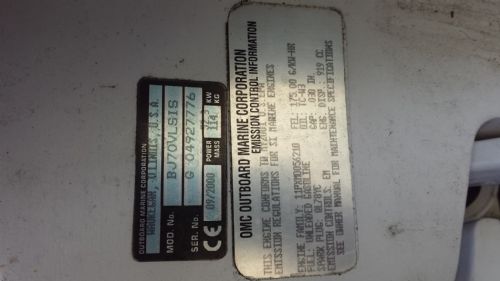 |
Posted By: Steps
Date Posted: 27 Sep 2016 at 8:41am
|
As has said before.. its not just slip.. its about power to weight ratios at any given rpms having enough difference of required power HP at the prop and the potential.... Get the boat powered correct 1st.. then prop for what going to be used for...and those rpms. If not powered right for the end use.. its a matter of making as best possible use of a bad situation.... Using 2.2.3 or 2.42 gear ratio either way it sounds like I have minimal slip going on? read what I said again "4000 RPM will give 23 knots@ 2.23 17" slip 9% 2 motors right? getting down below 10% at cruise assuming a good power to weight ratio is pretty good 4000 rpm 23 knots @ 2:42 slip 1% 2 motors right? that lowers slip factors significantly but 1% at a cruise speed is a bit low.. 1% unrealistic All depends on speed/ rpm accuracy and power to weight ratio and correct gear box ratio |
Posted By: MikeAqua
Date Posted: 27 Sep 2016 at 9:25pm
|
1,227 kg (including me) 2 x 70 HP 2.42 The speed readings I trust - 3 separate GPS receivers agree on speed and distance covered. The tachs? No idea. They match at full throttle. |
Posted By: Steps
Date Posted: 28 Sep 2016 at 10:37am
|
on : 2x 70 hp 140 hp for a trailered plaining hull total weight 1250kg Propped for general use/ fishing 2 engines cruise around the 7% slip WoT 3% At 5000 rpms 36/ 37 mph WoT 19 pitch. 4000 rpms 26/ 27 mph around a 7% slip estimating the hp/ rpm graph @ 4000 rpms you have a good 30% difference between actual hp to required on a 19 pitch... min 15 to 30% If my conservative estimate of the rpm/ hp curve is ball park u could up to a 21 pitch blade same slip numbers to 30/ 31 mph which would give better economy...bit more fuel per hr but get there faster.. less time. But around 4500 thru to WoT you will be 39/ 40 mph Max load loading on the power head but loads distributed between 2 legs gearboxes on the 21 pitch. "19 pitch. 4000 rpms 26/ 27 mph around a 7% slip" Thats around the "26 knotts " that you are doing are currently doing IF data readings are correct All the info is spread around several posts above.. quick look cant find your current prop pitch numbers. A 1% slip at a cruise of 4000 rpms is unrealistic 19 pitch would give 30 mph 17 pitch 26 mph And at a WoT 5000 rpms 17" 33 mph 19" 37 mph Subject to data accuracy 21 would be bit high 19 more practical Ideally 19 1/2 or 20" ....If u actually have slip as low as they are, there is no room to fine tune between the pitches by increasing cupping and/ or rake. |
Posted By: MikeAqua
Date Posted: 28 Sep 2016 at 8:51pm
|
I bought a photo-tachometer today, so I can check actual RPMs vs tachometers. Speed I'll just have to trust the GPS. If everything checks out I'll try increasing propeller pitch from 14 x 17 to 14 x 19 (I can't find 14 x 20 or 14 x 20.5 in the correct hub) I have a fuel flow sensor on the way so I'll be able to see the effect of different props on fuel economy. |
Posted By: Steps
Date Posted: 29 Sep 2016 at 9:16am
|
I bought a photo-tachometer today, so I can check actual RPMs vs tachometers. $30 induction tachs of trademe work very well.. as mentioned before Speed I'll just have to trust the GPS. GPS units are accurate.. older phone units refresh times tend to be slower but good for constant speed. Accuracy depends on clear space between satellites rather than the units (I can't find 14 x 20 or 14 x 20.5 in the correct hub) Correct same as trying to find a diameter over 14 for lower pitches.. as said before you have 2 motors and that gives huge grip.. far more If your data is correct or close than need....so going slightly small diameter should not be an issue. You will also.. as mentioned before not find 20 or20.5 pitches. Pitches tend to go up in 2" increments in odd numbers.. fine tuning between is one with rake and cupping As mentioned before, several very expensive after market and Merc do have them.. with interchangeable brand hubs I have a fuel flow sensor on the way so As mentioned before.. cars do distance per fuel volume... tractors bulldozers do volume fuel per hr. Cars and general use boats stop start vary speed, loads etc so . Bulldozers, big gin palaces tractors pulling a bailer or plugh all day are constant load Even L/ hr info for cruise on a car or boat will not be efficient. This is why. If I cruise @ 4150 rpms @ 68 km/hr I use .6 nm/L If I cruise at 61 km/hr I use .78 nm/L cruise at 54 km I use .84 nm/l The faster I go the more fuel per hr I use but there is a balance where getting there faster for the overall trip.. stop start, moving place to place, water chopps up , less trim etc my general best cruise speed is around the 60 km/hr Now throw in a curely.. with 115 V4 hp best overall was 53 km @ 3900 @ .75 nm/l The former numbers are 150hp V6 the bigger engine uses more fuel per hr but faster cruises with butterflys far more closed results in significantly improved economys with similar slip numbers. |
Posted By: MikeAqua
Date Posted: 29 Sep 2016 at 5:56pm
|
Yep nm/l is the parameter I'll be using. The fuel flow sensor will network with the GPS so it can calculate nm/l, display instantaneous reading and calculate a running average. |