Whole home surge protection
Printed From: The Fishing Website
Category: General Forums
Forum Name: Tech Topics
Forum Description: IT - Computers, software, phones, ISP's....
URL: https://www.fishing.net.nz/forum/forum_posts.asp?TID=112129
Printed Date: 16 Jun 2026 at 10:57pm
Topic: Whole home surge protection
Posted By: 3rnzir
Subject: Whole home surge protection
Date Posted: 08 Sep 2015 at 5:53am
|
Anyone retro fitted one to their panel? With so many household appliances/led lighting with delicate circuitry now,grunty protection surely is a must these days. I found on Amazon a model made by Schneider called a HEPD80.(HomeElectronicsProtectionDevice80Kv) Made is the USA but it can cope with the 110-240v range. This unit is installed/wired from the outside of the electrical panel,with a couple of green leds.If a led is flashing,a surge has occurred. This unit is feed thru a couple of additional circuit breakers,these are the replaceable items should the surge be a biggie. About US$100 for the HEPD80,then the breakers are extra. The power supply in my town has been rubbish this winter, Any sparkies out there care to comment? Maybe NZ source gear that is appropriate for this task. While researching this topic online,I found that the average amount of Amps discharged by a lighting strike is 20,000 Amps.May have been volts.Still heaps though. So a 80Kv HEPD unit should be plenty,right? Cheerz ------------- Peace.Via superior firepower.. |
Replies:
Posted By: Steps
Date Posted: 20 Oct 2015 at 8:39am
|
Its my understanding surge protection is for the occasional spikes and short and partial short circuits.... not a lightening strike. With lightening the energy is so high it will jump across most stuff and still screw it.. which is why buildings/ towers etc have huge spike aerials to ground. Also consider...having a master like that without having each circuit protected individually , trip the master and everything goes down....sort of like tripping the switch on the power pole on the street, the whole house is down. just like the protection of each fuse rated its own use, anything behind that should also be rated correctly... And if have fuses after, the trips react in only a few milisecs, way faster than a fuse.. so it may trip and take down all circuits before the local fuse melts. Its because of these sorts of things we have tradesmen who hopefully know their stuff. |
Posted By: Otto
Date Posted: 20 Oct 2015 at 10:17am
|
Basic course protection is what can easily be provided with something like this. Installed after the main switch, has an indicator showing when a surge has occurred. Would still recommend down-stream protection for other sensitive appliances Another or extra protection can also be done as per this link http://www.pdlglobal.com/data/product_documents/600SM%20Surge%20Arrester%20sheet.pdf" rel="nofollow - http://www.pdlglobal.com/data/product_documents/600SM%20Surge%20Arrester%20sheet.pdf Full protection against lighting strikes, expensive. 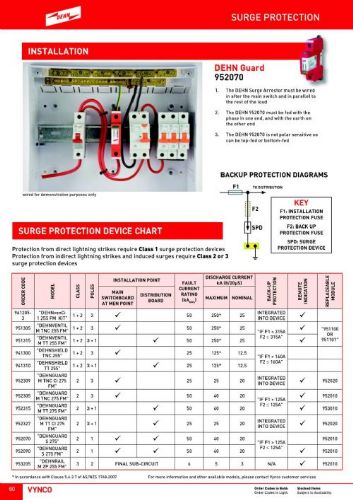 |
Posted By: westom
Date Posted: 20 Oct 2015 at 11:04am
Many recommend and buy near zero joule protectors only because hearsay and advertising recommend it. A protector, adjacent to an appliance, can either block or absorb a surge. Correctly noted. That 2 cm internal part clearly cannot stop what 3 kilometers of sky could not. Those hundreds or thousand joules clearly cannot absorb a surge that can be hundreds of thousands of joules. Never confuse a device, called a surge protector, with a device called a surge protector. Those are two completely different devices. An effective 'whole house' surge protector does not try to block or absorb a surge. Direct lightning strikes without damage have been common for well over 100 years. Because a proven device (called a protector) only connects a surge to what does protection. Protection is always about where hundreds of thousands of joules are harmlessly absorbed. That is outside on a low impedance (ie less than 3 meter) connection to single point earth ground. Only a properly installed electrode system does protection. Direct lightning strikes do not create damage when connected low impedance (ie wire has no sharp bends) to what dissipates hundreds of thousands of joules. Protection is a system. Some systems do not even have protectors. But in every case, every wire inside every incoming cable makes a low impedance (ie wire not inside metallic conduit) connection to earth ground. Then a surge current is not inside hunting for earth destructively via household appliances. Even power board protectors must be protected by this well proven solution. A protector is only as effective as its earth ground. As has been well understood for over 100 years. A majority never learned this; buy near zero 'magic box' protectors that have no earth ground. And that hope you never learn this reality. Protection is always about where hundreds of thousands of joules harmlessly dissipate. Informed homeowners always properly earth a 'whole house' protector. Critical is the quality of and low impedance connection to what actually does protection - single point earth ground. |
 Steps wrote:
Posted By: MacSkipper
Date Posted: 20 Oct 2015 at 12:07pm
|
Reminds me Westom of what our electrical safety refresher tutor said in May - nowadays a lot of earthing problems appearing because plastic plumbing pipes used now in houses and street - the old days of copper piping made it easy to get a good earth plane around house and whole street. ------------- Good fishing trip nothing breaks, great trip catch fish. |
Posted By: westom
Date Posted: 20 Oct 2015 at 12:28pm
Cold water pipe, today, is insufficient for earth ground. In older installations, a ground wire might transverse the basement. Wire is many times too long. All but disconnected from earth. Another reason why earthing does not exist. Some had so little respect for human safety as to even ground (elsewhere in a house) to copper pipes. Copper pipes should never become electrical conductors even before plastic pipes. Plastic pipes are another reason. More violations. Some will connect a safety ground wire from a receptacle directly to an earth ground rod. Also a safety violation. But many assume safety ground and earth ground are same. Critical for making a 'whole house' protector effective is single point earth ground. And that low impedance (no sharp bends, no splices, less than 3 meters, not inside metallic conduit) connection. That means all incoming utility wires (telephone, TV cable, satellite dish, invisible dog fence, outside TV antenna) must enter at the service entrance. Since all must also make a low impedance connection to that earth ground. A 'whole house' solution is so effective because of what that protector connects to - single point earth ground. All four words have electrical significance. BTW, discussed is earthing for two completely different reasons. Code addresses human safety. Above additional requirements (and a 'whole house' protector) are for transistor safety. |