
Night Predators in Niue

As my eyes adjusted to the pitch-black starlit night in Niue, I felt a whack against my back that felt like a tennis ball hitting me.
“What the heck was that?” I yelped to my skipper, Clifford Marsh.
“Flying fish bro, you will need to be quicker next time,” he chuckled.
We had only gone a few hundred metres from the main wharf when the water erupted like a swarm of locusts with flying fish, known locally as hahave.
“We better get set up mate, looks like it's going to be a good night,” Clifford said as we ventured further into the darkness on our adventure, the hahave banging against the side of the boat like little bullets. We were chasing the flying fish as well as searching for the much-prized giant trevally that prey on them at this time of night. The night would not disappoint.
 Clifford Marsh proudly displaying his customised night fishing kit!
Clifford Marsh is a young Niuean charter operator who has been fishing the waters of Niue his entire life and runs Niue Wahoo Fishing Charters. His father, Graham, was also a charter operator before him so fishing is definitely in his blood, which became obvious after spending time with him over the week we were in Niue. He usually operates up to two charters a day in his Stabicraft 2050 Supercab, generally trolling lures for wahoo, mahimahi, and tuna. These fish are then sold to the local cafés and restaurants in Niue for the best fish sandwiches and fresh sashimi you will ever try. But recently he started taking visitors on night adventures doing what he has done for fun and a bit of pocket money since he was a boy – chasing the flying fish.
“What I realised was people love doing what the locals do when on holiday and getting unique experiences they won’t get at home, and Niue has lots of these, so I added the flying fish and GT experience to my business, and fishers love it,” he tells me.
 Flying fish (hahave) are an important, versatile, and accessible fish for Niueans.
Last year, he commissioned a new Frewza F14 with a 30 horsepower two-stroke Tohatsu, then made a few island-style modifications to make it the perfect flying fish-catching machine. This included lifting points to lift the boat in and out of the water from the wharf (as there are only a couple of boat ramps in Niue) on the winch located there. He added a wooden seat at the front, a leaning bench for stability, and a PVC pipe tiller extension that allows him to remain standing and have a free hand for a net. There’s also a powerful flounder-style light on the bow to light up the water ahead.
Other vital equipment for catching the flying fish are a headlamp and net, neither of which are off-the-shelf models! The nets themselves are the standard rubber type we use for snapper in New Zealand but with a pool scoop length extension added. Cliff tells me he has “blown out” a few nets in his time as the fish hit it with a fair amount of force, but the rubber ones seem to have enough stretch. The headlamp is something else as well – a motorbike crash helmet with a flood light bolted to the front and then connected by several metres of electrical wire direct to the boat battery. The number of chips on the fibreglass of the helmet suggested this has been well used. WorkSafe would have a field day in New Zealand, but it all made sense once we got going, and it never felt dangerous.
Once we got set up and I had the pool scoop ready to go, the lights were turned on and I received my instructions. We would be running up and down the coast, a couple of hundred metres out, with the lights on full beam. The fish are attracted to the light and would also fly out of the water with the boat disturbing them as we drove by. When they landed from their flight, we would grab them off the water’s surface with the net, or if they were flying towards us we would raise the net and catch them mid-flight. Tonight, we would be travelling in convoy with a larger vessel, swapping crew to fish and film from the larger boat. My two sons were also joining the trip.
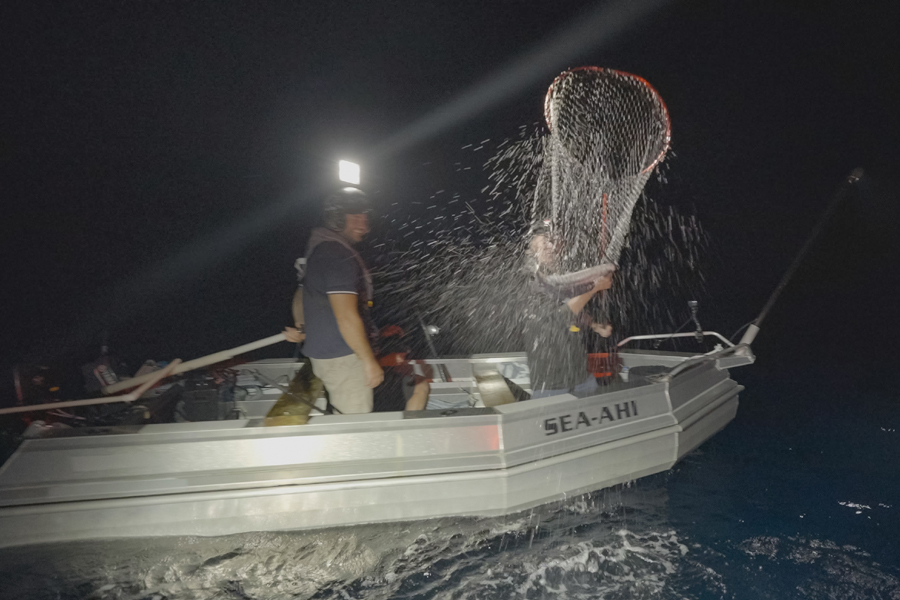 Success!
It didn’t take long before we spotted our first targets and swooped in at speed for a graceful pickup. A miss, then another miss! These things were everywhere but not as easy to catch as I thought. I was soon put straight after trying to net them from behind. I was instructed to aim towards the head and catch them as they tried to escape. This made total sense, and I soon got into a rhythm as we turned sharply at high speeds to get to their landing spots. There was also some solid banter about sticking to catching butterflies in the Niue rainforest, but I won’t go into that.
The next hour of adrenaline-filled action saw about 30 fish landed, some literally just flying in the boat by themselves, along with a few shots to the body. One of my sons on the larger boat was trying to catch them with his hands rather than the net for a laugh, using his chest as a backstop! It was exciting to say the least, charging around in the dark with the sound of the breaking swell on the reef close by, but things were about to go up a notch when some massive splashes erupted beside the boat.
“GTs!” Cliff yelled.
The GTs attacked the flying fish in packs with serious surface-breaking aggression. We watched them circle under and beside the boat, with their silver flanks looking almost white in the crystal-clear water. Water visibility in Niue is often up to 80 metres, and with the bright lights shining down through the water we could see just how many there were. Some trophy specimens were amongst the school, too.
 Bigeye trevally were also in on the action.
While Clifford suggested poppers were going to be the most effective, we persevered trying to toss freshly caught live flying fish to them on some suitably weighted gear that could handle these monsters, but they seemed to know there was a hook in there and, despite interest, they wouldn’t take the bait. In hindsight, we should have taken the local advice, but we wanted to try something different. To be honest, it was just as exciting watching the packs of GT feed naturally on the flying fish as it would have been hooking up. Meanwhile, on the larger boat, the popper was tossed in and it was demolished on the first cast! After this fish was brought in, more casts with the popper also proved successful with further fish landed, including a bigeye trevally. We continued catching flying fish and chasing the GTs for the next couple of hours and I cannot express how much fun it was.
The locals tell me the best time to target the flying fish is on the new moon when it is completely dark. Niue is classed as the world’s only ‘dark sky nation’ with unbelievable stargazing in clear skies on offer. The economy in Niue is firmly centred around the ocean and tourism – I understood why when Clifford said a bag of 10 flying fish went for $30, and on a good night he could get around 300 fish, plus the charter fee. We only managed a portion of that as first timers and jokingly Clifford said, “We might go back out, but I have a 5am charter to prepare for!”
The fish are used by local vaka (canoe) fishermen, with a single cubed piece on a hook for pelagic species, or by charter and boat fishers as dead baits for chin-weighted or downrigger trolling. Many locals also eat the flying fish as raw fish or cook them over a charcoal barbecue (often an old tire rim). So, hahave are an important, versatile, and accessible fish for Niueans.
 With such clear water, the diving in Niue is superb.
Topwater fishing is relatively new in Niue as most of the charter operators have focused on traditional trolling lures and spearfishing. While the typical methods are successful most of the time (and very exciting when a big wahoo strikes at over 100kph!), it can get monotonous doing this on every trip. I couldn’t help but think what an untapped market topwater fishing could be in a fishery this good. Clifford has clearly spotted a gap in the market and is doing something different from what people are used to.
During our stay in Niue, we also encountered another night predator – this one a vegetarian. The population of giant coconut crabs (uga) has flourished since their export was banned a few years ago – so much so, that we had to dodge a few on the roads driving home at night. These giant land-based crabs are generally found in the forested areas close to the shore, and locals will take you out at night to find uga attached to coconut baits tied to the jagged coral rocks. We managed to find a couple of beauties and even got to enjoy our delicious catch at a local restaurant the next night.
 Lachie Porter with a good haul of uga (coconut crabs) from the forest.
In between the fishing, we enjoyed the remarkable snorkelling available around the island, had our first full family dive (that also turned into a dolphin swim), and managed to spot some whales. The amazing experiences kept coming and we slept very well every night as a result. But it would be hard to top the flying fish and GT chasing at night, and I will never forget that feeling of being smacked by fish in the pitch black and waiting for the next incoming missile. It's something I would highly recommend to any fisher who thinks they’ve tried it all. I will most certainly be heading back to give it another go now that I’ve had a practice run, but I’ll be listening to Clifford next time and using his poppers to catch the elusive GTs!
To find out more about Niue: www.niueisland.com
To find out more about Niue Wahoo Fishing Charters: www.niuewahoofishingcharters.com
- By Hayden Porter


Major Bites
Minor Bites
Major Bites
Minor Bites
Latest Articles
Analysis: The Fisheries Amendment Bill Debate
June 2026New Zealand’s Fisheries Amendment Bill has reach Parliament, carrying the weight of both expectation and alarm... Read More >

Extreme Aluminium Trailers Review
June 2026Extreme Boats has long been recognised for its award-winning aluminium vessels, and is now expanding into high-quality aluminium trailers... Read More >
The Export NZ Fishing Competition Announces Season Winners
June 2026Another exciting season of The Export NZ Fishing Competition – has come to an end, and we’ve just announced our prize winners... Read More >
History of Zane Grey's Fishing in NZ
June 2026One hundred years ago, the trajectory of big game fishing in NZ changed forever with the arrival to its shores of one man - Zane Grey... Read More >
BBQ'd Gurnard with Citrus and Herb Butter
May 2026This is a pretty ‘cheffy’ recipe, featuring a sauce that is definitely one to impress guests with, but it's fairly easy to cook... Read More >