
Surfcasting for Gurnard

When I first saw a gurnard get caught by my dad, I was amazed by how it looked: it had a face like a frog (and definitely grunted like a frog) and had pectoral ‘wings’ as colourful as a peacock. You also can’t forget the finger-like feelers they use to ‘walk’ on the bottom while they seek out their favourite foods – crabs and other crustacea.
It look me a long time to learn how to target them, but after finally landing one, I was hooked on catching gurnard. Over the past few years, I have tried a number of different locations and used a variety methods to try target these ‘carrots’.
For some anglers, gurnard are a popular target species, especially given their table appeal, but for most, they are considered as nothing more than a bycatch.
Gurnard are not always easy to catch. On the boat and with the right technology, it can be easy to locate gurnard, but on land it’s a different story. I have found there are some key elements to ensure a successful gurnard mission off the beach.

Picking the Season
The key element when targeting gurnard is selecting the right time of the year. I have caught gurnard all year around, but I’ve found winter and early spring to be the prime season for targeting them.
Snapper, along with many other popular recreational species that are usually abundant in warmer months, will have moved out of the harbour, thus reducing the competition for food. Another benefit is that with the lack of summer pickers around, you can risk using softer baits to attract gurnard. It can get frustrating when you tie a soft-textured bait on the hook only to have it stolen by small pickers.
Location
The second key consideration for catching gurnard is casting distance. Unlike snapper or kahawai that can be caught close into shore, you need to cast out far from the shore into water at least 10 metres deep. They seem to prefer the calm, deeper waters rather than the crashing waves, so look for plenty of deep, sheltered water. A marine chart can be useful for seeking these locations out.
The other key element I discovered while fishing for gurnard was their preferred habitat. They can be found on both the east and the west coasts, but areas that have a lot of sediment or an open sandy bottom are far more productive than foul ground. Gurnard primarily feed on small crustaceans such as small shrimps and crabs, but they will also eat small fish, shellfish and worms that are hidden beneath or on the bottom. After gutting my catch, I most often find small paddle crabs, and even the odd cockle or two.

Tackle
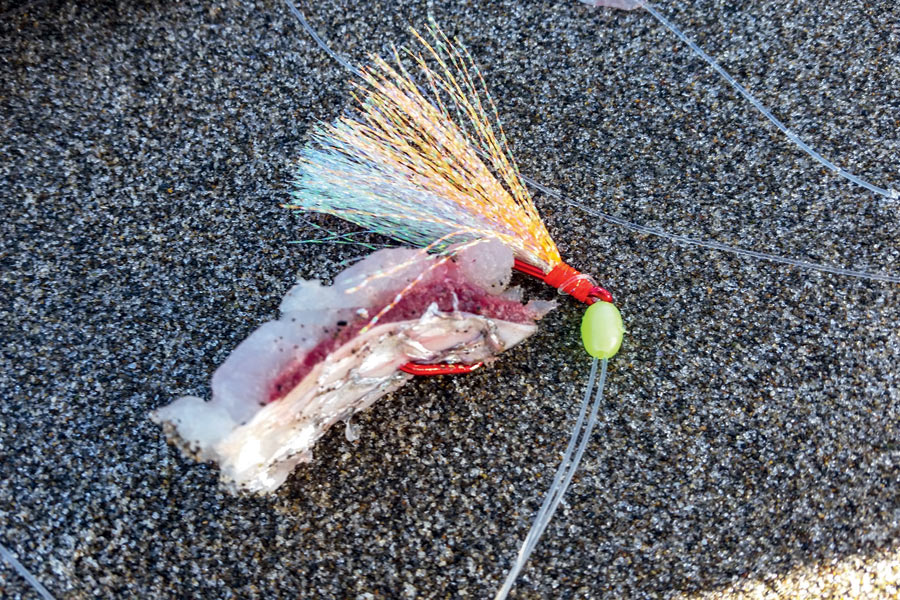
For hook style, I prefer to use recurve hooks like the KLT from Black Magic Tackle. I cast out a long way, so it can be difficult to feel the bite and know when tostrike. A recurve will hook the fish itself, so doesn’t require good bite detection or a strike. The fish takes the bait into its mouth, and as it moves away, the hook will roll into the corner of its mouth.
Unlike snapper or kahawai that go for the bait aggressively, gurnard usually just suck in the bait. They are also not exactly a hard fighting fish so having a hook that doesn’t require a strike is handy. Sometimes after a short run they will stop and start swimming towards you, giving the impression that whatever you had hooked is gone. Don’t be fooled: keep winding and you will most likely be pleasantly surprised you are still attached to the target species.
For size, I like to use between 3/0 to 5/0 hooks. Gurnard have large mouths so they will happily swallow bigger baits. For trace, I like to use 60lb tough trace that will handle the odd larger snapper I occasionally encounter. A heavier trace also allows the rig to withstand the strain of a powerful cast. The last thing you want is to snap your rig off when making a long cast.
If you wish to detect the gurnard’s bite more accurately, use non-stretch, sensitive braid. Another benefit of braid is that it has a thinner diameter than mono, which will increase your casting distance.
Since gurnard are bottom dwellers, it’s best to use rigs that sit on the bottom where the fish are naturally feeding. I have caught them with running rigs and pulley rigs, but I’ve found the ledger rig to be the most productive, along with flasher rigs.
I prefer ledger rigs that have just two hooks. This helps reduce the likelihood of tangling and you don’t go through so much bait. There is also less resistance with two hooks/baits, which makes those longer casts easier.
Use two different rigs on two rods to see what works best. I will use a pulley rig to try and get the bait out as far as possible and then use a ledger rig for fishing a little closer, which enables me to cover as much territory as possible.
Bait Choices
Gurnard are not fussy eaters. I have caught them using squid, sanmar and shellfish, but the most successful baits are oily and soft, such as salted skipjack tuna. Cut these up into cubes roughly 2.5cm (1-inch) squared, which makes them easy to swallow. For bait longevity, try wrapping it to the hook using an elasticised thread. This not only holds it together, but also offers some protection against the pickers.

Small baits will increase your casting distance, enabling you to fish deeper.
Handling gurnard
When landing your gurnard, treat them with care as they have a sharp dorsal fin and spikes around their head, which can inflict a painful puncture wound for the unwary.
The best way to handle them is to either lip grip them between your finger and thumb or handle them with a towel. They have a minimum size limit (25cm), so make sure you have a fish measure with you. During winter, you’ll encounter the kahawai as a bycatch as they also like the scent of oily baits. For best eating results, bleed these fish before putting them on ice.

Fishing Reports Visit Reports
Tauranga Fishing Report - 28/05/26
Tarakihi on the bite Trips are few and far between at this time of year,... Read More >
Canterbury Fishing Report - 28/05/26
Fresh and salt turning it on! It is not very often I get to say... Read More >
Bay of Islands Fishing Report - 28/05/26
Lures paying dividends We finally had a break in the SE winds that have been... Read More >
Manukau/West Coast Fishing Report - 28/05/26
Snapper and gurnard in the harbour The weather has finally taken a turn for the... Read More >


Major Bites
Minor Bites
Major Bites
Minor Bites
Comments